
How to Choose an Epoxy System That Will Actually Survive the Heat
Commercial products report roughly 149°C to 200°C, but their figures use different thermal metrics and depend on different cure qualifications.
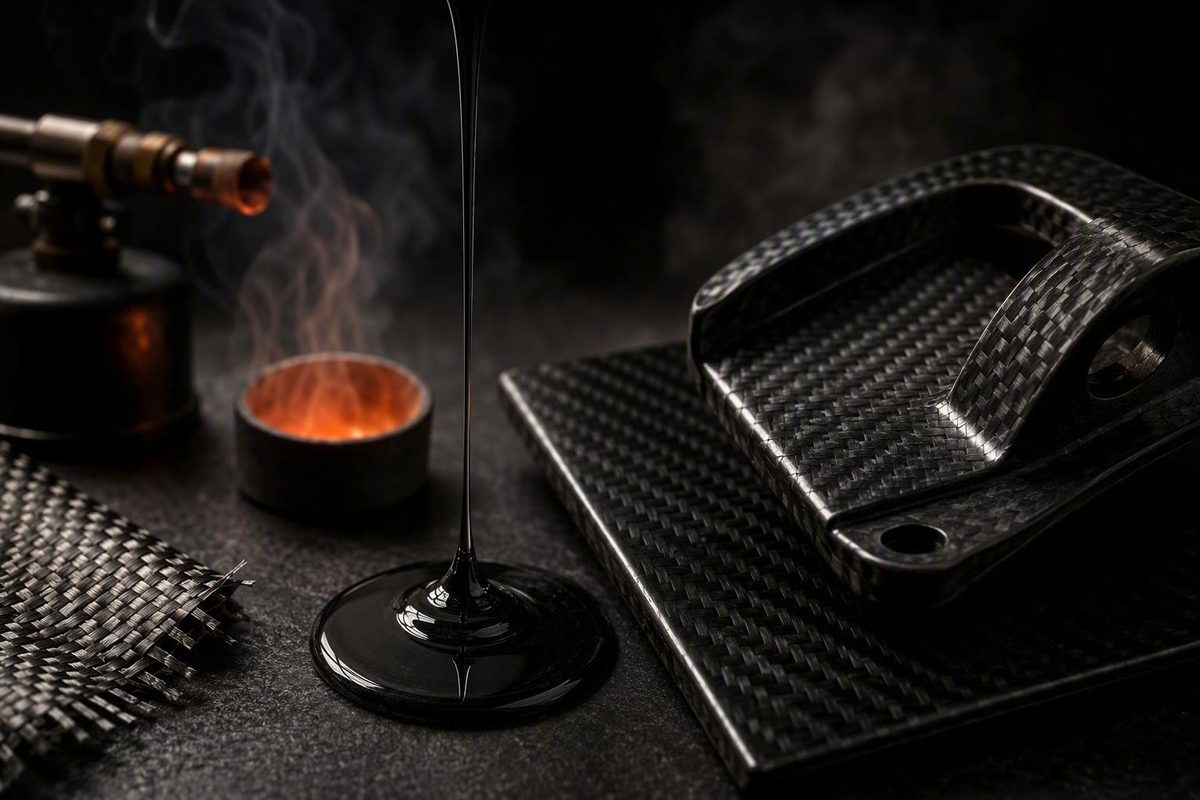
A high temp epoxy resin should not be selected by finding the largest temperature printed on a product page. That number might describe glass-transition temperature, maximum service temperature, short-term heat resistance, or strength under an unspecified load. Those are different properties measured under different conditions.
The better approach is to define the complete duty cycle, identify the property that must be retained at temperature, and then match the resin to the reinforcement, manufacturing process, post-cure equipment, and surrounding materials. The finished construction—not a neat-resin sample, isolated adhesive bead, or carbon fiber alone—must survive the required heat, load, moisture, chemicals, and thermal cycles.
The product values in this guide are seller- or retailer-stated figures. They have been preserved under the metric used by each source rather than converted into a false temperature ranking. They should be treated as screening information until supported by current technical documentation and representative testing.
What “high temperature” means for an epoxy resin
The available evidence does not establish a universal temperature at which an epoxy officially becomes a “high-temperature epoxy.” The term is application-relative. A general-purpose system may be inadequate at a temperature that a specialized, properly post-cured formulation can tolerate.
Epoxy is a thermosetting resin. When mixed with its specified hardener, chemical reactions create a cross-linked polymer matrix. Unlike a thermoplastic, the cured thermoset does not simply melt and become freely flowable again. It can nevertheless soften, creep, lose adhesion, oxidize, or chemically decompose as temperature rises.
A resin’s practical upper limit depends on more than the highest temperature it encounters:
- Whether it received the complete specified cure and post-cure
- Whether exposure is continuous, intermittent, or a brief peak
- Mechanical load, pressure, vacuum, and restraint
- Moisture absorption or immersion
- Oils, fuels, solvents, coolants, and cleaning chemicals
- Air, inert gas, or another atmosphere
- Part thickness, geometry, stress concentrations, and inserts
- Thermal-cycle count and heating or cooling rate
- The acceptable loss of stiffness, strength, adhesion, or dimensional accuracy
“Still solid” is not the same as “still suitable.” An epoxy can look intact while becoming too compliant to hold alignment, too weak to carry load, or too prone to creep to maintain a seal.
Carbon fiber does not remove this limitation. A carbon-fiber composite depends on the combined behavior of the fiber, sizing, matrix, and interfaces. The fiber is manufactured separately under conditions very different from those tolerated by an organic matrix, as an overview of how carbon fiber is made illustrates. If the epoxy softens or degrades, intact fibers may no longer remain correctly aligned or transfer load effectively.
For that reason, a product described as high temperature should not be assumed suitable for direct flame, hot exhaust gas, or sustained exposure at 500–1000°C. The commercial products reviewed here concern elevated polymer-service temperatures, not refractory service.
Tg, service temperature, and peak resistance are not the same rating
Glass-transition temperature, or Tg, is the temperature range in which a cured polymer changes from a hard, glassy condition toward softer, more rubber-like behavior. It is a transition range, not a universal cliff at which every property disappears simultaneously.
Post-curing can increase the achieved Tg of a suitable system by advancing cross-linking, but the result still depends on the formulation and completed cure cycle.
Tg must be distinguished from at least five other thermal descriptions:
- Maximum service temperature: The supplier’s recommended upper operating temperature, ideally qualified by duration, environment, load, and an acceptance criterion.
- Short-term peak resistance: A temperature tolerated during a limited transient without crossing a stated failure threshold.
- Heat-deflection temperature: A test-specific measure of deformation under a prescribed load and specimen configuration.
- Decomposition temperature: The point or range at which chemical breakdown becomes significant. It is not a sensible structural operating limit.
- Retained properties at temperature: Strength, modulus, adhesion, or creep resistance measured while hot or after thermal aging.
The compared products demonstrate why the label matters. One reports a post-cured Tg, another reports temperature resistance, another lists both DMA Tg onset and maximum service temperature, and another claims strength under load. These figures cannot be sorted into a scientifically defensible first-to-fourth ranking.
The source pages do not provide a common test method, exposure duration, applied load, specimen construction, environmental conditioning, or pass criterion. A reported Tg is not equivalent to verified continuous service at that same temperature. Likewise, a claim of strength under load is difficult to assess without knowing the load, duration, specimen, and retained-property threshold.
The method used to determine Tg also matters. Buyers should ask which method and criterion support the published value.
It is equally important to distinguish dry Tg from wet Tg. Absorbed moisture can plasticize an epoxy, allowing molecular movement at a lower temperature and reducing its practical thermal limit. Dry laboratory data may therefore overstate performance in humid, immersed, or repeatedly washed service. An industrial selection guide identifies both moisture conditioning and post-cure as relevant to practical Tg, although its general guidance is not a substitute for product-specific data (high-temperature epoxy selection guide).
Designers often screen candidates by keeping operating temperature below Tg. That is a useful first-pass heuristic, not a guarantee. No fixed offset works universally because the necessary margin depends on load, duration, moisture, manufacturing variation, failure consequences, and the property that must be retained.
Compare candidate systems without creating a false temperature ranking
The table preserves the thermal metric used by each seller. Every value is a supplier or retailer claim rather than independent comparative verification.
| Product | Intended process | Supplier-stated thermal metric | Value | Cure qualification | Mix ratio | Viscosity or flow | Pot life | Initial cure or demold | Reinforcement compatibility | Important missing data |
|---|---|---|---|---|---|---|---|---|---|---|
| EL160 High Temperature Epoxy | Primarily hand laminating and vacuum bagging; limited infusion | Maximum service temperature and DMA Tg onset | 170°C | Specified post-cure required | 100:35 by weight | 550 mPa·s; more viscous and slower-flowing than a dedicated infusion resin | About 5–6 hours | Seller recommends 12 hours at 40°C or at least 24 hours at 25°C before later post-cure; a room-temperature-cured part may remain brittle | Carbon, glass, and aramid | Wet Tg, detailed hot-property retention, creep, aging, and the complete post-cure cycle |
| EpoxAmite HT | Hand lay-up, vacuum infusion, composite parts, and tooling | Temperature resistance | Up to 149°C | Conditional on proper cure; schedule not shown on the supplied page | 100:33 by weight | Described as ultra-low viscosity; no numerical value supplied | 60 minutes | Listed cure time of 24 hours; that figure alone does not establish full thermal qualification | Carbon, S-glass, E-glass, and aramid/Kevlar; supplier-stated clear color | Tg, proper-cure schedule, test method, hot mechanical properties, wet data, and exposure duration |
| PRO-SET HTP-180 with HTP-280 | Infusion, synthetic-composite tooling, and part manufacture | Glass-transition temperature | Up to 149°C | Proper post-cure required | Not supplied on the cited page | Not supplied | Not supplied | Room-temperature demold after 24–48 hours, followed by a freestanding post-cure | Described for synthetic composites; no fiber-by-fiber list on the page | Service-temperature rating, wet Tg, viscosity, mix ratio, pot life, mechanical retention, and complete post-cure schedule |
| MAX HTE A/B | Laminating, bonding, coating, casting, potting, impregnation, and related uses | Claimed structural strength under load | Up to 200°C | Seller states that heat post-cure is required for complete cure | 4:1 component ratio for the listed kit | Not supplied | Not supplied | Heat post-cure required; possible heat sources are mentioned, but no complete maximum-performance cycle is established | Carbon, fiberglass, Kevlar, and other specialty fibers | Test method, load level, exposure duration, retained properties, Tg, viscosity, pot life, and complete post-cure schedule |
These products should be compared by fit, not by a single descending temperature column. Start with four questions:
- Which manufacturing process must the resin support?
- Which property must be retained at the required temperature?
- How much working and flow time does the part require?
- Can the shop execute and verify the documented post-cure?
A system with a lower headline temperature but complete data for the intended process may be more defensible than one with a higher but poorly defined claim.
Match the resin to the manufacturing process and entire material stack
A resin suitable for one fabrication process is not automatically suitable for another. Hand lay-up, infusion, prepreg processing, tooling, adhesive bonding, coating, casting, and electrical encapsulation impose different demands.
For hand lay-up, the resin must wet the reinforcement without draining excessively from vertical surfaces or resin-starving the laminate. Working time must cover mixing, application, ply placement, debulking, and installation of bagging consumables.
For vacuum bagging, wet-out and working time remain important, but resin movement under vacuum must also be considered.
For infusion, documented low viscosity and sufficient flow time are central requirements.
A laminating resin that can technically be infused may still be a poor process choice. EL160 illustrates the distinction: its seller permits limited infusion but positions it primarily as a hand-laminating and vacuum-bagging system.
For prepreg processing, the resin is already combined with reinforcement at a controlled content. Storage, out-time, tack, consolidation pressure, cure cycle, and tooling compatibility become part of the material specification. A liquid laminating resin cannot be assumed to reproduce prepreg behavior merely because both use epoxy chemistry.
For tooling, headline resin strength is only one concern. A tool may also need:
- Vacuum tightness and low porosity
- A stable, repairable surface
- Acceptable print-through
- Dimensional stability during cure and service
- Resistance to repeated thermal cycles
- Compatibility with release agents and surface coats
- Sufficient stiffness under vacuum, pressure, and handling loads
A one-time hot exposure and hundreds of production cycles are different qualification problems.
For adhesive bonding, use data based on the relevant joint configuration, substrate, preparation method, bond-line thickness, load direction, and service environment. A laminate temperature rating does not prove that an adhesive joint will retain lap-shear, peel, or fracture performance at the same temperature.
For casting, geometry and mass strongly influence cure. Casting data should apply to the intended thickness and configuration rather than to a thin laminate.
For coatings and electrical encapsulation, adhesion, pinhole control, dielectric requirements, thermal conductivity, thermal expansion, and chemical exposure may matter more than laminate tensile strength. A seller’s application list does not establish electrical, regulatory, or long-term environmental qualification.
The complete thermal stack must tolerate both post-cure and service. That stack may include:
- Resin and reinforcement
- Fiber sizing
- Core material
- Adhesive films and secondary bonds
- Inserts and fasteners
- Surface coats and paint
- Existing laminate or repair layers
- Substrate and mold materials
- Sealants and vacuum fittings
Forum suggestions and repair anecdotes can identify useful questions or possible material classes. They cannot establish long-term suitability because they rarely document actual temperature, load, preparation, cure state, environment, or inspection results.
Post-cure is part of the material specification
Post-curing is not an optional enhancement when a published figure depends on it. Controlled heating after the initial cure can advance a suitable system toward its intended degree of cross-linking and increase its achieved Tg and elevated-temperature performance.
It helps to separate the process into five stages:
- Mixing: Resin and hardener are correctly proportioned and blended.
- Initial cure: The material gels and develops handling strength.
- Demolding: The part is removed from its mold or support.
- Controlled post-cure: The part follows the documented product-specific thermal cycle.
- Controlled cooling: The construction returns to handling temperature without unacceptable distortion or residual stress.
These stages should not be collapsed into one “cure time.” A part that can be demolded is not necessarily fully cured, and a room-temperature cure does not necessarily deliver the advertised high-temperature performance.
Each product in the comparison conditions its published figure on the seller’s stated cure requirements, but the metrics remain different. EL160’s service-temperature and Tg figures depend on the specified post-cure. EpoxAmite HT’s resistance claim applies when properly cured. PRO-SET’s figure is expressly a post-cured Tg. MAX HTE’s seller says that heat post-cure is required for complete cure.
For EL160, the initial-cure options shown in the comparison table are only the stages before the required post-cure. The seller also warns that a room-temperature-cured part may remain brittle, making careful demolding important. Handling strength does not prove that the published thermal figures have been reached.
The PRO-SET retailer likewise describes parts as demoldable after 24–48 hours at room temperature before a freestanding post-cure. Demolding is therefore an intermediate manufacturing milestone, not proof of maximum Tg (PRO-SET high-temperature infusion system).
MAX HTE’s seller mentions an oven, infrared radiation, or solar heat as possible post-cure sources. Identifying a heat source does not establish equivalent temperature control or prove maximum performance. The page’s solar-heating statement concerns reaching a handleable condition, not demonstrated completion of a fully specified maximum-performance cycle (MAX HTE cure information).
Do not infer missing ramp rates, dwell temperatures, dwell times, support requirements, or cooling rates. Obtain the current technical data sheet and follow the complete product-specific instructions. If the supplier cannot provide the cycle associated with a published rating, that rating is not yet actionable for production.
Post-cure capability is therefore a selection constraint. Before ordering resin, verify:
- Oven or heating capacity for the complete tool and part
- Temperature uniformity throughout the working volume
- Calibrated monitoring at representative points on the part
- Tool and fixture stability during heating
- Support against sagging or warping
- Controlled heating and cooling
- Ventilation and equipment suitability for the specified chemical process
Monitoring should reflect the actual construction and the locations most likely to lag or overheat.
Cure behavior measured on neat resin may also fail to represent a reinforced laminate or prepreg. A 2025 peer-reviewed study of one aerospace DGEBA system found that pressure affected neat-resin and carbon-fiber-prepreg cure behavior differently. The authors concluded that prepreg kinetics should be prioritized when optimizing that composite process (study in Polymer Composites). That result does not provide a cure schedule for other products, but it supports a broader principle: validate the actual reinforced system rather than relying on neat-resin behavior alone.
Failure modes and handling risks become more serious with heat
Epoxy curing is exothermic: the chemical reaction releases heat.
EL160’s seller warns that an uncontrolled mixed mass can exotherm, smoke, or ignite, particularly when left in a pot. The same guidance warns that voids may expand during post-cure or later heat cycles and instructs users to read the technical and safety documents, wear gloves and eye protection, provide ventilation, and observe hazardous-goods requirements (EL160 product and safety guidance).
Follow the documented batch and container guidance for the selected product. Do not invent a universal safe batch size: formulation, starting temperature, container geometry, mixed mass, and ambient conditions all affect heat buildup.
Other failure modes may be less dramatic but equally damaging:
- Brittle demolding: An incomplete room-temperature cure may provide insufficient toughness before the required post-cure.
- Void growth: Entrapped gas can expand as temperature rises.
- Moisture-related blistering: Trapped or absorbed moisture may expand during post-cure or later heat cycles.
- Delamination: Internal pressure, weak interfaces, or differential movement can separate plies or coatings.
- Distortion: Resin, fibers, cores, wood, and metals can respond differently to heating.
- Joint cracking: Restrained inserts or thick-to-thin transitions can concentrate thermal stress.
- Leakage: Microcracking and bond-line movement can compromise vacuum or pressure tools.
- Creep: A hot epoxy may deform progressively under sustained load without obvious decomposition.
- Adhesion loss: A coating or joint can release from its substrate while the bulk resin remains visually intact.
Metal fillers may change thermal conductivity, shrinkage behavior, or dimensional response. They should not be represented as increasing Tg unless that result has been demonstrated for the complete filled formulation. Faster heat transfer is not the same as higher polymer temperature capability.
At minimum, product-specific handling should include:
- Reading the current safety data sheet and technical data sheet before use
- Wearing the gloves, eye protection, and other equipment specified for the product
- Providing the ventilation required by the product documentation
- Controlling mixed mass and container geometry according to supplier guidance
- Using only the specified cure equipment and process conditions
- Following applicable storage, transport, and hazardous-goods restrictions
Do not assume suitability for hot oil, exhaust repair, motor windings, food-contact surfaces, or outdoor clear finishes from the words “high temperature.” Those uses may require chemical-aging data, dielectric properties, flame or smoke information, UV durability, or regulatory approval that a general laminating-resin page does not provide.
A qualification workflow for choosing and testing a resin
A disciplined qualification program can eliminate unsuitable candidates before a full tool or part consumes significant labor and material.
1. Write the duty profile
Document:
- Continuous operating temperature
- Intermittent peak temperature
- Peak duration and frequency
- Applied mechanical load
- Pressure or vacuum
- Required dimensional tolerance
- Number of thermal cycles
- Moisture and humidity
- Fluids and cleaning agents
- Air, inert gas, or another atmosphere
- Acceptable deformation or property loss
- Consequences of failure
“Must withstand 150°C” is incomplete. “Must retain vacuum tightness and dimensional alignment during repeated two-hour cycles at 150°C in humid air” is a testable requirement.
2. Request the complete documentation
Obtain the current TDS and SDS rather than relying only on a reseller summary. Ask for:
- Complete cure and post-cure instructions
- Test method behind each thermal rating
- Specimen type and conditioning
- Dry and wet Tg
- Strength and modulus retained at temperature
- Creep data at the relevant stress and temperature
- Adhesion data for the intended substrates
- Heat-deflection behavior
- Chemical-resistance and aging results
- Thermal-cycling data
- Coefficient of thermal expansion where dimensional control matters
Also ask whether the published result applies to neat resin, a reinforced laminate, an adhesive joint, a coating, a casting, or finished tooling.
3. Screen manufacturing compatibility
Make a small but representative process coupon. Reproduce the intended:
- Fiber and sizing
- Lay-up sequence and fiber fraction
- Part thickness
- Core and inserts
- Substrate preparation
- Bond-line or coating thickness
- Consumables
- Vacuum, pressure, or consolidation method
- Shop temperature and realistic working time
A neat-resin puck may reveal mixing or gross cure problems, but it cannot qualify a structural laminate.
4. Execute and monitor the prescribed cure
Complete the documented initial cure and post-cure. Place suitable temperature sensors at representative areas of the part, including thick sections, edges, inserts, and thermally shielded regions. Record actual part temperature rather than treating the oven setpoint as proof of compliance.
5. Inspect before hot testing
Look for:
- Soft or incompletely cured areas
- Warping and dimensional change
- Surface print-through
- Cracks around corners and inserts
- Void growth or blistering
- Leakage under vacuum or pressure
- Coating separation
- Delamination
A coupon that already exhibits defects after post-cure should not proceed as though its headline temperature figure remains valid.
6. Test the real duty cycle
Apply representative temperature, load, exposure duration, moisture, and fluids. Include repeated thermal cycles if the production part will cycle. Measure the property that matters: deformation, stiffness, joint strength, leakage, adhesion, electrical behavior, or another defined acceptance criterion.
A room-temperature hardness check is not enough. Nor is a single hot exposure without load if the production part must carry stress for months.
Consider a laminate intended for continuous service at 140°C. A product advertising a figure only slightly above that temperature might initially appear adequate. But if the figure is dry Tg rather than continuous service temperature, it provides little assurance about wet performance, creep, retained strength, or aging. A higher headline claim does not resolve those questions without its test basis.
The defensible response is to obtain the relevant data and test the actual laminate under representative load and environment. If those data are unavailable, the uncertainty should be treated as a design issue rather than filled with an assumed safety margin.
Coupon testing supports engineering qualification; it does not replace mandatory compliance work.
When epoxy is the wrong matrix
The reviewed commercial products use thermal figures clustered between approximately 149°C and 200°C, but those figures describe different metrics and depend on different cure qualifications. They do not support sustained conventional-epoxy service at 500°C, 1000°C, or similarly extreme temperatures.
The distinction between fiber and matrix is decisive. Carbon reinforcement may remain physically present under conditions that destroy an epoxy matrix, particularly where atmosphere is controlled. Intact fibers do not preserve a useful composite after the matrix has softened, oxidized, decomposed, or lost adhesion.
There is no single temperature at which every designer must abandon epoxy. The decision threshold should be based on duty:
Move beyond epoxy when the required continuous temperature, retained property, environment, or safety margin cannot be documented by the supplier and validated in the finished construction.
Material categories that may warrant investigation include:
- Bismaleimide, or BMI, matrices
- Polyimides
- High-temperature silicones
- Ceramic or mineral tooling
- Sodium-silicate systems
- Mechanical fastening that removes a hot adhesive joint
- Carbon-carbon constructions
These are categories to investigate, not interchangeable substitutes or product recommendations. Each brings different processing requirements, oxidation limits, brittleness, cost, tooling demands, health precautions, and manufacturing complexity. Community technical discussions about extreme-temperature composites also point away from ordinary epoxy, but such discussions should be used to generate questions—not as qualification evidence for a material selection (extreme-temperature resin discussion).
For high-temperature tooling, changing the substrate or tool concept may be more reliable than forcing an epoxy adhesive or sealer beyond its documented limits. A mineral tool, mechanically assembled structure, replaceable hot-face layer, or isolated bond line may solve the actual problem more directly.
The practical decision tree is concise:
- Document the complete duty cycle.
- Identify the property that must be retained at temperature.
- Verify the product-specific rating, test basis, and cure schedule.
- Confirm that the complete material stack can survive post-cure and service.
- Qualify a representative construction.
- If the requirement cannot be documented and validated, move to a higher-temperature material class or a different tool concept.
The right high-temperature epoxy is not the product with the largest number in its headline. It is the system whose documented thermal metric, process behavior, cure schedule, and retained properties match the complete application.
Frequently asked questions
What is the highest temperature a high temp epoxy resin can withstand?
There is no universal maximum for the category. The compared systems use different thermal metrics, including Tg, temperature resistance, maximum service temperature, and claimed strength under load. Their headline figures therefore cannot be treated as equivalent limits.
The usable temperature for a particular part may be lower because of continuous load, moisture, chemicals, creep, thermal cycling, or incomplete post-cure. Select by the required retained property and supporting evidence, not the largest advertised number.
Is glass-transition temperature the same as maximum service temperature?
No. Tg describes the transition from glassy toward softer, more rubber-like polymer behavior. Maximum service temperature is an operating recommendation that should be associated with a defined performance criterion.
An epoxy may lose too much stiffness, creep resistance, adhesion, or dimensional stability near Tg. Conversely, a brief, lightly loaded exposure is not equivalent to continuous structural operation. A published Tg should never be silently relabeled as a continuous-service rating.
Does high-temperature epoxy always require an oven post-cure?
Not every product necessarily uses the same heating equipment, but the compared thermal figures depend on proper cure or post-cure. Some sellers mention ovens, infrared heating, or solar heat as possible sources. That does not make the methods automatically equivalent.
The required outcome is a controlled, product-specific thermal cycle with adequate temperature uniformity and monitoring at the part. If a supplier permits a non-oven method, obtain its written procedure and acceptance criteria. Room-temperature demolding alone does not establish maximum Tg or service performance.
Can high temp epoxy resin be used with carbon fiber and vacuum infusion?
Yes, some systems are marketed for carbon fiber and vacuum infusion. EpoxAmite HT, for example, is described for hand lay-up or vacuum infusion with carbon, glass, and aramid reinforcement (EpoxAmite HT product information).
Process suitability still depends on documented viscosity, pot life, expected fill time, reinforcement permeability, part size, temperature, and flow strategy. A laminating resin that works in a small infusion trial may flow too slowly for a large or complex part. The fiber sizing, core, inserts, and complete post-cure construction must also be compatible.
Can epoxy withstand 500°C or 1000°C?
The reviewed commercial evidence does not establish conventional epoxy for sustained service at either temperature. At extreme heat, preserving carbon reinforcement alone is insufficient if the epoxy matrix softens, loses adhesion, oxidizes, or chemically decomposes.
For such duties, investigate higher-temperature matrices, ceramics, mineral systems, carbon-carbon, mechanical joining, thermal barriers, or a redesigned tooling concept. Selection must account for atmosphere, load, exposure time, oxidation, processing equipment, and the property that must survive—not temperature alone.