
How to Choose a Carbon-Fiber Cue Without Buying the Wrong Shaft
First narrow the field by product category and compatibility. Then let diameter, taper, balance, feedback and return terms decide among credible picks.
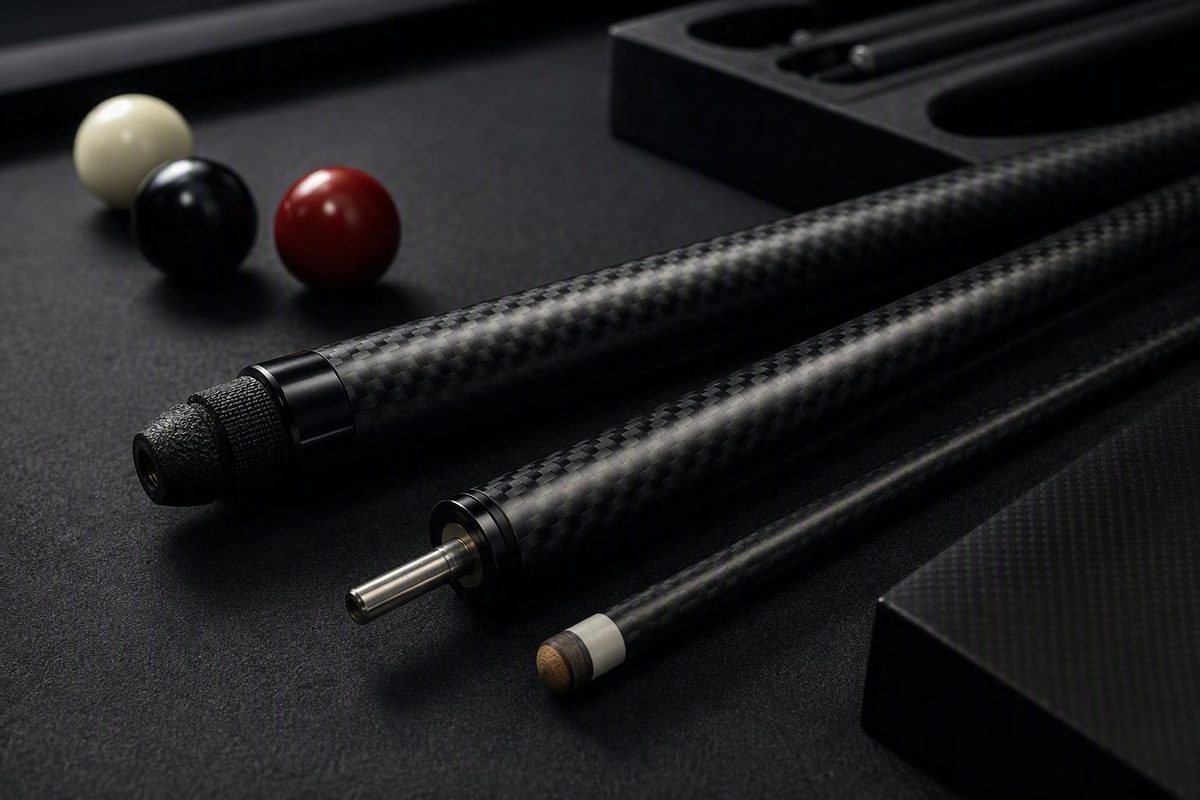
The short answer: there is no evidence-based universal winner
There is no independently proven best carbon fiber pool cue for every player. The available evidence does not include controlled, like-for-like testing of cue-ball squirt, durability, vibration, balance, or long-term reliability. Most recommendations and performance claims come from manufacturers or retailers with a commercial interest in selling the equipment discussed.
That limitation matters because “carbon-fiber cue” can describe three fundamentally different products:
- Complete playing cues, consisting of a butt and a playing shaft.
- Replacement shafts, intended to fit an existing cue butt.
- Break cues, built around the priorities of the opening break.
A $500 replacement shaft cannot be ranked directly against a $500 complete cue, and neither belongs in the same performance ranking as a purpose-built break cue. A well-regarded shaft also does not establish the quality of a complete cue’s butt, wrap, joint, balance, finish, or overall construction.
The most defensible recurring shaft shortlist from the supplied catalogs and commercial guides is:
- Predator REVO
- Cuetec Cynergy
- Pechauer Rogue
- Meucci Carbon Pro
- Jacoby BlaCk
These are prominent shopping candidates, not proven winners. Repeated catalog visibility does not demonstrate that one has the lowest measured deflection, greatest durability, or best feel for your stroke. Multi-brand collections also mix prices, configurations, product categories, ratings, and stock statuses without publishing standardized comparative tests.
A practical buying process is therefore more useful than forcing an overall winner:
- Decide whether you need a complete cue, replacement shaft, or break cue.
- Set a total setup budget, including accessories and possible return costs.
- Confirm the exact joint, facing, and collar requirements.
- Choose a diameter and taper that feel comfortable in your bridge.
- Evaluate the installed tip, shaft weight, assembled balance, sound, and feedback.
- Confirm the current warranty, repair procedure, stock status, and return policy.
- Test the cue if possible—or buy under terms that permit a meaningful evaluation.
How this guide treats the evidence
- Retailer-displayed facts: Model names, configurations, prices, diameters, ratings, review counts, and stock labels observed in seller listings.
- Owner-feedback signals: Retailer-displayed ratings and review volumes. These reflect reported customer sentiment but are not controlled performance measurements.
- Promotional claims: Statements about accuracy, power, durability, professional use, or superiority are treated as manufacturer or retailer claims rather than independent findings.
- Unanswered questions: Comparable deflection measurements, blind feel tests, long-term failure rates, exact compatibility matrices, balance changes, and current warranty coverage remain largely unavailable.
- Testing disclosure: This guide is based on the supplied listing captures and commercial guides, not hands-on testing. Commercial details were treated as August 2026 snapshots and must be checked again before purchase.
The result is a conditional shortlist, not a podium. Product category and compatibility should narrow the field; diameter, taper, balance, feedback, and return terms should decide among otherwise credible candidates.
First decide what you are buying: complete cue, shaft upgrade, or break cue
A complete playing cue includes a butt and a shaft intended for ordinary shot-making and positional play. Its price covers more than shaft technology. Butt construction, grip or wrap, joint, weight system, decoration, balance, and included accessories all contribute to the package.
A carbon-fiber shaft may be the headline feature, but it does not tell you whether the assembled cue will feel balanced or comfortable. Nor can promotional claims about a particular shaft establish the quality of the butt, finish, joint alignment, or weight-adjustment system paired with it.
A replacement shaft offers another route. If you already like your cue butt, replacing only the shaft may provide the low-deflection construction or lower-maintenance surface you want without requiring you to abandon a familiar grip, wrap, or butt profile.
Buying the right shaft model with the wrong joint option still produces the wrong purchase.
Most prominent listings for Predator REVO, Cuetec Cynergy, Pechauer Rogue, Meucci Carbon Pro, and Jacoby BlaCk are replacement shafts. By contrast, visible Linc models, Scorpion Sneaky Pete models, Poison Maelith, and Cuetec SVB Cynergy configurations are complete cues.
A break cue is a separate tool. Its design priorities may include efficient energy transfer, a break-specific tip, stiffness, and durability under repeated hard strokes. Cuetec Cynergy Breach and Pure X carbon-fiber break cues therefore belong in a break-cue comparison, not in a ranking of playing shafts.
Retail collections frequently blur these boundaries. One collection may contain complete cues, standalone shafts, break cues, and extensions or other accessories. Catalog position and product counts can consequently create the appearance of a ranking where none exists.
Use this three-branch decision tree:
- You like your present butt: Identify its exact joint and shop for compatible replacement shafts.
- You are starting fresh or replacing the whole setup: Compare complete playing cues, including the butt, wrap, joint, total weight, and assembled balance.
- You want break-specific equipment: Shop the break-cue category separately and do not use ordinary playing characteristics as the sole comparison criteria.
Before buying a “complete carbon-fiber cue,” confirm exactly what the listing includes. Look for the named shaft model, diameter, installed tip, joint, shaft length, cue weight or adjustment range, and available configuration choices. Product photographs and broad phrases such as “carbon cue” are not sufficient.
Leading carbon-fiber shaft upgrades compared
The table below is limited to replacement shafts, but it is not a technically controlled comparison. The visible listings differ in diameter and may also differ in joint option, tip, taper, shaft weight, or other configuration details. Prices, ratings, and review counts are retailer snapshots rather than permanent specifications or independent test results.
| Replacement shaft | Visible diameter | Listed price | Retailer rating | Review count | Main evidence limitation |
|---|---|---|---|---|---|
| Meucci Carbon Pro | Not supplied in the captured listing | $450 | 4.7/5 | 117 | No controlled deflection or durability comparison |
| Cuetec Cynergy 15K | 11.8 mm | $449 | 4.8/5 | 101 | One diameter and listing snapshot |
| Jacoby BlaCk | 12.4 mm | $495 | 4.9/5 | 64 | Smaller feedback sample than Meucci or Cuetec |
| Pechauer Rogue | 12.4 mm | $510 | 4.9/5 | 30 | No standardized performance data |
| Pechauer Rogue | 11.8 mm | $510 | 5.0/5 | 21 | High displayed average but a relatively limited sample |
| Predator REVO | 12.9 mm | $549 | 4.6/5 | 39 | Manufacturer performance claims are not independently validated here |
The six prices, ratings, review counts, and visible diameters above were displayed in an August 2026 capture of the PoolDawg carbon-fiber catalog. The listed premium shafts cluster from $449 to $549, with the visible REVO configuration carrying the highest price in this specific comparison.
Review volume is useful only within strict limits. An average based on 117 reviews provides a broader owner-feedback signal than an average based on 21, but it does not establish lower cue-ball squirt, better impact resistance, longer service life, or a better match for your bridge and stroke.
The retailer does not provide a controlled review methodology or establish that every reviewer evaluated the same joint, diameter, tip, or butt combination. Ratings may also reflect shipping, service, appearance, or initial satisfaction rather than long-term performance.
The most supportable interpretation is:
- Meucci Carbon Pro has the largest displayed owner-feedback sample in this group.
- Cuetec Cynergy 11.8 mm has the second-largest sample and a slightly higher displayed average.
- Jacoby BlaCk 12.4 mm combines a strong displayed rating with a moderate sample.
- Pechauer Rogue appears in two diameters, but each rating rests on fewer reviews.
- Predator REVO 12.9 mm remains a prominent premium candidate, although its visible price is higher and the supplied evidence does not independently validate the manufacturer’s broader performance claims.
No overall winner follows from those observations.
Lower-priced shaft candidates
Premium pricing is not the only route into carbon fiber. The supplied retailer captures also showed these lower-priced shaft listings:
| Replacement shaft | Visible listed price | Listing context |
|---|---|---|
| Linc Radial | $199 | Available in 11.8, 12.5, or 12.9 mm |
| Pearson Carbon Clear 2 | $269.10 | Lower-priced multi-brand catalog listing |
| Pure X carbon-fiber shaft | $296.10 | Lower-priced multi-brand catalog listing |
| Spartan Victory | $395 | 12.75 mm in the captured listing |
The Linc price and three visible diameter choices appeared in the Seybert’s Linc collection, while the Pearson and Pure X prices appeared in the Billiards.com carbon-fiber collection.
PoolDawg displayed the Spartan Victory at $395, with a 12.75 mm diameter and a 4.8/5 rating from 20 reviews in the captured listing. Those figures remain retailer-displayed observations, not comparative performance measurements.
The evidence does not show whether a $500 shaft performs proportionally better than a $200 or $300 shaft. A lower price may reflect differences in finish, tip, taper, joint availability, quality control, service, warranty, or resale demand. It may also represent genuine value. Price alone cannot settle the question without standardized testing and long-term ownership data.
Price date: Every amount and retailer-feedback figure in this guide is an August 2026 snapshot. Before ordering, reconfirm the price, availability, exact joint version, installed tip, taper, shaft weight, warranty, repair process, and return conditions.
Complete playing cues and break cues by budget and use
Complete cues should be treated as shopping candidates rather than category winners. Their value depends on the assembled product—not merely the presence of a carbon-fiber shaft.
Lower-cost complete playing cues
Four visible Linc complete cues were listed at $369 each:
- Linc Black with Red/Gray Graphic
- Linc Black with Blue/Silver/White Graphic
- Linc Dark Gray Stained Maple with Red/Silver Points Graphic
- Linc Black with Orange/Silver/Gray Graphic
Seybert’s calls the collection “Best Budget Carbon Fiber Pool Cue,” but the captured collection showed only Linc products and supplied no comparative testing, scoring system, or market-wide selection method. It also mixed four complete cues with a replacement shaft and an extension. The retailer label should therefore be read as merchandising, not as an independently established category award.
Scorpion Sneaky Pete complete cues were displayed at $405 in the captured PoolDawg catalog. The visible white and red versions had only one and two reviews, respectively. Samples that small should carry little comparative weight, even when the displayed ratings are favorable.
These cues may still merit investigation, particularly for buyers who prefer understated Sneaky Pete styling. The available ratings simply do not justify a strong performance conclusion.
Entry-level and mid-priced complete cues
The commercial snapshots showed the following complete-cue configurations:
| Complete playing cue | Displayed price | Other observed details | Evidence limitation |
|---|---|---|---|
| Poison Maelith | $449 | Venom carbon-fiber shaft; Radial joint | “Entry-level” is Predator’s placement within its own range |
| Cuetec CT944 SVB Cynergy | $695 | 4.9/5 from 11 reviews; marked out of stock | Rating is not controlled performance evidence |
| Predator P3 configurations | About $999–$1,841 | Price varied with configuration | Manufacturer guide, not an independent market comparison |
The Maelith and P3 details appeared in Predator’s August 2026 carbon-fiber cue buying guide. The manufacturer identifies the Poison Maelith as an entry-level option, but that designation does not establish it as the best entry-level cue across the wider market.
PoolDawg displayed the Cuetec CT944 SVB Cynergy at $695, with a 4.9/5 rating from 11 reviews, and marked the captured listing out of stock. Eleven reviews provide more context than one or two, but they still cannot establish objective performance or predict whether the cue’s wrap, balance, sound, or feedback will suit a particular player.
At the premium end, Predator P3 prices varied substantially with the selected configuration. A premium shaft’s marketing cannot establish complete-cue superiority. Ask what the additional money buys: butt construction, wrap materials, finish, weight adjustment, joint system, configuration choice, service terms, or appearance and brand positioning.
Break-cue candidates
Break cues require a separate shortlist:
| Break cue | Displayed price | Other observed details |
|---|---|---|
| Cuetec Cynergy Breach | $749 | 4.9/5 from 20 reviews |
| Pure X carbon-fiber break cue | Approximately $461 | Described as having a hard phenolic tip |
The Cuetec figures were shown in the captured PoolDawg catalog. The approximate Pure X price and tip description came from a retailer-authored Cue-Pros carbon-fiber roundup, not from a controlled comparison.
Do not compare either price directly with a replacement playing shaft. A break cue includes the butt, shaft, joint, tip, and assembled setup, while a standalone shaft assumes that you already own a suitable butt.
A practical complete-cue shortlist by shopping situation is therefore:
- Lower-cost investigation: Linc or Scorpion
- Another entry-level candidate: Poison Maelith
- Higher-priced complete-cue candidate: Cuetec SVB Cynergy
- Break-specific shopping: Cuetec Cynergy Breach or Pure X break cue
That is a map of shopping situations, not a declaration of winners.
What low deflection means—and what diameter does not tell you
When the cue tip strikes the cue ball away from its vertical centerline, the cue ball can initially be pushed sideways from the intended line. This effect is commonly called cue-ball squirt.
A low-deflection shaft is designed to reduce that initial sideways displacement. In practical terms, it may allow a player to use less aim compensation on shots involving side spin.
Carbon-fiber shafts are often associated with low-deflection construction, but the material label alone does not explain performance. Relevant factors include:
- Effective mass near the tip
- Internal construction
- Ferrule or vault-plate design
- Shaft flex
- Taper
- Tip construction and condition
- Interaction between the shaft and the player’s stroke
Commercial guides commonly promote carbon fiber for consistency, durability, relative climate stability, and low maintenance. Those may be meaningful reasons to buy, but the supplied sources do not quantify the size of the advantages through standardized head-to-head testing.
How to interpret diameter
Manufacturer guidance commonly frames the principal diameters as follows:
- Around 11.8 mm: Precision-oriented, with a smaller visual reference and potentially more demanding bridge feel.
- Around 12.4–12.5 mm: An all-around middle ground.
- Around 12.9 mm: More familiar or forgiving for players moving from a larger traditional shaft.
Predator uses this general 11.8, 12.4, and 12.9 mm framing in its guide, describing the sizes as precise, versatile, and forgiving, respectively. These are preference-based manufacturer descriptions—not proof that one diameter is inherently more accurate or produces less squirt.
A thinner shaft does not automatically have lower deflection. Two shafts with the same tip diameter can differ in tip-end mass, internal construction, flex, taper, and feedback. Shafts with different diameters may also produce similar practical results for a particular player.
Choose diameter by considering:
- Bridge comfort
- Visual familiarity during alignment
- Open-bridge and closed-bridge use
- Taper through the bridge hand
- Installed tip
- Stroke consistency
- Current shaft diameter
- Willingness to adapt to a different sight picture and feel
Equipment can alter feedback and the amount of compensation required on spin shots. The evidence does not support promises that carbon fiber will automatically produce more spin, power, accuracy, or match wins.
Joint compatibility: the check that prevents an expensive mistake
The most important specification for a replacement shaft is not its brand name or visible carbon weave. It is whether the shaft properly fits your butt.
Common joint families named in the supplied commercial guidance include:
- Radial
- Uni-Loc Quick Release
- 5/16×14
- 5/16×18
- 3/8×10
These joint families and thread labels are listed in a manufacturer-authored carbon-fiber cue buyer’s guide. The source is commercially interested, but the list illustrates why buyers must identify the exact joint rather than selecting a shaft by appearance.
Start with the cue butt’s exact make, model, and documented joint specification.
Even a matching joint label does not by itself guarantee an ideal installation. Other considerations include:
- Pin fit
- Joint facing
- Collar diameter and style
- Alignment
- Shaft length
- Shaft weight
- Assembled balance
- Any applicable manufacturer restrictions
Do not attempt to make an uncertain combination fit by applying force.
Compatibility checklist
Before ordering a replacement shaft:
- Photograph the butt pin and joint face clearly.
- Identify the butt’s manufacturer and exact model.
- Confirm the thread specification with the butt manufacturer or an informed seller.
- Select the shaft’s exact joint option, not merely the correct shaft brand.
- Compare the shaft and butt collar diameters and collar styles.
- Confirm whether the joint is flat-faced or piloted where relevant.
- Check the shaft’s listed length and weight.
- Ask whether the seller or manufacturer can advise how the shaft may affect assembled balance.
- Confirm return eligibility before chalking the tip or playing with the shaft.
- Thread the cue together gently and stop if it binds, cants, or requires force.
Specifications alone cannot establish whether that change will feel natural in your grip and stroke.
Treat joint adapters as a question for the relevant manufacturer or seller. The supplied evidence does not establish how a particular adapter affects alignment, balance, feel, performance, or warranty coverage. Do not assume that an adapter produces the same result as a shaft manufactured for the correct joint.
Exact compatibility matrices, collar measurements, adapter consequences, and warranty terms remain unverified for many combinations. Do not rely on invented or generalized fit claims. Whenever possible, test the assembled cue in person or buy from a seller with clear conditions for an unchalked test fit and return.
Carbon fiber versus wood: decide whether the premium fits your game
Carbon fiber and wood offer different packages of benefits and compromises. Neither material is universally superior.
Carbon fiber is commonly favored for:
- Repeatable external dimensions
- Lower routine maintenance
- Relative resistance to environmental change
- Durable playing surfaces
- Low-deflection construction
- Consistency from one session to another
These are recurring commercial claims rather than quantified findings from standardized comparative tests. The available guides do not show exactly how much advantage a particular carbon shaft has over a well-made wood shaft.
Wood remains a valid choice for:
- Traditional tactile feedback
- A broader range of entry prices
- Greater customization and adjustability
- Familiar sound and vibration
- Potential access to local maintenance or repair
- Players who simply prefer the response of maple or another cue wood
Low deflection is not exclusive to carbon fiber. Low-deflection wood shafts also exist, so the meaningful comparison is not necessarily “modern carbon versus ordinary wood.” It may be one specific carbon shaft against one specific low-deflection wood shaft, installed on the same butt and evaluated by the same player.
Feel is especially personal. A player accustomed to maple may describe carbon fiber as stiffer, more muted, sharper, quieter, or simply unfamiliar. Another player may interpret the same response as solid and consistent. Neither reaction proves better performance.
A retailer-authored carbon-fiber-versus-wood comparison similarly presents carbon fiber as more stable and lower maintenance while describing wood as more traditional, broadly affordable, adjustable, and tactile. It also acknowledges the existence of low-deflection wood shafts. Those observations remain general commercial guidance rather than controlled material testing.
Repair can differ as well. Conventional wood-shaft maintenance may be available from an experienced local cue technician. Suspected structural damage to a carbon-fiber shaft may instead require manufacturer guidance, specialized assessment, or replacement. Do not sand a composite shaft or attempt a structural repair unless the manufacturer explicitly authorizes the method.
Carbon fiber may justify its premium if you prioritize low upkeep, repeatable dimensions, relative environmental stability, and low-deflection design. Wood may make more sense if you prioritize traditional feedback, customization, local serviceability, or lower cost.
Players who use substantial side spin may place more value on reduced squirt and consistent compensation. Players who rarely use side spin may value the same premium less. A hands-on trial—or at least a returnable purchase—is the best way to evaluate grip, balance, vibration, sound, and hit feel.
Final buying checklist, care routine, and verdict
Before ordering, verify all of the following:
- Product category: Complete playing cue, replacement shaft, or break cue
- Exact model: Including generation and configuration
- Joint: Thread, pin, facing, and selected joint option
- Collar: Diameter, material, and style
- Shaft diameter: Measured at the tip
- Taper: Including how it feels through your normal bridge length
- Installed tip: Brand, hardness, diameter, and playing or break purpose
- Shaft length and listed weight
- Assembled cue weight and balance
- Butt features: Wrap, grip diameter, weight adjustment, and extension compatibility
- Total price: Not merely the advertised shaft or base configuration
- Warranty and repair process
- Return conditions and return-shipping cost
- Current stock and expected configuration
Prioritize shaft suitability, joint construction, tip, weight, and balance before decorative appearance. A cue can look excellent and still be wrong for your bridge, stroke, or preferred balance.
Include ownership costs in the budget:
- Protective case
- Joint protectors
- Chalk
- Tip-maintenance tools
- Possible adapter costs
- Return shipping
JFlowers likewise advises buyers to prioritize the shaft, joint, tip, weight, and balance over appearance and to consider a hands-on trial or a seller with clear return terms in its pool-cue buying-mistakes guide. That guidance is manufacturer-authored, but its emphasis on fit and testing is consistent with the limitations of specifications and online reviews.
Conservative carbon-fiber cue care
- Wipe the shaft with a clean, soft, nonabrasive cloth.
- Follow the shaft manufacturer’s approved cleaning instructions.
- Avoid abrasive pads, harsh chemicals, and undocumented solvents.
- Avoid unnecessary moisture and damaging storage conditions.
- Store the cue in a protective case.
- Use joint protectors when the cue is disassembled.
- Maintain the tip without damaging the shaft surface.
- Inspect the shaft, finish, joint, and collar for cracks, separation, looseness, or other damage.
- Never force the joint during assembly.
- Do not sand the shaft or attempt an undocumented structural repair.
A retailer-authored carbon-fiber cue maintenance guide similarly recommends a soft cloth, avoidance of abrasive chemicals and excess moisture, protected storage, joint protectors, and routine damage inspection. As conservative editorial guidance, stop playing with equipment that appears structurally damaged until the manufacturer or a qualified service provider can assess it.
The verdict remains conditional. Compare complete cues, replacement shafts, and break cues separately. Among the supplied premium shaft listings, Meucci Carbon Pro and Cuetec Cynergy have the strongest displayed owner-feedback volume. Predator REVO, Pechauer Rogue, and Jacoby BlaCk remain prominent alternatives, but none is proven superior for every player.
Let exact compatibility narrow the list. Let diameter, taper, tip, assembled balance, return terms, and hands-on feel make the final decision.
Frequently asked questions
Can I put a carbon-fiber shaft on any pool cue butt?
No. A carbon-fiber shaft must be offered with the correct joint, and physical attachment alone does not establish an ideal fit.
Confirm the butt’s exact thread specification, pin and facing arrangement, collar dimensions, shaft length, and resulting balance. Do not force a shaft onto a pin or assume visually similar joints are interchangeable.
If the cue or shaft manufacturer cannot confirm compatibility, buy through a seller that permits an unchalked test fit and return.
Is an 11.8 mm carbon-fiber shaft better than a 12.4 or 12.9 mm shaft?
Not universally. Commercial guidance commonly describes 11.8 mm as precision-oriented, 12.4–12.5 mm as an all-around middle ground, and 12.9 mm as more familiar or forgiving. Those are preference-based descriptions, not objective performance rankings.
Diameter alone does not determine deflection or accuracy. Tip-end mass, internal construction, taper, flex, tip, bridge comfort, and stroke all matter. If you are uncertain, test more than one diameter rather than assuming thinner is better.
Does a carbon-fiber shaft automatically improve accuracy and spin?
No. A low-deflection design may reduce cue-ball squirt and change how much aim compensation you need when using side spin. That can be useful, but it does not automatically improve stroke delivery, speed control, spin production, shot selection, or accuracy.
A new shaft may also require an adaptation period because its feedback and deflection behavior can differ from your current equipment. Treat it as a change to the playing system, not as an automatic performance upgrade.
What is the difference between a carbon-fiber playing cue and a carbon-fiber break cue?
A playing cue is intended for ordinary shot-making, positional play, speed control, and repeated use throughout a rack.
A break cue is purpose-built for the opening break and may use a harder tip and construction selected around impact and energy transfer. Its price and playing characteristics should not be ranked directly against a replacement playing shaft or an ordinary complete cue.
Compare playing cues with playing cues, replacement playing shafts with replacement playing shafts, and break cues with break cues.
How do I clean and maintain a carbon-fiber pool-cue shaft?
Wipe it regularly with a soft, clean, nonabrasive cloth and use only products or methods approved by the manufacturer. Avoid abrasive pads, sanding, harsh chemicals, and excess moisture.
Store the cue in a protective case, use joint protectors, maintain the tip carefully, and inspect the shaft and joint for damage. If you find a crack, separation, loose joint component, or another suspected structural problem, set the shaft aside until its manufacturer or a qualified service provider can advise you.
No evidence in the supplied comparisons supports declaring one model the universal best carbon-fiber pool cue. Every price, rating, review count, configuration, and stock reference above is an August 2026 snapshot and should be rechecked before purchase.