
How to Choose a Composite Bracket Without Relying on Strength Claims Alone
They divide into finished supports, structural stock and custom parts. Compare evidence for the complete bracket and load path, not headline strength claims.
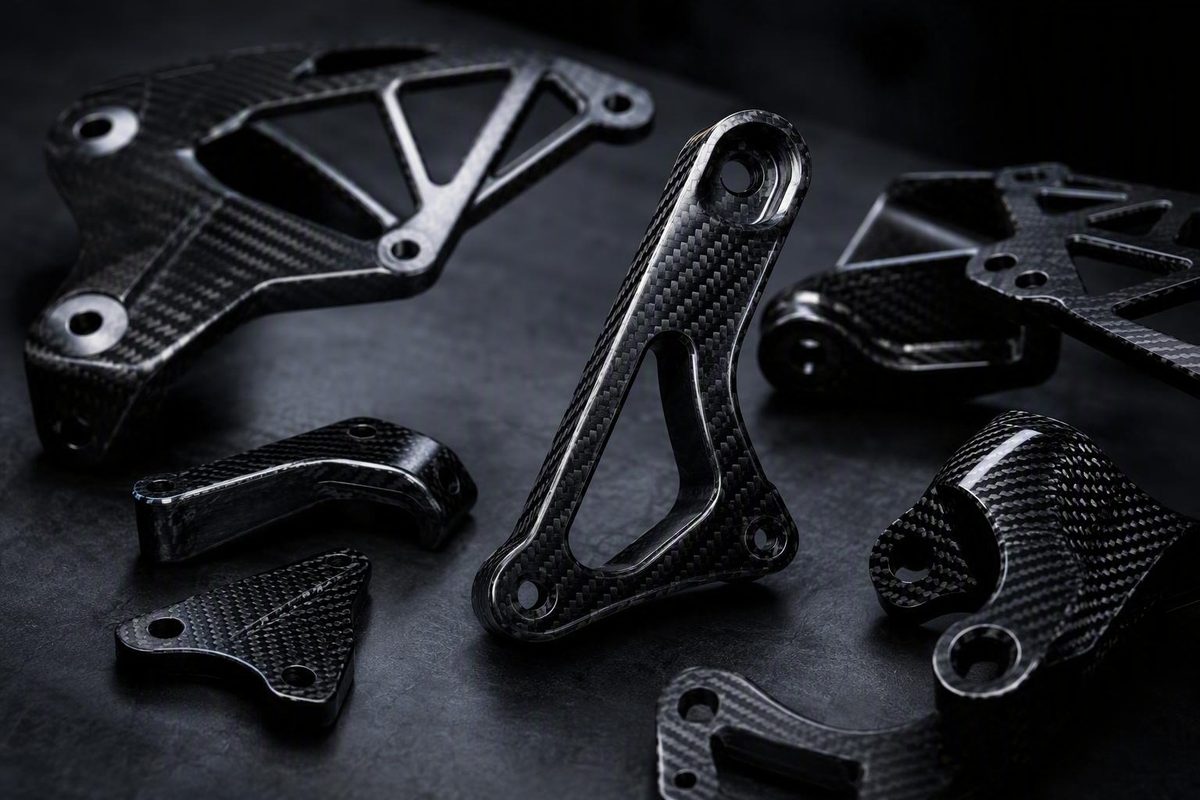
Carbon fiber is not a bracket rating. It is one ingredient in a material system whose performance depends on the fibers, resin, laminate architecture, geometry, joints, manufacturing quality, installation, and loading.
That distinction matters because “carbon fiber brackets” can describe three very different purchases:
- A finished countertop or cabinetry support with defined dimensions and installation guidance.
- A generic angle, channel, or flat profile intended for further fabrication.
- A custom engineered component made for a specific industrial or OEM assembly.
The right choice starts by identifying which category you need. It ends with evidence about the complete bracket and load path—not a headline tensile-strength comparison.
This is a product-selection guide, not project-specific structural engineering or installation approval. Verify current manufacturer instructions and obtain qualified engineering review where loads, modifications, code requirements, or failure consequences warrant it.
What Counts as a Carbon-Fiber Bracket?
A useful category map separates carbon-fiber brackets into finished supports, structural stock, and custom parts.
Finished countertop and cabinetry supports are sold for recognizable applications. Retail listings include hidden-island, knee-wall, flat-wall, double-sided island, stud, and floating-shelf supports. A finished product may include clips, dimensional options, adhesive instructions, and recommended overhangs. Those features make it easier to specify, but they do not automatically establish a universal load capacity.
Generic structural profiles include sharp or radius angles, C-channels, and flat laminate. They can become bracket components after cutting, drilling, bonding, or assembly, but they are material for a design—not an installation-ready structural solution. Generic profiles may have no mounting holes, fastening schedule, application-specific instructions, or rated load.
Custom engineered brackets include L brackets, angle brackets, bonded assemblies, locally reinforced laminates, and hybrid parts with metal inserts. A custom supplier may tailor thickness, fiber orientation, hole reinforcement, finish, and interfaces around the assembly’s load path. One supplier describes CNC-machined, molded, and bonded carbon-fiber/epoxy brackets with reinforced hole zones and optional metal inserts; these are supplier capabilities rather than universal category specifications (custom carbon-fiber bracket options).
Quick routing guide
- Countertop fabricator or installer: Start with “Finished Carbon-Fiber Countertop Supports” and “Installation, Adhesives, Fasteners, and Cabinet Conditions.”
- General fabricator: Focus on “The Design Variables That Determine Whether a Bracket Works” and “Generic Profiles and Custom Brackets.”
- OEM engineer or sourcing team: Go to the manufacturing, test-evidence, and RFQ sections.
Do not group unlike carbon materials together
The label “carbon fiber” can conceal materially different systems:
- Continuous carbon-fiber/epoxy laminate uses oriented continuous fibers in a cured thermoset matrix.
- Short-fiber molded composite uses chopped reinforcement whose orientation is strongly influenced by mold flow.
- Recycled-fiber thermoplastic tape combines reclaimed reinforcement with a melt-processable polymer and may be compression molded or formed.
- Carbon-carbon uses carbon reinforcement in a carbon matrix rather than an ordinary polymer resin.
A property or test result for one cannot be assigned to the others.
When Carbon Fiber Makes Sense—and When Metal May Be Better
Carbon fiber becomes a serious candidate when a project is constrained by installed mass, low-profile stiffness, corrosion exposure, or dimensional change with temperature. It is not automatically the best bracket material.
The key distinction is between specific properties and absolute bracket performance. Specific stiffness and specific strength describe performance relative to mass. They do not reveal:
- how much load a bracket can safely carry;
- how far it will deflect;
- whether a bolt will crush or pull through the laminate;
- how it will respond to impact;
- what safety factor applies; or
- whether the mounting substrate will fail first.
Carbon-fiber laminates are directional. Fibers can be placed to make a part very stiff along a primary load path, but performance may be much lower across the fibers or through the laminate thickness.
When aluminum or steel may be the better answer
Metal often deserves preference where the assembly needs:
- tolerance of frequent impact or rough handling;
- visible deformation before complete failure;
- straightforward field repair or replacement;
- integral threads or uncomplicated bolted joints;
- efficient heat dissipation;
- familiar inspection methods;
- simple procurement at low material cost; or
- rapid, repeatable production without composite layup and cure controls.
Density alone does not settle the installed-mass question. An equal-volume comparison ignores laminate thickness, local plies, inserts, adhesive, isolation barriers, washers, clips, and fasteners. Compare complete assemblies qualified for equivalent service rather than equal-sized material samples.
Decision matrix
| Selection factor | Carbon-fiber composite may be favored when… | Aluminum or steel may be favored when… |
|---|---|---|
| Mass | Every unit of installed mass matters and the laminate can follow defined loads | Weight is secondary to cost, simplicity, or joint robustness |
| Deflection | Directional stiffness can be tailored and geometry is tightly controlled | Loads are multidirectional or boundary conditions are uncertain |
| Impact | Impact is limited and damage inspection or controlled replacement is planned | Repeated knocks, drops, or abuse are expected |
| Corrosion | The environment attacks ordinary metals and compatible joints can be designed | A suitable alloy, coating, or stainless material solves exposure economically |
| Thermal stability | Low dimensional drift is critical | Predictable expansion is acceptable or can be accommodated |
| Heat dissipation | Thermal isolation is useful | The bracket must conduct heat away |
| Field repair | Replacement is practical and composite repair is controlled | Bending, welding, machining, or local repair must be easy |
| Production volume | Mass savings justify tooling and process validation | Conventional cutting, forming, casting, or machining scales more simply |
| Inspectability | Nondestructive inspection or controlled replacement is available | Visible yielding and familiar crack inspection are priorities |
| Connections | Bonded joints or engineered inserts fit the design | Threads, bearing loads, and repeated disassembly dominate |
Any numerical comparison must identify the metal grade, carbon-fiber laminate, resin, geometry, loading direction, and test method. Without those details, “stronger than steel” is a marketing phrase rather than a usable design input.
The Design Variables That Determine Whether a Bracket Works
Two products can both be called carbon-fiber brackets and have radically different capacities because the name says almost nothing about their construction.
Finished performance depends on:
- fiber type, orientation, and local density;
- laminate schedule and balance;
- resin system;
- cured thickness;
- bracket geometry;
- voids, porosity, cure quality, and dimensional accuracy;
- load direction;
- support conditions and restraint;
- hole and edge details; and
- the way force enters and leaves the part.
Design the laminate around the load path
Copying a metal bracket at the same shape and thickness is usually a poor starting point. A metal design may depend on isotropic behavior, ductile yielding, formed bends, welded corners, or strong bearing around holes.
There are three distinct evidence levels:
- Raw-fiber data describes an individual reinforcement under controlled conditions.
- Laminate coupon data describes a specified stack of fiber and resin in a particular test direction.
- Finished-bracket testing captures geometry, joints, manufacturing defects, boundary conditions, and actual load introduction.
Only the third directly measures a representative component. Even then, the test fixture, attachment method, loading direction, and environment must resemble the intended installation.
Where failure commonly starts
Critical regions often include:
- inside corners, where load direction changes;
- holes and slots;
- free edges;
- abrupt thickness transitions;
- ends of bonded joints;
- inserts and clip interfaces; and
- small contact areas under concentrated loads.
Broad load-spreading hardware, controlled bolt torque, reinforced hole zones, or bonded metal inserts may help when joints are repeatedly assembled or torque-critical.
Resin and environment matter
Carbon fibers do not define the complete environmental limit. A low-temperature epoxy system and a higher-temperature thermoplastic composite should not share one service-temperature assumption.
Cured angles can also distort during manufacture. Cure shrinkage, cooldown from process temperature, and differences between in-plane and through-thickness behavior have been identified as possible contributors to warpage in autoclave-cured carbon-fiber/epoxy angles. Tooling geometry may require compensation to deliver the intended final angle (manufacturing-distortion reference).
Finished Carbon-Fiber Countertop Supports: Types, Sizes, and Prices
Finished countertop supports are the most installation-oriented part of this market. Available configurations include:
- Concealed island supports: flat members embedded or mounted flush within cabinetry.
- Knee-wall supports: brackets transferring an overhang load into a pony or knee wall.
- Flat-wall supports: supports for countertops meeting a wall or vertical mounting face.
- Double-sided island supports: members extending to support overhangs on opposing sides.
- Stud brackets: supports intended to attach at framing members.
- Floating-shelf supports: concealed supports for shelf applications.
The following prices are seller snapshots reviewed on August 21, 2026. They are not quotations or like-for-like installed-cost comparisons.
| Product or listing | Intended application | Width | Thickness | Available lengths | Included hardware | Seller-recommended overhang | Listed price | Evidence status |
|---|---|---|---|---|---|---|---|---|
| CarbonBar Hidden Island Support | Concealed countertop or island overhang | 2 in. | 0.2 or 0.4 in. | 29, 32, 34, 38, 44 in. | Two CarbonConnect Direct clips | Total overhang: 11, 14, 16, 20, or 26 in., respectively | No confirmed selected-configuration price in the primary field | Seller specification and recommendation; no reproduced load report in the evidence reviewed (Chemical Concepts product listing) |
| CarbonBar knee-wall support | Knee or pony wall | Not established here | Not established here | Varies by option | Not established here | Not established here | From $13.50 | Category listing only (Chemical Concepts category listing) |
| CarbonBar double-sided support | Opposing island overhangs | Not established here | Not established here | Varies by option | Not established here | Not established here | From $17.40 | Category listing only |
| CarbonBar flat stock | Further fabrication | 1 in. for one listed profile | 0.2 in. | 48 in. for one listed profile | None documented | Not applicable | From $25.00 | Stock listing, not a validated bracket |
| CarbonBar hidden-island category listing | Concealed island or overhang | Configuration not tied to price | Configuration not tied to price | Configuration not tied to price | Configuration not tied to price | Not established by price listing | From $30.93 | Unmatched category or related-product starting price; not assigned to the defined product configuration above |
| Original Granite Bracket collection | Knee-wall, hidden-island, flat-wall, and double-sided supports | Varies | Varies | Varies | Varies | Not established on collection page | From $45.32 to $80.06 across four listings | Retail collection snapshot; no load ratings or dimensions on the collection page (collection prices) |
| Legacy hidden-island support | Concealed island or overhang | 2 in. | 0.4 in. | Even lengths from 28 to 44 in. | Not established here | Not stated in captured listing | $88.95 to $103.95 by length | Retail listing; no tested load shown (Legacy Brackets listing) |
For the best-documented hidden-island product, Chemical Concepts specifies a two-inch width, two profile thicknesses, and five lengths. It includes two mounting clips and is described as fitting within standard 24-inch cabinetry. The seller recommends total overhangs of 11 inches with the 29-inch bracket, 14 inches with the 32-inch bracket, 16 inches with the 34-inch bracket, 20 inches with the 38-inch bracket, and 26 inches with the 44-inch bracket.
A recommended overhang is not a verified universal allowable load. Countertop material and thickness, cabinet substrate, bracket spacing, distributed loads, concentrated point loads, and workmanship can all change the result. The seller identifies granite, engineered quartz, Dekton, butcher block, sintered stone, and concrete as compatible materials, but that list is not engineering approval for every slab and installation.
How to interpret the prices
The table deliberately separates the defined hidden-island specification from the unmatched $30.93 category or related-product price. The available evidence does not confirm that the specified lengths, thicknesses, clips, and overhang recommendations are all available at that starting amount.
Other price differences may reflect dimensions, thickness, product generation, included hardware, seller, packaging, or listing date. Adhesive, clips, fasteners, labor, shipping, cabinet reinforcement, tools, inspection, and engineering review may sit outside the advertised price.
The available evidence does not support a universal bracket count or spacing rule. Obtain spacing from the current instructions for the exact product or from project-specific engineering that considers the countertop, cabinets, overhang, loading, and consequences of failure.
Installation, Adhesives, Fasteners, and Cabinet Conditions
Installation instructions are product-specific. Do not transfer adhesive or fastening guidance from one carbon-fiber support to another merely because the products have similar dimensions.
For the documented CarbonBar hidden-island support, Chemical Concepts says the 0.2-inch profile must use CarbonBond Epoxy or CarbonBond 1C Hybrid Adhesive and explicitly states that silicone is insufficient. The seller permits standard silicone or construction adhesive for the 0.4-inch profile. Those instructions apply to the identified product and thickness, not to carbon-fiber brackets generally (product-specific adhesive guidance).
An adhesive name is not a complete bond specification. A controlled installation should also establish:
- compatible substrates;
- defined surface preparation;
- adequate bond area;
- specified adhesive thickness;
- application and cure temperature;
- cure time before loading;
- service-temperature and moisture limits; and
- a practical inspection or acceptance method.
Cabinet construction is part of the structure
A bracket does not support a countertop in isolation. It transfers load into cabinets, framing, masonry, or another substrate.
Framed and frameless cabinets can create different attachment paths. A strong bracket attached to an inadequate cabinet panel still produces a weak system.
Connection components may play different roles:
- Clips locate or restrain the support and transfer load at defined points.
- Mechanical fasteners provide clamp force, shear transfer, or pull-out resistance.
- Adhesive spreads load over a larger area and may prevent local movement.
- Local reinforcement protects high-stress laminate regions.
- Inserts provide durable threads or bearing surfaces.
Their presence does not prove that every possible combination is acceptable. Use the documented arrangement or an engineered alternative rather than inventing a fastening schedule from appearance alone.
Contact with aluminum and machining hazards
Carbon-fiber composite can form the electrically conductive side of a galvanic couple with aluminum when moisture or another electrolyte reaches the interface. Electrical isolation may therefore be needed, using concepts such as nonconductive barriers, compatible bushings, isolated fasteners, or properly specified coatings. Cutting and drilling present a separate concern: machining can sever fibers, initiate edge damage, and create conductive carbon dust that requires suitable extraction or filtration, compatible tooling, eye and respiratory protection, controlled cleanup, and protection of nearby electrical equipment (engineering and machining cautions).
The appropriate isolation or machining plan depends on the actual product, exposure, drainage, coating durability, load path, and workplace controls. Verify whether any modification changes the seller’s test coverage, installation guidance, or warranty rather than assuming that field alteration is permitted.
Cutting and drilling
A seller may permit on-site cutting and drilling of a particular profile, but permission is product-specific and modification is not structurally neutral. It can:
- sever load-carrying fibers;
- reduce edge distance;
- create delamination or splintering;
- change the intended load path;
- expose unsealed laminate edges; and
- move the part outside the configuration represented by existing instructions or test evidence.
Product approval and a fabrication plan should come before the first cut. After machining, inspect the hole or edge for visible damage and confirm that the altered geometry still satisfies the design requirements.
Pre-installation checklist
Confirm all of the following:
- exact bracket model and profile;
- bracket dimensions and modification status;
- cabinet, framing, wall, or masonry substrate;
- total overhang and supported length;
- countertop material and thickness;
- anticipated distributed load;
- anticipated point and impact loads;
- approved bracket spacing;
- specified adhesive and surface preparation;
- required clips, fasteners, washers, barriers, or inserts;
- cure time before loading;
- environmental exposure;
- galvanic-isolation requirements;
- fabrication and dust-control plan, if modification is permitted; and
- required engineering or code approval.
If any item is unknown, the task has moved beyond simple product selection.
Generic Profiles and Custom Brackets: Manufacturing Routes
Commercial structural stock includes sharp and radius angles, C-channels, and flat profiles in multiple weaves and dimensions. As sourcing illustrations, Rock West Composites lists a 12-inch sharp angle with 1.5-inch legs and a 0.08-inch wall from $37.99, upcycled angles with 2.5-inch legs, and C-channels in 36- or 74-inch lengths with 0.05-inch walls (angle and channel catalog).
These profiles do not become validated brackets because they resemble an angle or channel. The designer still needs to establish fiber direction, hole position, edge distance, corner loading, support conditions, joint design, allowable deflection, and how loads enter adjoining parts.
Manufacturing routes
CNC machining from flat laminate can suit prototypes and lower-to-medium quantities. It avoids dedicated molding tools, but machining cannot redirect fibers around corners or holes. The stock layup must already suit the load case.
Molded continuous-fiber construction can place reinforcement around corners and along principal loads. It may reduce secondary assembly but introduces tooling, layup, cure, dimensional-control, and inspection requirements.
Bonded or hybrid assembly joins flat or molded composite elements, sometimes with metal interfaces. It can solve complex geometry or provide durable threads, but bond lines, inserts, and galvanic isolation become design-critical.
Short-fiber injection molding can produce complex, repeatable shapes at volume. Fiber orientation follows material flow rather than a simple drawing direction, so gates, knit lines, wall thickness, and mold filling affect structural performance.
Compression-molded recycled-fiber tape may preserve more alignment than randomly filled molding compounds, depending on feedstock and process. It still requires material characterization, process control, and component validation.
A supplier-authored automotive case study illustrates this process sensitivity. MCAM reports that mold-flow analysis predicted an initial short-carbon-fiber bracket design would fail at about half the required strength. Geometry and mold-fill changes reportedly improved fiber alignment enough to meet undisclosed OEM requirements. Because the case omits the OEM, test standards, sample counts, and raw results, it is a design lesson rather than transferable proof (automotive bracket case study).
A narrower peer-reviewed aerospace study published on August 5, 2026, used recycled-carbon-fiber/PEI tape. Researchers combined directional coupon tests, microscopy, bracket loading, and finite-element modeling; the tested bracket reportedly reached 93% of a PEKK reference’s peak load under that study’s conditions. The available material does not establish universal performance, certification, service life, or suitability for countertop supports (recycled-fiber aerospace bracket study).
At the material level, carbon fiber becomes a composite part only after reinforcement is combined with a matrix and consolidated or cured. Carbon Reference’s precursor-to-finished-part overview explains the progression from precursor and carbonization through surface treatment, sizing, fabric or tape, resin, and cure.
Make-versus-buy comparison
| Route | Best fit | Main engineering burden | Main commercial trade-off |
|---|---|---|---|
| Finished support | Documented application within current instructions | Verify substrate, loads, spacing, and installation | Fastest purchase; limited flexibility |
| Machine stock profile | Prototype or unusual low-volume geometry | Layup suitability, holes, edges, joints, and inspection | Low tooling; high modification risk |
| Custom machined laminate | Low-to-medium volume with controlled flat geometry | Drawing, laminate specification, and machining quality | Moderate flexibility without a molding tool |
| Molded custom bracket | Repeated or complex part | Tooling, fiber placement, cure, and validation | Higher upfront effort; repeatability potential |
| Short-fiber molded part | Complex high-volume geometry | Mold flow, knit lines, local orientation, and qualification | Production efficiency after validation |
| Hybrid metal-composite | Threaded, bearing, or removable interfaces | Insert bonding, isolation, and differential expansion | Added parts and interfaces; more robust assembly features |
Choose based on engineering effort, tooling, quantity, connection complexity, inspection needs, modification risk, and availability of bracket-level test data—not shape alone.
How to Read Strength Claims and Test Evidence
Not all evidence carries the same weight. A practical hierarchy is:
- Seller description: intended use and marketing language.
- Seller specification: dimensions, materials, included hardware, and options.
- Seller recommendation: overhang, adhesive, or installation guidance.
- Simulation result: a modeled prediction dependent on inputs and assumptions.
- Supplier-authored case study: useful application context, often without full data.
- Representative bracket test: physical component data with realistic fixtures.
- Independent peer-reviewed study: stronger scrutiny, though still limited to its specimens and conditions.
Claims such as “four times stronger than steel,” “five times lighter,” “virtually zero deflection,” or “weatherproof” are incomplete without a defined steel grade, laminate, geometry, load case, environmental condition, and test method. Even a correctly measured tensile strength along the fibers cannot be converted directly into countertop capacity or bolt-joint strength.
A material property describes a tested material specimen under defined conditions. A design allowable is a value selected for engineering use after accounting for direction, variability, environment, manufacturing, damage, joints, safety factors, and the applicable design method. They are not interchangeable.
What a useful structural report should contain
At minimum, ask for:
- bracket drawing and measured geometry;
- fiber, resin, and laminate schedule;
- manufacturing route and cure condition;
- sample count and lot information;
- test standard, where applicable;
- test fixture and boundary conditions;
- loading direction and rate;
- load-displacement curves;
- failure location and mode;
- specimen-to-specimen variability;
- environmental conditioning;
- acceptance criteria and safety factor; and
- a clear relationship between test load and the published recommendation.
A colorful stress plot alone is not qualification.
The automotive case is a useful example of simulation exposing weak fiber flow before production, but its public account lacks the application identity, standards, raw results, and calculation basis. The recycled-fiber aerospace study demonstrates a stronger workflow—coupon characterization, microscopy, bracket testing, and modeling—but the supplied material still leaves questions about sample count, full methods, absolute peak loads, variability, and lifecycle boundaries.
What the current evidence cannot tell you
- A universal load capacity for “a carbon-fiber bracket”
- A universal countertop bracket-spacing rule
- Whether a listed product has applicable building-code approval or certification
- Long-term outdoor durability for every resin, coating, adhesive, and joint
- Independently verified equivalence to a steel or aluminum bracket across load, impact, fatigue, and environment
The correct response to incomplete evidence is not necessarily rejection. It may be a narrower claim, a more conservative application, representative testing, or a request for missing validation.
Buyer and RFQ Checklist for Carbon-Fiber Brackets
A useful request for quotation defines the assembly before asking a supplier to quote the part.
Application
- What does the bracket support, locate, or connect?
- What are all normal, abnormal, transport, installation, and maintenance load cases?
- In which directions do loads act?
- Which loads are distributed, concentrated, cyclic, or impact-driven?
- What safety factor or design code applies?
- What is the allowable deflection or positional drift?
- What service life is required?
- What are the consequences of failure?
Geometry
- Overall length, width, height, and profile
- Supported length and overhang
- Hole diameters, slots, and locations
- Edge distances
- Inside and outside corner radii
- Nominal and minimum thickness
- Installation envelope
- Mating-part tolerances
- Required flatness, angularity, and surface finish
Material system
- Continuous, discontinuous, virgin, or recycled reinforcement
- Fiber grade and architecture
- Laminate orientation and stacking sequence
- Resin system
- Cure or consolidation process
- Reinforced holes, corners, and load-entry zones
- Bonded or molded inserts
- Cosmetic or protective finish
- Operating-temperature range
- UV, moisture, chemical, and abrasion protection
Connections
- Fastener type and material
- Washer, backing plate, or other load spreader
- Bolt torque and locking method
- Insert material, geometry, and retention method
- Adhesive specification
- Surface preparation
- Bond area and bond-line thickness
- Cure conditions
- Galvanic isolation
- Frequency of assembly and disassembly
Manufacturing and quality
- Machined, molded, laid-up, bonded, or hybrid route
- Tooling ownership and maintenance
- Material and cure records
- Dimensional inspection plan
- Laminate-orientation verification
- Acceptable voids, porosity, edge damage, and cosmetic defects
- Nondestructive inspection where warranted
- Lot and material traceability
- Repair and rejection criteria
Validation
- Applicable test standards
- Representative fixture and boundary conditions
- Sample count
- Load-displacement results
- Failure modes and locations
- Environmental conditioning
- Variability and statistical basis
- Safety factors and design allowables
- Engineering sign-off
- Building-code or application-specific approval, where required
Additional questions for countertop buyers
Record the countertop material and thickness, cabinet construction, total overhang, bracket spacing, included clips, specified adhesive, cure time, installation sequence, and warranty restrictions. Clarify whether cutting, drilling, substituting adhesive, or omitting clips changes the seller’s instructions, represented test configuration, or warranty coverage.
Compare complete installed scope
A useful price comparison includes:
- exact bracket configuration and quantity;
- inserts, clips, washers, and isolation barriers;
- adhesive and surface-preparation materials;
- fasteners;
- custom drilling or fabrication;
- labor;
- shipping and packaging;
- special tools and dust extraction;
- inspection and testing; and
- engineering review.
The decision rule is straightforward: use a documented finished system when the exact application and installation fall within validated guidance. Move to custom engineering when loads, geometry, environment, modifications, uncertainty, or failure consequences exceed that guidance.
Frequently Asked Questions
How much weight can a carbon-fiber bracket hold?
There is no universal answer. Capacity depends on laminate construction, dimensions, load direction, support conditions, joints, substrate, allowable deflection, safety factor, and failure mode. A countertop seller’s recommended overhang is not a weight rating. Ask for representative bracket load-displacement tests and verify that the fixture, mounting method, spacing, and loading match the project.
Are carbon-fiber brackets stronger than steel or aluminum brackets?
Not categorically. A carbon laminate can provide excellent stiffness or strength relative to its mass in designed directions. Steel or aluminum may perform better at impact-prone, threaded, bearing-loaded, heat-dissipating, repairable, or multidirectionally loaded interfaces. Compare complete brackets made from defined materials and geometries under the same test conditions.
Can carbon-fiber brackets be cut or drilled on site?
Some sellers permit modification of specific profiles using compatible tools, but that permission is product-specific (CarbonBar fabrication guidance). Cutting or drilling can sever fibers, damage edges, change hole clearances and load paths, and move the product outside its documented configuration. Obtain approval, control conductive dust, and inspect the modified area before use.
Can silicone be used to install a carbon-fiber countertop support?
Only when the current instructions for the exact product and thickness permit it. Category-level guidance may mention silicone or two-part epoxy, but individual profiles can have stricter requirements. The documented 0.2-inch CarbonBar hidden-island profile requires one of the seller-specified structural adhesives and does not permit silicone, while the 0.4-inch profile has broader options.
Can a carbon-fiber bracket be mounted directly against aluminum?
Direct contact may create a galvanic-corrosion risk when conductive carbon composite and aluminum are exposed to moisture or another electrolyte. The joint may need a nonconductive barrier, compatible bushing, isolated fastener, or specified coating; the isolation system should be reviewed for the actual environment, drainage, loads, and maintenance conditions (carbon-fiber and aluminum joint guidance).
Carbon fiber is a bracket material system, not a universal performance rating. First identify whether you need a finished countertop support, fabricatable structural stock, or a custom component. Then evaluate the complete load path, laminate, joints, environment, installation instructions, and bracket-level evidence.
For unusual spans, heavy point loads, modified products, or safety-critical assemblies, obtain representative load-and-deflection data and application-specific engineering approval before proceeding.