
How to Specify the Right Carbon-Fiber Rod, Strip, or Solid Profile
Match round, square, and flat profiles to load direction; then compare fiber architecture, resin, tolerances, joints, machining, and dust controls.
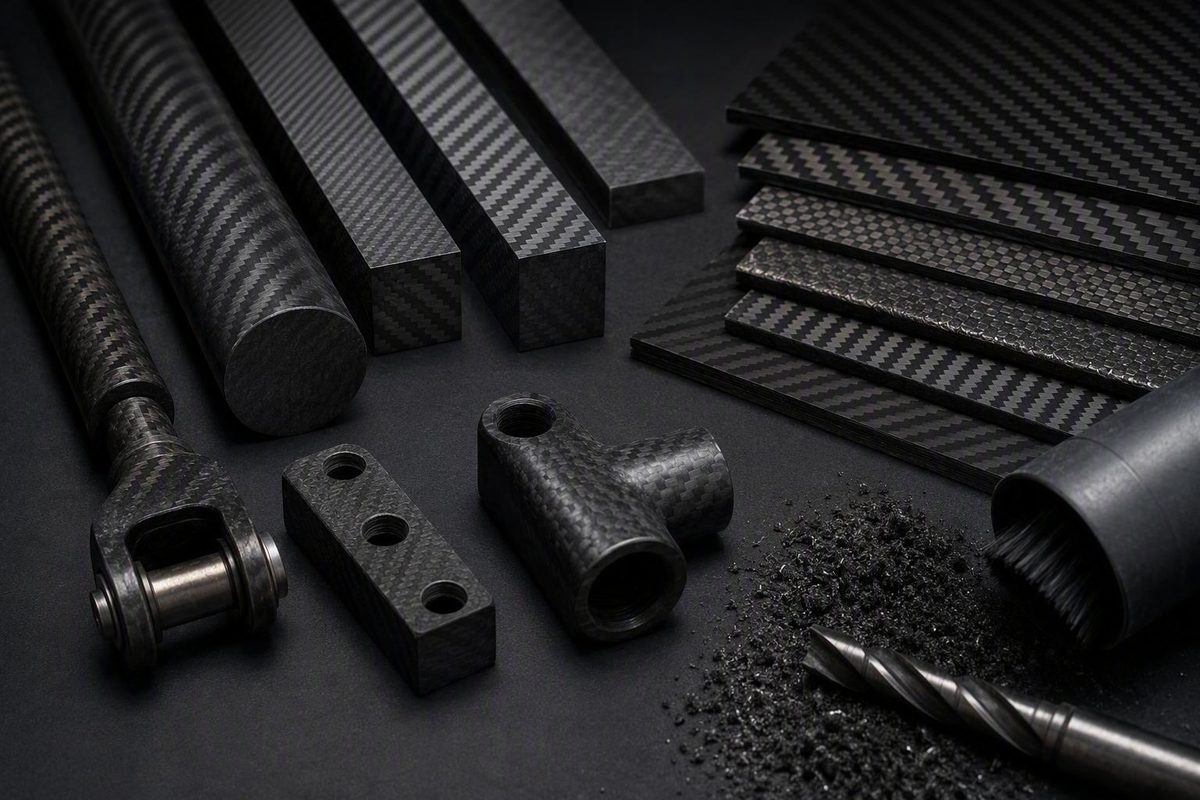
Choose carbon fiber bar stock by the complete load path, not by the largest tensile-strength number in a listing. Start with profile geometry and load direction, then specify fiber architecture, resin system, temperature range, tolerances, joints, machining, documentation, and dust controls. Many readily available solid products in the commercial sample reviewed here are pultruded and predominantly reinforced along their length.
Quick selection guide: match the profile to the load
“Bar stock” is a useful purchasing category, but the profile must suit both the load and the intended connection. A round rod is not automatically suitable for torsion, and a flat strip performs very differently depending on its orientation.
| Profile | Suitable starting point | Main selection issue |
|---|---|---|
| Solid round rod | Axial ties, pushrods, linkages, dowels, and members whose orientation must not depend on a flat face | A unidirectional rod may have strong longitudinal properties but inadequate torsional, transverse, or joint performance |
| Square bar | Guided members, keyed layouts, fixtures, and structures needing flat bonding or clamping faces | Corners, clamps, holes, and pins can create local splitting or bearing loads |
| Rectangular strip | Spar caps, stiffeners, edgewise beams, and compact reinforcement | Bending stiffness changes sharply with orientation; specify which dimension is the section depth |
| Purpose-made flat reinforcement stock | Countertops, cabinetry, stone, millwork, and other installation-specific reinforcement | Require documented spans, supports, adhesive preparation, boundary conditions, and loads |
| Hollow tube | Shafts, booms, beams, and other parts needing a weight-efficient hollow section | Treat it as a separate category with wall-thickness, layup, crush, buckling, and joint requirements |
For primarily axial tension, a longitudinally reinforced pultruded rod or bar is a common starting point. For one-direction bending, the same construction may also be appropriate if the profile is oriented correctly. In either case, verify the exact product rather than transferring properties from a similar-looking bar. Bonded ends, pins, threads, clamps, and other load-introduction details require separate analysis or testing.
For a rectangular section, bending stiffness depends on the selected bending axis. Placing the larger cross-sectional dimension in the depth direction therefore makes the strip much stiffer about its strong axis than about its weak axis. This is a geometric change in rigidity, not an increase in material strength.
Do not select a torsion shaft from longitudinal tensile strength alone. A purely unidirectional rod has little reinforcement positioned to carry off-axis and shear loads. Ask for a wound, braided, or otherwise multi-angle architecture, together with product-specific torsional data. “Multi-angle” does not mean isotropic.
Purpose-made flat reinforcement profiles are available for countertop and millwork applications. Suitability still depends on span, support geometry, adhesive, substrate, installation quality, load distribution, and safety factors.
If the part fundamentally needs a hollow, weight-efficient section, compare carbon-fiber tubes. Calling a tube a “hollow rod” does not make its wall, buckling, crush, or joint behavior comparable to solid carbon fiber bar stock.
What carbon fiber bar stock is—and why fiber direction matters
Carbon-fiber-reinforced polymer, or CFRP, consists of carbon fibers held in a cured resin matrix. The finished profile is a composite, not a solid block of elemental carbon.
In this guide, carbon fiber bar stock covers solid round rods, square bars, rectangular strips, and purpose-made flat profiles. Supplier terminology is inconsistent: the same general form may be called a bar, rod, strip, flat stock, graphite bar, extrusion, or pultrusion. Confirm the actual cross-section and whether it is solid rather than relying on the product title.
Pultrusion recurs throughout readily available stock. In basic unidirectional profiles, this places the fibers along the profile’s length. That arrangement is efficient for longitudinal tension and properly oriented bending, but it should not be treated like metal with approximately equivalent properties in every direction.
The directional difference can be substantial. Easy Composites reports representative tensile strengths of 400–500 MPa lengthwise and 18–30 MPa widthwise for its unidirectional pultrusions. It expressly labels those figures as typical values that must not be used as specifications. The same datasheet lists an 80°C maximum service temperature for that product family, not for carbon fiber bar stock generally. Easy Composites documents the construction, values, and limitations.
A multi-angle or wound rod may place more reinforcement away from the longitudinal axis than a purely unidirectional pultrusion. That can make it a better candidate for torsion or combined loading, but the architecture must be defined. Fiber angles, proportions, winding pattern, surface layers, and any core construction all matter. Labels such as “omnidirectional,” “uniform,” or “isotropic” should not substitute for a laminate description and test data.
Do not transfer a temperature limit, strength value, or machining instruction from one manufacturer’s epoxy pultrusion to an unidentified vinyl-ester, thermoplastic, or wound product.
Available profiles and sizes: a dated market snapshot
The following examples show the range of retail and custom supply; they are not interchangeable grades. Dimensions and commercial terms are supplier-attributed snapshots accessed September 11, 2026. Inventory, prices, discounts, clearance status, minimum quantities, and lead times can change, so confirm them in the final quotation or on the product page.
| Supplier and profile | Cross-section and listed length | Construction or material information | Commercial terms and data limitations |
|---|---|---|---|
| Goodwinds flat and square stock | 14 listed products; widths 0.106–0.787 in., thicknesses 0.020–0.200 in.; generally 48 in. long | Unidirectionally oriented carbon fibers in resin | Retail stock, quantity pricing, and custom-machining inquiries; listed length tolerance ±0.062 in. The page ambiguously applies a “diameter” tolerance to a category containing non-round profiles |
| Chemical Concepts CarbonBar flat reinforcement | 1- or 2-in. widths; 0.2- or 0.4-in. thicknesses; 48- or 94-in. listed lengths | Purpose-made reinforcement stock for countertop, cabinet, stone, and millwork applications | Retail variants and quantity discounts; check installation and structural documents for the exact span, support, substrate, adhesive, and load case |
| Rock West BAR-20B-L39 rectangular strip | 0.039 × 0.787 × 39 in. | Pultruded unidirectional strip; standard-modulus carbon fiber and bisphenol-A epoxy | Cutting and sanding offered under stated conditions; engineering properties are calculations for reference, not guaranteed test results |
| Easy Composites round or square rod | Listed nominal dimensions from 0.5 to 12 mm | 100% unidirectional pultrusion with fibers running lengthwise | Published mechanical values are representative typical values, not minimums, maximums, or specifications |
| Aohong solid round rod | Common-size table from 3 to 50 mm; custom lengths and features advertised | Supplier describes wet filament winding or pultrusion/hot pressing and selectable fiber orientations | Custom manufacturing and RFQ sales; published diameter, length, strength, density, temperature, MOQ, and lead-time statements conflict and require written confirmation |
Goodwinds provides a useful retail comparison because it lists its profiles together, but its property tables use diameter-based classifications even though the category includes flat and square products. Ask which cross-sectional dimension controls the classification, and obtain the applicable drawing and test basis before using its seller-reported minimum properties.
Chemical Concepts lists six combinations across its widths, thicknesses, and lengths. These are application-oriented reinforcement products rather than generic test coupons. Purchasing decisions should follow the supplier’s installation and structural documentation for the actual layout.
Rock West gives unusually specific product identification: model, geometry, fiber, resin, orientation, and length. However, the supplier says its laminate properties and mechanical calculations are based on Classical Lamination Theory, are for reference only, and are not guaranteed. It also says it cannot supply strength-test data for that strip.
Custom manufacturing is a different purchasing route from retail stock. Aohong advertises round rods with stepped diameters, bores, grooves, flats, threads, coatings, polishing, and other secondary features. Its page also contains conflicting figures for key dimensions, properties, temperatures, minimum quantities, and fulfillment. Do not average them or select the most favorable number. Put each requirement in the RFQ and require a written, model-specific response.
How to evaluate specifications without comparing incompatible numbers
Classify every property before putting it into a selection matrix:
- Guaranteed minimum specification: A contractual limit applicable to the ordered product, preferably tied to a named test method, conditioning procedure, inspection plan, and acceptance criteria.
- Named test result: A measured result for an identified specimen, method, orientation, environment, and report. It may describe one sample or lot without guaranteeing future deliveries.
- Typical supplier value: A representative or average figure supplied for guidance, not an acceptance limit.
- Theoretical calculation: A predicted value derived from laminate theory, constituent properties, or another model.
- Unverified marketing claim: A value or superlative without enough information to reproduce, classify, or contract against.
Numbers from different bars are not directly comparable merely because they use the same units. At minimum, align profile geometry, fiber architecture, resin, fiber fraction, manufacturing method, conditioning, loading direction, and test method. A thin unidirectional strip tested along its fibers is not a fair proxy for a wound rod in torsion or a drilled square bar in bearing.
Goodwinds labels certain properties as minimums, but its category page does not identify test standards or conditions. That is stronger wording than “typical,” yet it remains incomplete for structural procurement. Easy Composites explicitly says its representative figures are not specifications. Rock West identifies its engineering figures as theoretical reference calculations and says test or strength data are unavailable for the cited strip.
Aohong illustrates why internally inconsistent supplier data must be resolved in writing. Its page gives conflicting tensile strengths, densities, operating temperatures, diameter ranges, maximum lengths, MOQs, and lead times. None should become a purchase specification until the supplier identifies the exact construction and commits to a value or range on the quotation, drawing, or certificate.
Most importantly, a high longitudinal tensile value establishes only a narrow part of performance. It does not prove torsional capacity, transverse strength, compressive stability, drilled-hole bearing strength, pin-joint durability, impact tolerance, fatigue life, or behavior under combined loads.
For load-bearing purchases, request:
- guaranteed minimum properties and allowable variation;
- the named ASTM, ISO, or equivalent test method;
- specimen geometry, fiber direction, conditioning, and test temperature;
- fiber architecture, fiber grade, and fiber fraction;
- resin identity and cure condition;
- continuous and short-term temperature limits, with their test basis;
- lot or batch traceability and a certificate of conformity;
- inspection records and sample-retention requirements;
- explicit identification of values that are typical, calculated, tested, or guaranteed.
If a supplier cannot provide design-grade information, treat the material as prototype stock until application-specific testing establishes otherwise.
Dimensions, joints, and customization to settle before ordering
A complete drawing or RFQ should specify:
- profile shape and whether it is solid;
- nominal diameter, width, thickness, and cut length;
- cross-sectional, cut-length, straightness, flatness, and twist tolerances;
- edge condition and surface finish;
- fiber architecture and orientation;
- fiber grade and resin system;
- continuous and short-duration service temperatures;
- guaranteed mechanical properties and test methods;
- environmental conditioning, where relevant;
- traceability, inspection documents, and certificates;
- order quantity, sample approval, and delivery date;
- packaging, return restrictions, and nonconformance procedure.
Separate cut-length tolerance from cross-sectional tolerance. If a rectangular-stock page specifies only a “diameter tolerance,” ask the supplier to correct or clarify it on the quotation. Also establish where dimensions are measured, whether a resin-rich surface or finishing allowance is included, and whether tolerances apply before or after sanding.
List every secondary operation: sawing, abrasive cutting, grinding, drilling, counterboring, grooves, flats, coatings, bonded end fittings, or threads. A supplier’s ability to machine a feature does not establish that the resulting part is structurally suitable.
These are precisely the loads that longitudinal tensile data do not characterize. Define edge distances, interference, clamp pressure, hole finish, and inspection criteria through joint-specific analysis and testing.
Supplier-completed machining can be preferable when fits are tight, quantities are large, traceability matters, or modifying the stock would void return or warranty rights. Before issuing the order, settle custom MOQ, tooling and setup charges, first-article approval, inspection method, lead time, responsibility for rejected parts, and ownership or shipment of full-length remnants and scrap.
Cutting and drilling carbon fiber bar stock
Carbon fiber bar stock can be cut and drilled, but it should not be machined as though it were homogeneous metal or ordinary wood. CFRP is abrasive, and poor tooling or support can cause delamination, fraying, uncut fibers, fiber pull-out, cracking, heat damage, rapid tool wear, and dimensional error.
Critical holes and pockets may require in-process measurement because their dimensions can change as the composite relaxes after material removal. CNCCookbook’s machining guide discusses dimensional relaxation, tool wear, heat, delamination, and conductive dust.
| Tooling option | Practical use | Main tradeoff |
|---|---|---|
| Sharp carbide | Prototypes, occasional cuts, or a small number of holes | Low initial cost, but abrasive stock can dull the edge quickly and degrade feature quality |
| Diamond-coated carbide | Repetitive work requiring varied tool geometries | Potentially longer life, but performance depends on coating, geometry, stock construction, and setup |
| PCD | Production drilling or trimming where edge quality, tool life, and resharpening justify the expense | Higher purchase cost; brittle cutting edges require careful handling |
RobbJack reports substantial tool-life gains for diamond-coated and PCD products, but these are commercially interested results rather than universal multipliers. Compare tools by cost per acceptable feature under the actual bar, machine, fixture, and inspection requirements. Its guide also emphasizes that composite constructions differ and positions carbide for limited work, with diamond-coated or PCD tooling for longer runs. RobbJack explains these tooling distinctions, workholding requirements, and common defects.
Fixture the stock rigidly and support it close to the cut. Minimize unsupported overhang, control vibration, and use sharp cutting edges. Inspect both entry and exit sides of holes as well as the full cut surface; an acceptable appearance on one face can conceal breakout or splitting on the other.
Do not copy a universal spindle speed, feed, coolant, or pass strategy from a sheet-machining example. Thin laminates, thick bars, unidirectional pultrusions, wound rods, and different resins do not machine identically. Establish starting parameters with the material and tool suppliers, make test cuts, monitor temperature and tool wear, and adjust against measured edge quality and dimensions.
After machining, inspect for:
- delamination or longitudinal splitting;
- cracks around holes, grooves, or thread roots;
- fuzzy edges, fraying, and uncut fibers;
- fiber pull-out or resin smearing;
- discoloration or other evidence of excess heat;
- bore size, straightness, surface finish, and final fit;
- dimensional change after the part has stabilized.
Control conductive dust before making the first cut
Build source-level extraction or enclosure into the machining setup before work begins. Toray recommends local dust removal, ventilation, particle monitoring, PPE, SDS review, and protection of nearby electrical equipment. Its carbon-fiber handling guidance details these controls.
Carbon fibers and machining dust are electrically conductive and can short or damage machine controls, computers, motors, and other exposed electrical equipment. Isolate or appropriately protect this equipment before cutting.
Review the Safety Data Sheet for the exact bar and resin system. Select goggles, gloves, protective clothing, ventilation, and respiratory protection through the workplace risk assessment and applicable local requirements. Intact cured stock and airborne machining debris are different exposure conditions. Toray describes cured-composite machining debris as nuisance dust while still recommending source capture, ventilation, PPE, monitoring, and electrical protection.
A PubMed-indexed study published in 1989, An evaluation of the toxicity of carbon fiber composites for lung cells in vitro and in vivo, found different responses among selected composite samples in cell and animal models. Three samples showed little toxicity, while two produced stronger responses; all were less toxic in the study than alpha-quartz. The research did not establish human workplace risk or ordinary inhalation dose, and its tested formulations may not represent current bar-stock resin systems. It nevertheless supports precaution rather than a blanket claim that all cured-composite dust is biologically inert. The abstract describes the sample-dependent findings and limitations.
Use cleanup methods that capture debris without re-aerosolizing it, such as an appropriately selected extraction system or a controlled wet-cleaning method compatible with the equipment and product. Protect nearby electronics, contain offcuts and dust, and dispose of waste according to the product SDS and applicable regulations. Toray specifically advises against incinerating carbon-fiber waste.
A sound purchasing sequence is short: define the load and bar orientation; choose the profile; specify fiber architecture, resin, and temperature range; demand correctly classified property data and tolerances; settle joints, machining, inspection, and commercial terms; then install dust controls before cutting. The right purchase is the documented profile that fits the complete load path and shop process—not the listing with the largest tensile number.