
Plain Weave Carbon Fiber Is Stable, but Crimped
Choose plain weave carbon fiber by load direction, drape, fiber grade, areal weight, sizing and process—not by its checkerboard appearance alone.
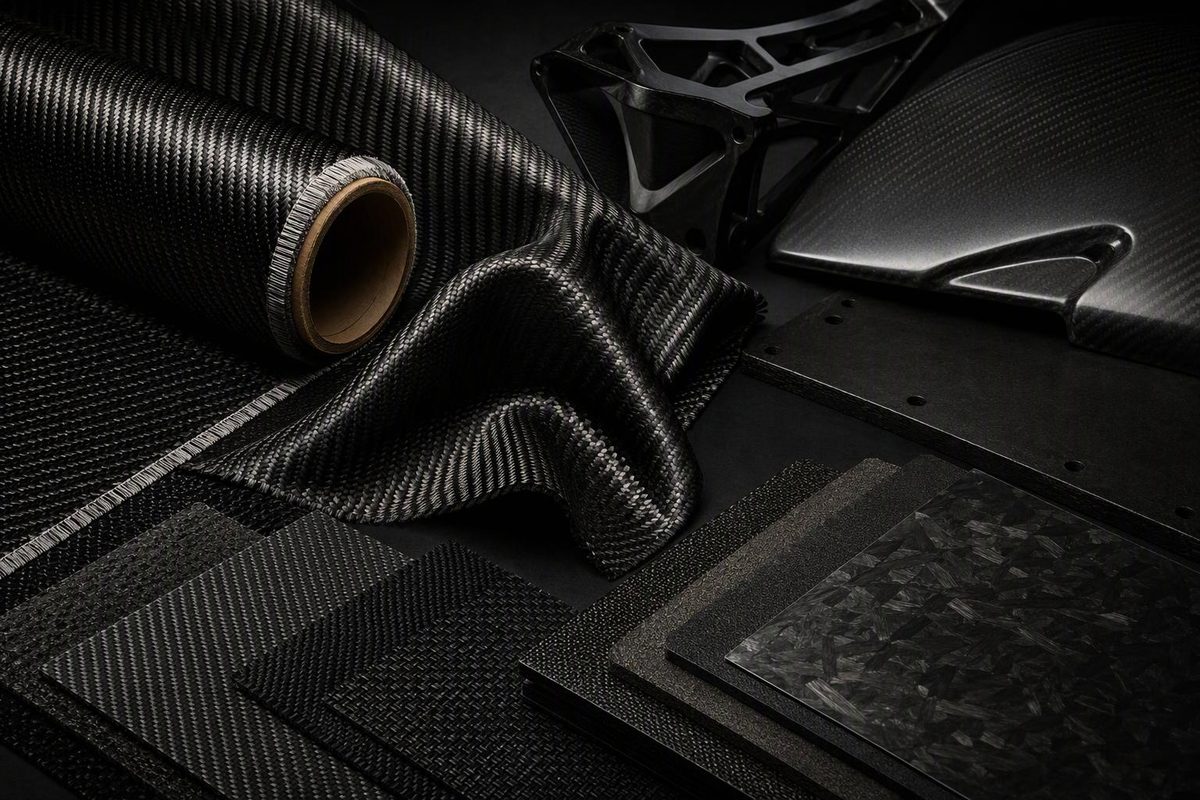
Plain weave carbon fiber is a woven reinforcement in which each warp tow alternates over and under each fill tow. The next tow reverses that sequence, producing a 1×1 checkerboard pattern.
That frequent interlacing makes the dry cloth stable and relatively resistant to unraveling. It also forces every tow into a wavy path called crimp. The practical tradeoff is straightforward: plain weave is easy to control on flat or gently curved tools, but it conforms less readily than twill or satin and keeps fibers less straight than unidirectional reinforcement.
Choose it when handling stability and reinforcement in two perpendicular directions matter more than maximum drape or maximum fiber alignment.
What the weave changes
Plain weave changes the path and handling of the tows; it does not identify the fiber grade, resin, fabric weight or finished laminate properties.
Three effects matter:
- The cloth holds its shape. Frequent crossover points restrain tow movement, so cut pieces are easier to position without the weave opening or skewing. Plain fabrics are generally less pliable and less prone to unraveling than twill or satin fabrics, according to ACP Composites’ woven-fabric guide.
- The cloth resists compound drape. Forming fabric over a mold requires the warp and fill tows to rotate relative to one another. NASA’s textile-composites handbook notes that satin weaves, with fewer crossovers than plain weave, have lower shear rigidity and drape more easily; significant double curvature can distort tow spacing and fiber regularity even in drapable fabrics (NASA CR-4750).
- Crimp costs some axial efficiency. A tow carries an aligned tensile load most efficiently when it is straight. In plain weave it repeatedly bends over and under the perpendicular tows. NASA identifies unavoidable tow waviness as a reason woven composites generally have lower in-plane stiffness than equivalent tape laminates with the same in-plane fiber volume (NASA CR-4750). The size of the penalty depends on the actual architecture, not the weave name alone.
Interlacing can bring handling, damage-tolerance and manufacturing benefits, but it does not make plain weave universally stronger. NASA’s plain-weave micromechanics study describes both those benefits and the architecture-dependent loss of in-plane stiffness and strength (NASA TM-107165).
Plain weave compared with twill and unidirectional reinforcement
| Decision | Plain weave | 2×2 twill | Unidirectional (UD) |
|---|---|---|---|
| Fibers in one layer | Warp and fill, usually 0°/90° | Warp and fill, usually 0°/90° | Predominantly one direction |
| Dry-material stability | High | Moderate | Depends on stitching, binder or backing |
| Compound-curve drape | Limited | Better | Limited across the fiber direction |
| Tow crimp | Frequent | Less frequent | Lowest when kept straight |
| Typical fit | Flat panels, gentle curves and stable cosmetic skins | Contoured shells and visible parts | Efficient reinforcement along a known principal load |
These are architecture tendencies, not guaranteed strength rankings. A 200 g/m² plain fabric and a 200 g/m² twill made from the same fiber can differ in drape and crimp while carrying nearly the same nominal amount of fiber. Hexcel, for example, lists 197 g/m² carbon fabrics in plain, 2×2 twill and 4-harness satin forms, illustrating that areal weight and weave are separate specifications (HexForce reinforcement table). For a more detailed comparison with the diagonal weave, see twill carbon fiber.
“Balanced” does not mean quasi-isotropic
A balanced plain weave has equal reinforcement in its warp and fill directions. Do not infer that balance from the checkerboard appearance: confirm the tow size and thread count in both directions.
Even a balanced 0°/90° layer is not equally stiff in every in-plane direction. It supplies fibers along two perpendicular axes, but it does not supply a dedicated ±45° system for shear or torsion. If the load case requires 0°, 90° and ±45° reinforcement, the laminate schedule must provide those orientations. Rotating a balanced plain-weave ply by 45° places its two tow families at +45° and −45° relative to the part axis.
The correct schedule follows the load path, including fasteners, bonded joints, cutouts and local bending. Matching the visible weave of an existing part is not enough to duplicate its structure.
Specify more than “3K plain weave”
A purchase specification should cover at least:
- Fiber manufacturer and grade. Fiber strength, modulus and strain capability vary by grade.
- Tow count. 3K is a nominal count of 3,000 filaments per tow; it is not a strength or quality grade. See how K-count fits into carbon-fiber tow selection.
- Areal weight, normally in g/m² or oz/yd².
- Warp and fill construction, including tow size, ends or picks per unit length, and whether the fabric is balanced.
- Width and areal-weight tolerances. These affect nesting, ply count and part-to-part consistency.
- Sizing and resin compatibility. Sizing protects the tow, changes handling and affects the fiber–matrix interface.
- Material form. Dry cloth, stabilized fabric and prepreg require different storage, layup and cure controls.
- Traceability and laminate data appropriate to the consequence of failure.
The need to name the fiber grade is not academic. Toray lists T300 at 3,530 MPa tensile strength and 230 GPa tensile modulus, while Hexcel lists AS4 at 4,501 MPa and 231 GPa; both are offered as 3K tow and identified as suitable for weaving (Toray T300 data sheet; Hexcel AS4 data sheet). Similar modulus and filament count do not imply identical strength.
Nor is 3K plain weave synonymous with one fabric weight. Hexcel’s carbon-fabric range includes plain weaves from 84 to 193 g/m² and heavier constructions (HexForce reinforcement table). Use the actual fabric data sheet to set ply count and consolidated thickness.
Layup decisions that preserve the architecture
Mark the warp direction. Keep orientation marks on patterns and kit plies. A balanced fabric may look identical after a 90° rotation, but roll direction can still matter for traceability, nesting and manufacturing consistency.
Dry-drape a representative ply before committing. Check corners, flanges, recesses and changes in curvature. If the fabric bridges, wrinkles or opens visibly, forcing it down with more resin will not correct the fiber architecture. Consider a twill, a lighter fabric, narrower pieces, a designed seam or a different preform. Any splice or dart in a structural region must be engineered because it interrupts fibers.
Treat bias drape carefully. Turning the fabric 45° can make it shear more readily over a shape, but it also rotates both reinforcement directions relative to the loads. Tow spacing and local areal weight can change as the grid deforms.
Control resin and consolidation. The cured material is carbon-fiber-reinforced polymer, not dry cloth. Resin chemistry, fiber volume, voids, cure temperature, pressure and laminate thickness all affect performance. Select the carbon-fiber epoxy for the process and service environment, then follow its mix, cure and post-cure data rather than a generic resin ratio.
Qualify the laminate, not the weave label. For a consequential part, use coupon and component tests representing the actual fiber, resin, layup, cure, geometry and environment. Fiber data-sheet values are not allowable values for a cured plain-weave laminate.
Finally, control cut fibers and cured machining dust. Carbon fiber is electrically conductive, and dust or offcuts can short electrical equipment. Monash University’s safety guidance recommends task-specific controls including extraction or ventilation for dry machining, suitable PPE and HEPA-filtered vacuum equipment designed for conductive dust (carbon-fibre composites safety guidance). Also follow the fabric, resin and process safety data sheets.
Plain weave is a sensible choice for stable bidirectional cloth on flat or mildly contoured parts. It becomes less attractive when the tool needs substantial compound drape or the structure rewards straighter, load-aligned fibers. In either case, select the complete laminate specification—not the checkerboard pattern.