
How to Choose the Right Tow for the Part and Process
A 12K tow may contain standard-, intermediate- or high-modulus fiber. K-count gives filament count. Process fit also depends on grade, sizing and wet-out.
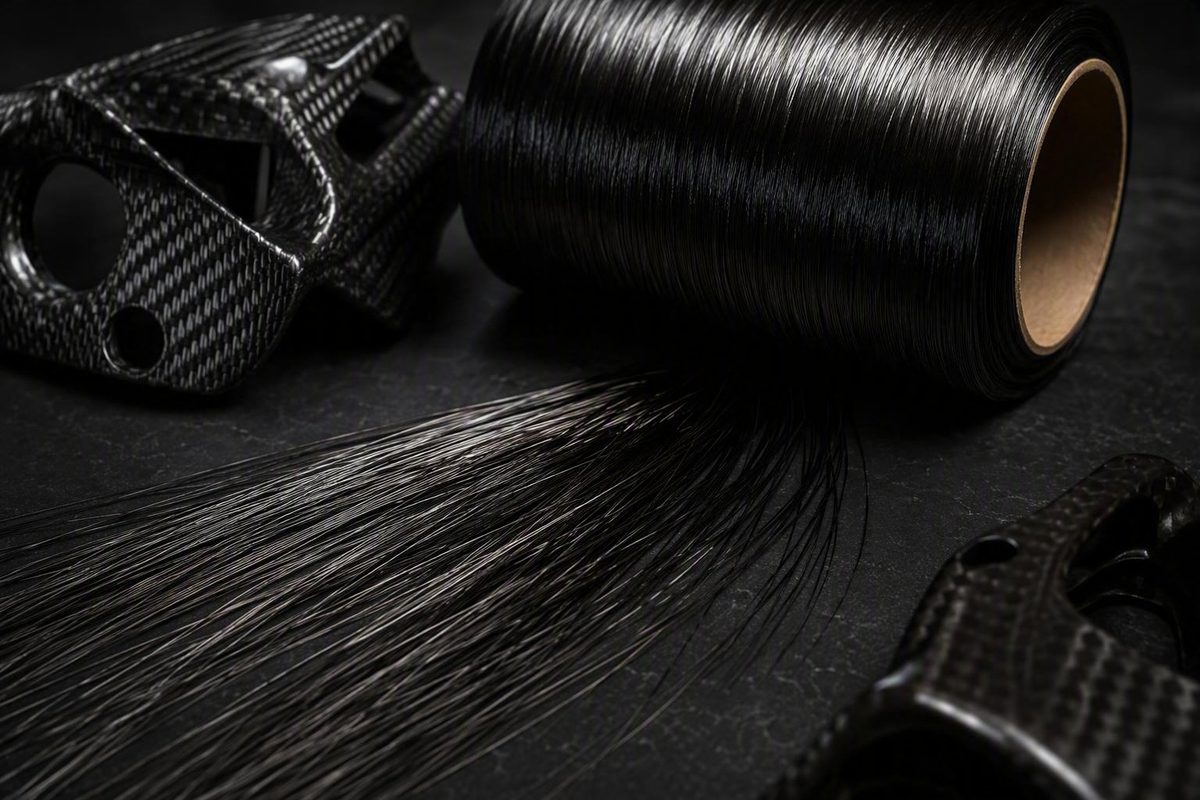
Carbon fiber tow is easy to describe and surprisingly easy to specify badly. A label such as 3K, 12K, or 24K tells you how many filaments are in the bundle. It does not, by itself, identify the fiber’s strength, stiffness, precursor, sizing, resin compatibility, equipment suitability, or qualification status.
A defensible selection starts with the part and manufacturing process. From there, it considers the exact fiber grade, precursor, sizing, linear density, package format, placement rate, impregnation capability, orientation, and supporting documentation. It also distinguishes raw-fiber data from the properties of the cured laminate that will actually carry load.
What carbon fiber tow is—and what it is not
Carbon fiber tow is a bundle of continuous carbon filaments, usually supplied untwisted on a reel or spool. It is an intermediate material: downstream manufacturers may weave it into cloth, spread it into thin tape, braid it, impregnate it as prepreg, pull it through a pultrusion die, or wind it around a mandrel. Mitsubishi Chemical likewise defines tow as bundles of continuous, untwisted filaments and describes it as an input to intermediate materials and carbon-fiber-reinforced plastics (Mitsubishi Chemical’s carbon fiber tow overview).
Dry tow remains flexible. Its filaments can bend, separate, spread, fuzz, and conform around a form. It becomes a rigid composite reinforcement only after it has been impregnated with a suitable matrix resin, consolidated as required, and cured.
That distinction separates tow from several related products:
- Woven cloth has already converted tow into interlaced warp and weft directions.
- Unidirectional tape holds predominantly parallel fibers in a controlled width and areal weight.
- Prepreg contains a pre-applied resin system and has defined storage and cure requirements.
- Chopped fiber consists of discontinuous lengths rather than a continuous bundle.
- Commercial carbon fibers are available in chopped, milled, and continuous forms Carbon Fiber Tow - an overview | ScienceDirect Topics.
- A finished CFRP part is a cured material system containing fiber, matrix, and any other specified constituents.
Terminology varies by reinforcement. Continuous carbon reinforcement is commonly called tow. Aramid reinforcement may instead be called yarn, with yarn size expressed in tex. Commercial listings sometimes use “tow,” “yarn,” and “thread” loosely, so buyers should confirm the actual material form rather than relying on a navigation label.
Tow should not be imagined as a fixed-diameter round thread. An untwisted bundle tends to flatten into a ribbon. Its apparent width and thickness change with tension, spreading, handling, sizing, measurement pressure, and spool winding. Dimensions in a listing can help estimate handling and coverage, but they are not immutable geometry determined by K-count.
In the manufacturing chain, tow sits after precursor conversion, carbonization, surface treatment, and sizing, but before many familiar reinforcement formats. Carbon Reference’s guide to how carbon fiber is made provides first-party context on precursor spinning, oxidation, carbonization, sizing, and weaving.
What 1K, 3K, 6K, 12K, 24K, and 50K mean
The K number is a filament count in thousands:
- 1K = 1,000 filaments
- 3K = 3,000 filaments
- 6K = 6,000 filaments
- 12K = 12,000 filaments
- 24K = 24,000 filaments
- 50K = 50,000 filaments
That is all the K-count directly establishes. It is not a rating of tensile strength, stiffness, quality, precursor type, modulus class, or aerospace qualification. These definitions and the broad processing tendencies below are consistent with published commercial guidance on K grades, but they should not be treated as universal product-performance rankings (K-grade overview).
Broad processing tendencies by K-count
| Tow count | Filaments | Relative placement precision | Relative deposition rate | Likely textile fineness | Impregnation considerations | Commonly associated processes |
|---|---|---|---|---|---|---|
| 1K | 1,000 | Very high | Very low | Very fine | Small bundle, but still requires complete wet-out | Fine weaving, detailed reinforcement, small features |
| 3K | 3,000 | High | Low | Fine | Often manageable for manual placement; verify exact sizing | Weaving, localized reinforcement, small-scale winding |
| 6K | 6,000 | Medium-high | Medium-low | Fine to medium | Balance between placement rate and bundle handling | Weaving, braiding, winding, general reinforcement |
| 12K | 12,000 | Medium | Medium-high | Medium to coarse | More internal filaments must be impregnated uniformly | Unidirectional work, winding, pultrusion, larger textiles |
| 24K | 24,000 | Lower | High | Coarser unless spread | Dense packing can increase sensitivity to wet-out conditions | Pultrusion, winding, industrial reinforcement |
| 50K | 50,000 | Lower | Very high | Generally coarse unless converted or spread | Requires capable spreading, impregnation, tension, and consolidation control | High-rate pultrusion, winding, large industrial sections |
These are selection tendencies, not guarantees. Smaller bundles generally make it easier to form fine textile patterns and place reinforcement around detailed geometry. The tradeoff is that more passes or picks are needed to deposit a given mass. Larger bundles place more fiber per pass and may improve production throughput, but they can be harder to spread, steer, and impregnate uniformly.
A larger tow does not automatically make a finished part heavier. If two layups deposit the same dry fiber mass over the same area, the K label alone does not add mass. What changes is the number of tows or passes needed, along with possible differences in spreading, crimp, gaps, resin content, and processing quality.
Terms such as regular tow, heavy tow, and large tow are not sufficiently consistent for purchasing. Compiled technical excerpts have used boundaries ranging from more than 24K to 50K and above, while the 2023 wetting study discussed later in this guide treated at least 24K as large tow. A ScienceDirect topic aggregation illustrates the variation in terminology. State the actual filament count and exact product grade instead of relying on an undefined category.
The practical rule is simple: choose K-count according to geometry, finish, deposition rate, impregnation capability, and manufacturing process—not because a larger or smaller number sounds superior.
Tow count, fiber grade, and laminate performance are different specifications
A useful way to prevent specification errors is to separate four layers of information:
- Filament count: 3K, 12K, 24K, and so forth.
- Underlying fiber: manufacturer, exact grade, PAN or pitch precursor, filament-level strength, and modulus.
- Tow handling: sizing, linear density, spreading behavior, package format, twist status, fuzz, and winding characteristics.
- Cured laminate: resin, orientation, fiber volume fraction, voids, consolidation, cure, specimen geometry, and test method.
The first layer cannot substitute for the other three.
Modulus is not K-count
Tensile modulus describes stiffness: how strongly the fiber resists elastic strain under tensile load. Broad conventions place standard-modulus carbon fiber near 230 GPa, intermediate modulus around 290–300 GPa, and high modulus at approximately 350 GPa or above. Definitions of ultra-high modulus vary, with published conventions using thresholds from about 400 GPa to more than 600 GPa. These are descriptive bands, not universal grade boundaries (commercial summary of modulus classes).
A 12K tow can contain standard-, intermediate-, high-, or another modulus class of fiber. A 3K and a 12K product can also have similar modulus.
A simple specification matrix
| Product | K-count | Fiber grade | Fiber modulus | Sizing | What K-count predicts |
|---|---|---|---|---|---|
| A | 12K | Standard-modulus Grade X | Standard | Epoxy-oriented | Bundle contains 12,000 filaments |
| B | 12K | Intermediate-modulus Grade Y | Intermediate | Proprietary | Bundle contains 12,000 filaments |
| C | 3K | Standard-modulus Grade Z | Similar to Product A | General-purpose | Bundle contains 3,000 filaments |
| D | 24K | Standard-modulus Grade X | Similar to Product A | Vinyl-ester-oriented | Bundle contains 24,000 filaments |
Products A and B show that equal K-counts can contain materially different fibers. Products A, C, and D show that different K-counts can have similar fiber modulus. The K-count answers only the bundle-size question.
Manufacturer product families make this distinction concrete. Mitsubishi Chemical publishes PAN- and pitch-based lines spanning several filament counts. Its listed typical tensile moduli range from approximately 234 GPa to 935 GPa, while listed tensile strengths vary separately rather than rising with K-count. The manufacturer explicitly identifies these table entries as typical rather than guaranteed values (Mitsubishi Chemical’s grade tables).
PAN and pitch answer different material objectives
More than 90% of commercial carbon fiber is reported to use PAN precursor. PAN-based fibers are widely used for structural reinforcement, while pitch-based grades can provide exceptionally high modulus and greater thermal and electrical conductivity. Pitch fiber is not automatically stronger in tension or better for a structural part; precursor selection should follow the required balance of tensile and compression behavior, stiffness, thermal function, processability, and cost.
Fiber data are not laminate allowables
A manufacturer’s tow table generally describes fiber-level properties under identified test conditions. It does not state the guaranteed tensile strength of a hand-wet laminate, pultruded bar, wound tube, or woven skin.
Cured performance also depends on:
- fiber orientation and waviness;
- matrix chemistry and cure state;
- fiber volume fraction;
- bundle impregnation;
- consolidation pressure;
- void content and defects;
- surface preparation and interfaces;
- laminate sequence and thickness;
- specimen geometry;
- conditioning and test method.
Aligned unidirectional fibers contribute most strongly along their axis. Woven reinforcement distributes fiber into at least two principal textile directions, but it introduces crimp and does not become equally strong in every direction.
Before comparing numbers from different sellers, align the exact grade, units, sizing state, test standard, conditioning, and whether the result refers to a filament, tow, resin, or cured laminate. Without that alignment, a neat comparison table can be more misleading than useful.
Match the tow to the manufacturing process
Tow selection is partly a materials decision and partly a machine-and-tooling decision. The same fiber can be convenient in one process and troublesome in another.
| Process | What generally favors the process | Main control requirements | Typical selection concern |
|---|---|---|---|
| Weaving | Small to medium tow for fine patterns; larger tow for faster coverage | Tow stability, tension, abrasion, sizing, broken filaments | Balance textile fineness against loom productivity |
| Filament winding | Continuous packages and efficient deposition | Tension, bandwidth, alignment, wet-out, winding path, cure | Match bundle size to resin delivery and winding speed |
| Pultrusion | Continuous tow and steady high-rate feed | Creel tension, resin impregnation, alignment, die consolidation, cure | Avoid dry bundles and uneven fiber distribution |
| Braiding | Stable tow that tolerates carrier motion | Package compatibility, abrasion, tension, steering | Prevent fuzz, breakage, and pattern distortion |
| Localized reinforcement | Tow that can follow a joint or load path | Orientation, wet-out, termination, consolidation | Do not equate wrap count with validated capacity |
| Tube or vessel wrapping | Continuous tow with suitable deposition width | Winding angle, tension, impregnation, overlap, cure | Structural schedules require engineering and testing |
| Unidirectional members | Straight, aligned fibers and controlled fiber content | Alignment, wet-out, compaction, void control | Strong directional bias; transverse needs remain |
Weaving and detailed placement
Smaller tow is commonly associated with finer weave patterns, tighter visual scale, and more precise placement around small features. It also takes more picks or passes to deposit the same quantity of fiber. Larger tow can increase coverage per pass but may produce a coarser textile or require deliberate spreading.
Sizing and loom compatibility matter as much as count. A nominally fine tow that fuzzes or abrades in the actual guides may be a worse production choice than a slightly larger, more stable product.
Filament winding and pultrusion
Both processes benefit from continuous reinforcement and repeatable packages. Larger tow can increase deposition rate, but only if the equipment can control tension, alignment, impregnation, consolidation, and cure at that throughput.
A vendor’s application list establishes that a product is marketed for winding or pultrusion. It does not prove that the product will run at a particular line speed, achieve a specified void target, or satisfy the structural requirements of a part.
Local wrapping and reinforcement
Tow can be placed along an intended load path, wrapped around a joint, or used to build a narrow unidirectional feature. Its flexibility is valuable where broad fabric would add unwanted material or resist conformance.
The fibers must still be oriented, wetted, consolidated, terminated, and cured properly. There is no universal conversion from “number of wraps” to joint strength, burst capacity, or crush resistance.
Unidirectional members
Parallel tow is efficient when a part needs reinforcement primarily in one direction. It is also highly directional. A bundle aligned with an axial load does little to solve an unsupported transverse, shear, impact, bearing, or splitting requirement. A woven layer distributes reinforcement across multiple directions, but that architecture carries its own tradeoffs.
A 2017 forum discussion inferred that tow had been passed through resin before being wound around a form. It illustrates a possible wet-winding workflow, but it provides no confirmed process specification, winding tension, cure schedule, laminate thickness, or structural test results (Talk Composites discussion).
A separate forum thread describes manually wetting aligned tow in an epoxy-filled mold and vacuum-bagging it into a plank. That account is likewise anecdotal and does not establish validated material allowables, void limits, cure conditions, or component capacity (Boat Design Net discussion).
A sound decision path is:
- Identify load directions and geometry.
- Select the conversion process.
- Define placement precision and production-rate needs.
- Confirm that the process can impregnate and consolidate the bundle.
- Shortlist K-counts, exact grades, and package formats.
- Validate the resulting laminate rather than the dry tow alone.
Sizing, resin compatibility, and the large-tow wet-out problem
Sizing is a thin coating applied to carbon fiber. Depending on the product, it can protect fragile filaments, reduce handling damage, improve processability, and support adhesion to an intended matrix.
Sizing is not the structural matrix. A spool described as “epoxy-sized” is still dry tow unless it is explicitly sold as prepreg or another pre-impregnated format. It must receive the required matrix resin and cure before it becomes a rigid composite.
Compatibility is product-specific
Supplier recommendations vary by product. For example, Fibre Glast recommends epoxy or vinyl ester for its listed 24K tow when the fiber properties are important, while describing polyester more narrowly for cosmetic use. That guidance applies to the identified product and should not be generalized to every tow or sizing (Fibre Glast’s 24K product listing).
Before ordering, request or verify the supplier-specific information relevant to the product:
- exact sizing code or sizing family;
- intended matrix chemistry;
- current technical data sheet;
- whether desizing or pretreatment is required;
- resin viscosity and intended impregnation method;
- cure and post-cure requirements;
- applicable storage controls;
- any stated shelf life or retest interval.
Not every dry tow will have a defined desizing procedure, shelf life, or retest requirement. These are questions to ask, not assumptions to make. Do not infer resin compatibility merely from the word carbon.
Wet-out occurs at two scales
At the filament surface, resin must contact and interact with the treated, sized carbon. At the bundle scale, resin must also flow through the spaces among hundreds or thousands of filaments.
Those are related but distinct problems. A resin can appear to coat the outside of a tow while leaving dry filaments or voids inside. Dense packing makes this concern more acute in large tow, particularly when viscosity, residence time, spreading, pressure, or tension is poorly matched to the deposition rate.
A 2023 Composites Part B: Engineering study examined epoxy wetting of large-tow carbon fiber at both single-fiber and bundle scales. Under its specific materials and tension conditions, the authors reported a 144.7% increase in infiltration-rate constant and a 16.4% increase in composite tensile strength after tension-driven optimization (peer-reviewed large-tow wettability study).
Those percentages are not universal process gains. The available preview does not provide complete sample sizes, absolute tensile values, uncertainty, or all process details. The findings show that bundle architecture and tension can matter; they do not provide a recipe for every tow, sizing, resin, or winding line.
Variables to evaluate during representative trials include:
- tow tension and alignment;
- degree of spreading;
- resin viscosity at processing temperature;
- impregnation time or line speed;
- resin-bath or delivery geometry;
- consolidation method;
- cure control;
- internal dry spots, porosity, and void content.
A supplier’s statement that a tow “wets out easily” is useful product guidance. It is not independent proof that a particular resin, tool, temperature, and deposition speed will produce a void-free laminate.
Estimate tow length, mass, and project quantity
Tow is commonly sold by:
- reel length, such as meters or yards;
- spool mass, such as kilograms or pounds;
- yield or linear density, meaning length per unit mass or mass per unit length.
The core relationship is:
Tow length = Tow mass ÷ Mass per unit length
Units must be consistent. If mass is in grams and linear density is in grams per meter, the result is in meters.
Product-specific example
One listed 3K product has a linear density of 200 mg/m. For that exact product:
1\,kg = 1,000,000\,mg
Length = 1,000,000\,mg ÷ 200\,mg/m = 5,000\,m
One kilogram would therefore contain approximately 5,000 meters. The retailer also describes the material as a flat, variable ribbon rather than a fixed circular thread (Easy Composites’ 3K tow specification).
This is not a universal conversion for 3K tow. Linear density can differ with the exact fiber and product. Always use the documented yield or linear density for the spool being purchased.
If a supplier gives yield directly—such as meters per kilogram or feet per pound—multiply package mass by that yield after checking the units. Do not transfer yield from 3K to 6K, 12K, or even another manufacturer’s 3K product without documentation.
Winding and reinforcement paths
For winding or local reinforcement:
- Estimate the centerline length of one pass.
- Account for the actual helix, overlap, return path, and changing diameter.
- Multiply by the number of passes.
- Add a stated allowance for leader lengths, setup, trimming, breakage, trials, and process waste.
There is no universal waste percentage. A manual prototype, automated winder, and pultrusion line will have different losses.
Weaving
Weaving quantity depends on fabric dimensions, ends and picks per unit width, tow count, crimp, selvedges, edge waste, loom setup, and trial length. A retailer’s area estimate may illustrate a calculation, but it should not be treated as universal because textile architecture changes the required tow length.
Why width and thickness are weak quantity measures
Tow spreads and compacts. Two operators can measure different ribbon widths from the same spool under different tension. Length and mass are therefore better purchasing and inventory measures than apparent dry width or thickness.
Estimating resin demand
Resin demand should be calculated from dry fiber mass, constituent densities, and the target cured fiber volume fraction. Account separately for resin retained in hoses or pots, tool losses, bleed, trimming, and trial material.
A universal resin-to-tow ratio would ignore the differences among hand wet layup, vacuum bagging, winding, pultrusion, and infusion. It could also conceal an excessively resin-rich or poorly impregnated laminate.
When comparing suppliers, normalize quotations using consistent bases:
- cost per unit mass or length;
- exact manufacturer and grade;
- sizing and package format;
- spool size;
- currency and quotation date;
- tax, freight, duties, and documentation fees.
Headline spool price alone is rarely a fair comparison.
How to read a carbon fiber tow listing without being misled
A useful listing should identify the material, package, and evidence behind each property. Before buying, request or verify the following.
Material and mechanical specification
- [ ] K-count and filament count
- [ ] Manufacturer
- [ ] Exact grade designation
- [ ] PAN- or pitch-based precursor
- [ ] Tensile strength
- [ ] Tensile modulus
- [ ] Elongation at failure
- [ ] Filament diameter
- [ ] Fiber density
- [ ] Linear density or yield
- [ ] Twist or untwisted status
- [ ] Sizing code and sizing amount, where available
- [ ] Intended or tested matrix compatibility
Package and handling specification
- [ ] Net tow mass or usable length
- [ ] Spool and core dimensions
- [ ] Winding format and unwind direction
- [ ] Package identification
- [ ] Supplier-stated storage controls, if any
- [ ] Supplier-stated shelf life or retest information, if applicable
- [ ] Applicable import or export restrictions
- [ ] Current stock and lead time
These are supplier-specific fields to request. Their absence does not prove that a universal storage limit, shelf life, or retest interval applies.
Documentation
- [ ] Current technical data sheet
- [ ] Safety data sheet
- [ ] Test standards and conditioning
- [ ] Lot or batch identity
- [ ] Certificate of analysis, if required
- [ ] Traceability to the manufacturer and production lot
- [ ] Identification of typical versus guaranteed values
- [ ] Supplier change-control or equivalency information, if available
Some sellers offer batch-specific certificates of analysis and lot traceability, sometimes as a paid option. One Rocket-Fibers listing, for example, advertises an optional batch-specific certificate while leaving some 24K technical fields blank. The same listing pairs a calculated 6K diameter of 0.593 mm with 0.233 inches, values that do not convert consistently. Both details are reasons to request documentation tied to the exact product rather than silently correcting or filling in the listing (Rocket-Fibers’ tow listing).
Grade tables are not qualification records
A manufacturer table is useful for identifying grades and typical fiber properties. A retailer category such as “industrial” or “aerospace” is a sales classification unless it is backed by the specification, lot records, approved source, process controls, and qualification documents required for the application.
Likewise, a manufacturer’s quality-management certification does not automatically qualify every spool for every aircraft application. Qualification belongs to a defined material, source, process, specification revision, and application—not to a label in isolation.
Data-quality warning signs
Pause and request clarification when a listing contains:
- no test method or conditioning;
- mixed fiber and laminate properties;
- inconsistent units;
- missing sizing information;
- blank fields for one product variant;
- ambiguous mapping between spool size and tow grade;
- copied labels that contradict the row;
- implausible outliers.
For example, an ACP listing captured industrial 6K and 12K tensile values of 60 ksi and 6 ksi, while nearby entries were hundreds of ksi. Those figures are dramatically inconsistent and may be transcription errors; they should be flagged rather than used in a comparison (ACP Composites’ carbon fiber tow listing).
Prices, availability, pack formats, export controls, taxes, and lead times can change. Verify them when ordering. More importantly, do not rank products from unrelated listings as though they were independently tested head-to-head; the available evidence does not align exact grades, test standards, sizing, or processing conditions sufficiently for that conclusion.
A practical selection workflow—and where engineering validation begins
The following workflow turns a broad search for “carbon fiber tow” into a traceable purchasing decision.
1. Define the load path and service need
Identify where reinforcement is needed and in which directions. Separate tensile stiffness, tensile strength, compression, shear, impact, fatigue, thermal, electrical, and dimensional objectives. Do not use a high fiber tensile number as a substitute for a complete service requirement.
2. Choose the manufacturing process
Decide whether the tow will be woven, braided, wound, pultruded, manually placed, spread into a unidirectional layer, or converted by another process. This defines package, handling, tension, and impregnation needs.
3. Set placement precision and finish requirements
Small features, tight textile patterns, and controlled cosmetic scale may favor small tow. Large sections or hidden reinforcement may tolerate a coarser bundle. Specify whether surface appearance is functional, cosmetic, or irrelevant.
4. Determine an acceptable deposition rate
Calculate how much fiber must be placed per pass and how many carriers, spools, or passes the process can support. A smaller tow can offer precision but impose labor or cycle-time costs. A larger tow can increase throughput only if the downstream process keeps pace.
5. Assess impregnation and consolidation capability
Evaluate how resin reaches both the outside and center of the bundle. Consider viscosity, spreading, residence time, tension, tooling, pressure, bleed, cure, and inspection. If the process cannot wet and consolidate a shortlisted tow consistently, its attractive price or deposition rate is irrelevant.
6. Compare exact grades and sizing
Compare manufacturer and grade—not merely K-count. Align fiber modulus, tensile strength, elongation, precursor, linear density, filament diameter, sizing, intended matrix, package, and test method.
7. Verify documentation and test the laminate
Obtain current data sheets and lot identity. Establish appropriate incoming checks, run representative process trials, and test the actual laminate or component configuration. Record deviations rather than assuming the dry-fiber table predicts the finished result.
Three bounded examples
Fine woven or cosmetic work: A 1K or 3K tow may support a finer textile scale and detailed placement. It will usually require more picks or passes than a larger tow, and its actual appearance will still depend on weaving, spreading, resin, consolidation, and finish.
Large wound or pultruded sections: A 12K, 24K, or larger tow may improve deposition rate. That advantage is conditional on controlled tension, alignment, bundle impregnation, consolidation, and cure.
Local unidirectional reinforcement: Tow can follow an intended load direction with minimal off-axis material. The reinforcement must be terminated and integrated into the surrounding laminate, and the actual assembly must be validated. Dry tow count or wrap count does not establish capacity.
Final decision table
| Question to ask | Specification or evidence that answers it | Failure mode if ignored |
|---|---|---|
| Where must the part carry load? | Load cases, orientation, laminate design | Fibers placed in an ineffective direction |
| How precisely must fiber be placed? | Geometry, minimum radius, textile scale, K-count | Bridging, gaps, distortion, poor finish |
| How fast must material be deposited? | Linear density, tow count, line or placement rate | Excessive cycle time or overloaded process |
| Can the bundle be impregnated? | Sizing, resin viscosity, wet-out trials, section inspection | Dry fiber, voids, weak interfaces |
| Is the fiber stiff or strong enough? | Exact grade and aligned test data | Wrong property class despite correct K-count |
| Does the package fit the equipment? | Spool dimensions, winding, unwind direction, mass | Tension variation, stoppages, fiber damage |
| Is the material traceable? | Lot ID, certificate, current data sheet | Uncontrolled substitutions or unexplained variation |
| Does the cured part meet the need? | Representative laminate and component tests | Reliance on irrelevant raw-fiber values |
This article provides introductory selection and fabrication guidance; it does not establish structural qualification. Pressure-containing parts, primary structures, and safety-critical repairs should be treated as outside the scope of general supplier data and workshop anecdotes. They call for application-specific engineering, controlled materials and processes, current documentation, inspection, and testing appropriate to the consequences of failure.
For every prototype or production trial, retain the tow manufacturer, grade, lot, sizing, package identification, resin and hardener lots, mix ratio, fiber mass, process conditions, cure record, inspection findings, and test results. Those records make troubleshooting, controlled substitution, and repeat production possible.
Frequently asked questions
Is 12K carbon fiber tow stronger than 3K tow?
Not necessarily. 12K means that the tow contains approximately 12,000 filaments, while 3K means approximately 3,000. The numbers identify bundle size, not tensile strength or modulus.
A 12K product could use a stronger, weaker, stiffer, or more compliant fiber grade than a 3K product. Even when the underlying fibers are similar, finished-laminate performance depends on fiber quantity and orientation, resin, fiber volume fraction, wet-out, void content, consolidation, cure, and test method. Compare exact grades and cured-laminate evidence rather than K-count alone.
Can carbon fiber tow be used without resin?
Dry tow can be handled, woven, braided, stitched, temporarily wrapped, or used as feedstock for another conversion process without already containing resin. It does not become a rigid composite reinforcement until it is combined with a suitable matrix and cured. A dry bundle by itself should not be treated as a finished structural laminate.
Which resin is compatible with carbon fiber tow?
Compatibility depends on the exact sizing and fiber product. Suppliers commonly identify epoxy or vinyl ester for particular tows, and some also list polyester. That does not establish universal compatibility or equal performance.
Check the sizing code, technical data sheet, intended matrix, processing temperature, viscosity, cure schedule, and required laminate properties. When the interface is consequential, verify compatibility through representative processing and testing rather than relying only on a generic seller statement.
Why can large-tow carbon fiber be harder to wet out?
Large tow contains many densely packed filaments. Resin must not only coat the outside of the bundle but also travel through its internal capillary spaces. If the bundle remains tightly packed—or if viscosity, residence time, spreading, tension, and consolidation are poorly controlled—the outside can look wet while the interior retains dry areas or voids.
This is a process tendency, not proof that every large tow wets poorly. Sizing, spreading, resin chemistry, temperature, equipment, tension, and deposition rate can substantially change the outcome.
How many meters of carbon fiber tow are in one kilogram?
Use the exact product’s linear density:
Meters per kilogram = 1,000,000 mg ÷ mg per meter
For a tow specified at 200 mg/m, one kilogram contains approximately 5,000 m (product-specific linear-density example). Another 3K product may have a different linear density. Higher K-count products often provide less length per unit mass when filament diameter and density are broadly similar, but that tendency is not a purchasing conversion rule. The exact product yield or linear-density value is authoritative.
The selection rule
Start with the part and process, not the K number. Choose a filament count that supports the required placement rate and finish, an exact fiber grade that addresses the property objective, a documented sizing intended for the chosen resin, and a bundle that the available process can impregnate and consolidate.
Treat supplier figures as inputs to verification—not finished-part guarantees. For consequential laminates, use current documentation, controlled processing, inspection, and application-specific testing.