
Carbon Felt Is Not Just Soft Carbon-Fiber Insulation
Choose carbon felt by precursor, heat treatment, atmosphere, density, purity, resistivity and surface state—not temperature rating alone.
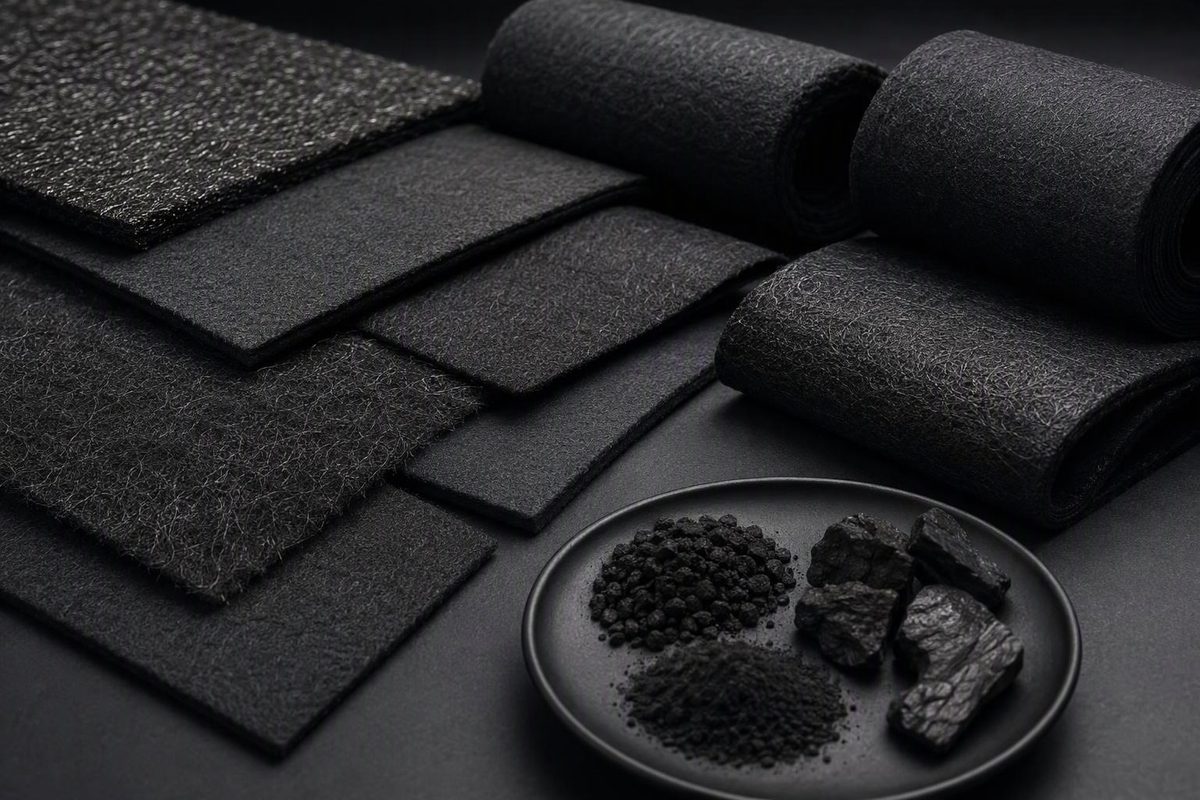
Carbon felt is a porous, nonwoven network of carbon fibers. Unlike woven carbon cloth, its fibers form a compressible mat rather than continuous warp and weft yarns. The resulting material has high void volume, low bulk density and electrical conductivity, but little of the directional structural performance associated with a conventional carbon-fiber laminate.
The name covers materially different products. Furnace insulation, a flow-battery electrode and activated adsorption felt may all be sold as “carbon felt,” yet they are not interchangeable.
Carbon felt versus graphite felt
The practical distinction is the final heat treatment:
- Carbon felt has been carbonized.
- Graphite felt receives a higher-temperature treatment that increases graphitic ordering and commonly increases purity and conductivity.
There is no universal purchase-grade temperature dividing the two names. One PAN-felt datasheet describes carbon and graphite grades pre-fired at 1,200°C and 2,200°C, with typical carbon contents of at least 97% and 99.9%, respectively (Graphite Insulation technical data). Mersen describes its carbon felt as processed at a minimum of 1,400°C and its graphite felt above 2,200°C (Mersen).
“Graphite” is therefore useful shorthand, not a complete specification. Compare final heat-treatment temperature, carbon content, ash or total impurities, electrical resistivity and thermal data for the actual grade.
Also distinguish both materials from:
- Oxidized PAN felt: stabilized PAN precursor that has not yet been carbonized
- Activated carbon felt: felt given a highly porous surface for adsorption; one commercial range specifies 950–1,500 m²/g depending on grade (activated-carbon-felt datasheet)
- Rigid carbon insulation: fibers bonded into a self-supporting board, cylinder or other shape
- Carbon-fiber fabric: organized continuous yarns intended to reinforce a laminate
Battery suppliers may also call a modest surface treatment “activation.” That does not necessarily create the very high surface area of adsorption-grade activated carbon felt.
PAN and rayon felts
PAN and rayon are common precursors for high-temperature carbon felts.
PAN felt is relatively stiff and broadly available. In NASA’s comparison of felt substrates for conformal heat shields, PAN products were available across a wider range of density and thickness and had characteristically higher strength and tensile modulus. Their intrinsic fiber thermal conductivity was also higher (NASA).
Rayon felt is softer and can provide lower thermal conductivity at high temperature. NASA kept rayon under consideration for its favorable heat-shield thermal behavior, although it noted supply-continuity concerns. One supplier recommends rayon instead of PAN above 1,800°C when thermal conductivity is the deciding property (CeraMaterials). That threshold is a recommendation for the supplier’s products, not a universal material boundary.
Precursor alone does not settle the choice. Density, fiber orientation, thickness, heat treatment, atmosphere and temperature all affect performance. Compare measurements made under conditions resembling the intended process.
Why felt can insulate despite conductive fibers
Carbon fibers can conduct heat, particularly along their length. Felt remains useful as insulation because it is mostly void space and its loose fiber network interrupts solid conduction paths. NASA specifically attributes low through-thickness thermal transport in its felt-based system to the lack of rigid fiber connectivity.
Three consequences follow:
- Density and compression matter. Compression reduces thickness and pore volume while changing fiber contact.
- Direction matters. In-plane and through-thickness heat transfer need not be equal.
- Temperature and atmosphere matter. Mersen’s data for one rayon soft felt rise from 0.21 W/m·K at 800°C to 0.80 W/m·K at 2,000°C (Mersen furnace-insulation guide). A room-temperature value cannot describe furnace performance.
Flexible felt can wrap curved hot-zone surfaces and be layered to build thickness. Rigid carbon insulation is more suitable when the insulation must be self-supporting, machined accurately or resist handling and gas flow.
Atmosphere sets the useful temperature
A claim such as “rated to 3,000°C” normally applies in vacuum or a compatible inert atmosphere—not in air. CeraMaterials states 3,000°C for its felt in vacuum or inert gas but only 400°C in oxidizing service. In a separate study of PAN carbon fibers exposed for one hour, tensile properties changed little through 300°C in oxygen, deteriorated progressively at higher temperatures and could not be measured after treatment at 600°C (heat-treatment study).
Those figures are not a universal service-life curve. Oxidation depends on time, oxygen concentration, gas velocity, contaminants, fiber grade and any protective treatment. Furnace specifications should state normal and upset atmospheres; air leaks, water vapor and reactive process gases may govern life more than the headline temperature rating.
Carbon felt as a battery electrode
In a redox-flow battery, felt forms a three-dimensional conductive network through which electrolyte can flow. Relevant properties include:
- in-plane and through-plane electrical resistance
- open porosity, permeability and thickness
- area weight and fiber orientation
- wettability and electrochemical activity
- chemical purity and compatibility
- resilience at the cell’s specified compression
A 2019 SGL datasheet lists open porosity above 90% for several PAN- and rayon-based battery felts and reports different resistivity values by direction. Its area-specific resistance is measured at 80% of initial thickness, showing why resistance data without a compression condition are incomplete (SGL Carbon battery-felt datasheet).
Compression can improve electrical contact while restricting liquid flow. In one vanadium-flow-cell study, contact resistance fell from about 2.0 to 1.2 Ω·cm² across the tested compression range. Its reconstructed-felt model associated a 60% increase in compression with a 44.5% pressure-drop increase (UCL study). The correct compression is therefore a cell-level tradeoff among contact resistance, pumping loss, mass transport and sealing—not a universal percentage.
Untreated felt is not automatically an optimized electrode. Thermal, chemical, plasma and catalyst treatments can alter wettability, surface chemistry and reaction kinetics. One study obtained its best result among tested air treatments at 500°C for two hours, while more severe treatments caused increasing oxidation loss (2024 treatment study). That recipe is specific to the studied PAN felt, electrolyte and cell. Supplier-controlled activation or a validated in-house process is safer than copying one literature condition directly.
Felt is a scaffold, not structural cloth
Carbon felt can be resin-infiltrated to make ablative material or a carbon–carbon preform. NASA used needled PAN- and rayon-based felts as porous scaffolds for phenolic impregnation in conformal thermal-protection materials. The loose network accommodated strain and limited through-thickness thermal transport; felt density and through-thickness interlocking also affected resin loading and resistance to delamination during processing.
These properties do not make dry felt a substitute for woven or unidirectional reinforcement. A part carrying a defined tension, bending or torsion load needs continuous fiber paths and qualified laminate properties. See carbon fiber tow selection for variables hidden by filament count and how carbon fiber is made for the precursor-to-fiber process.
What to put on a purchase specification
| Requirement | What to request |
|---|---|
| Material identity | PAN, rayon or other precursor; carbon or graphite grade |
| Form | Soft, rigidized, adsorption-activated or electrode-treated felt |
| Geometry | Nominal and compressed thickness, width, length and tolerances |
| Mass structure | Bulk density, area weight, porosity and fiber orientation |
| Thermal duty | Conductivity versus temperature, test atmosphere and direction |
| Environment | Continuous and peak temperature in the actual gas or vacuum condition |
| Cleanliness | Carbon content, ash or total impurities, sulfur and purification route |
| Electrical duty | In-plane and through-plane resistivity at stated compression and temperature |
| Fluid duty | Permeability or pressure drop at relevant compression and fluid conditions |
| Surface | Virgin, thermally activated, chemically treated, coated or sized |
| Quality | Lot traceability, inspection data and allowed thickness/density variation |
Published examples illustrate the range, not design allowables: one PAN insulation family lists 0.13–0.14 g/cm³, while the cited SGL electrode family spans 0.08–0.10 g/cm³. Use controlled data for the purchased grade.
Cutting and handling
Support soft felt while cutting and avoid stretching it out of shape. Determine whether exposed edges can shed fibers into the assembly, and vacuum loose debris rather than dispersing it with compressed air.
Fibers and dust can mechanically irritate skin, eyes and the respiratory tract. Carbon debris is also electrically conductive and can cause short circuits or equipment malfunctions. One carbon-felt safety data sheet calls for ventilation, eye and skin protection, respiratory protection when exposure limits may be exceeded, and protection of nearby electrical equipment from airborne fibers (Graphite Sales SDS). Consult the current SDS for the exact product, particularly if it contains sizing, binders, coatings or process contamination.
The reliable selection rule is to specify the felt by what it must do in its assembled, compressed and exposed state. The words carbon, graphite and high temperature do not establish suitability by themselves.