
A Pressure Pot Improves Resin Castings—Not Every Carbon-Fiber Layup
Choose a pressure pot for resin by working pressure, mold clearance and cure time. Learn why pressure casting is not vacuum bagging or autoclave curing.
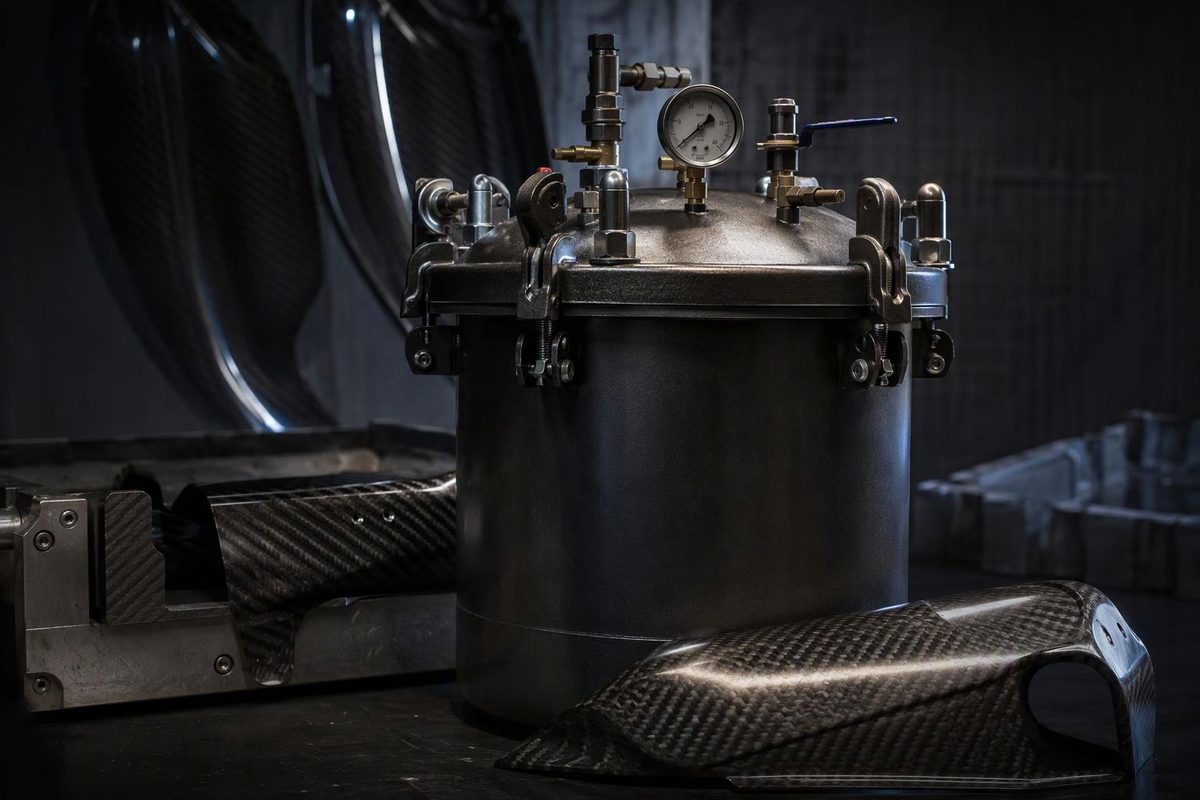
A pressure pot for resin is a compressed-air vessel used to hold a poured casting under pressure while it cures. It reduces the size of trapped bubbles; it does not extract air the way vacuum degassing does. It is most useful for small clear or rigid castings where visible bubbles spoil the result. Smooth-On’s equipment guidance makes that distinction explicitly.
For a carbon-fiber shop, the first question is therefore not which pot to buy, but which problem needs solving. A resin casting and a fabric-reinforced laminate require different process controls. A casting pot is not a substitute for vacuum bagging, resin infusion or a temperature-controlled autoclave.
Pressure casting, vacuum degassing and laminate consolidation
These processes use pressure differently:
| Process | What it does | Appropriate starting point |
|---|---|---|
| Pressure casting | Shrinks bubbles in resin after it has been poured into a mold | Small resin castings with visible internal or surface bubbles |
| Vacuum degassing | Removes trapped air from mixed liquid before pouring | Mold-making silicone or resin whose working time permits degassing |
| Vacuum bagging | Applies a pressure difference across a bag to consolidate a laminate | Fabric layups requiring controlled compaction |
| Vacuum infusion | Evacuates a bagged dry reinforcement, then draws resin through it | Carbon-fiber parts designed around an infusion process |
The first two distinctions come from Smooth-On. Airtech explains vacuum-bag consolidation, while Easy Composites’ infusion guide describes evacuating dry reinforcement, introducing resin and maintaining vacuum through cure.
In a pressure pot, the entire casting assembly sits inside the vessel. Pressure compresses trapped gas and can drive it into solution. Releasing pressure while the resin is still too soft can allow bubbles to reappear. Smooth-On recommends holding pressure through the material’s specified cure or handling-strength time—not simply until its surface looks firm. See its pressure-hold guidance.
For carbon-fiber laminates, consolidation depends on pressure difference, not chamber pressure alone. Airtech describes atmospheric pressure acting across a vacuum bag, with greater external pressure available inside an autoclave. Simply placing an unbagged wet layup in a casting pot does not reproduce that arrangement or provide the elevated-temperature cure required by many prepregs. Airtech’s process explanation covers both requirements.
Nor should pressure casting be treated as a remedy for dry reinforcement, incorrect mix ratio, misplaced plies or an unsuitable cure schedule. Start with the epoxy and process requirements for carbon fiber, rather than assuming bubble control establishes structural quality.
How much pressure should you use?
Use the resin manufacturer’s pressure recommendation within the vessel’s permitted operating limits. If those requirements conflict, choose different equipment or material; do not raise the pressure beyond the equipment instructions.
Smooth-On describes 60 psi—approximately 4.1 bar gauge pressure—for its illustrated casting process. That is a product/process example, not a universal setting for every epoxy, polyurethane or mold. Its pressure-casting guidance identifies the materials and procedure.
Also distinguish a vessel’s maximum pressure from its working pressure. As of October 2026, California Air Tools lists the 255C casting pot at 80 psi maximum and 60 psi operating pressure. Its linked manual explicitly warns not to use more than 60 psi in the tank. The higher headline figure is not permission to operate there. Product specifications and owner’s manual.
What to check before buying
- Usable dimensions, not just gallons. Measure the complete mold, support tray and any projecting features. Check both the opening and clearance beneath the fitted lid. As a sizing example, the 255C lists an internal width of 9¼ inches and depth of 10 inches with the lid applied. Manufacturer specifications.
- A documented casting application. Prefer a commercial vessel intended for resin casting, with a manual, regulator, readable gauge, relief valve and supported replacement parts. Do not assume a cooking pressure cooker or vacuum chamber is suitable for compressed-air service. Smooth-On specifically warns against homemade pressure chambers because of violent explosion risk. Pressure-casting safety guidance.
- Pressure retention and compressor compatibility. The pot must retain the required pressure throughout the hold period. Smooth-On recommends a chamber that can hold pressure with its valves closed rather than requiring the compressor to remain on. Follow the selected pot’s inlet-pressure, hose and air-quality requirements. Hold-time guidance and 255C manual.
- Commercial-use suitability. Check applicable pressure-vessel rules for your location and workplace. The 255C, for example, is identified as non-ASME, and its manufacturer directs commercial users to state and city codes. Product listing.
Plan the mold and cure before mixing
A pressure pot can expose defects in the mold itself. Bubbles inside cured rubber can collapse under pressure and create raised defects or dimples in the casting. Smooth-On recommends making regularly used pressure-casting rubber molds under pressure too; it also warns that hollow master models can collapse. Confirm the mold-making method before committing valuable tooling. Mold guidance. Our epoxy mold selection guide addresses the broader tooling choice.
Prepare the vessel, mold and air supply before mixing so loading and pressurizing fit within the resin’s working time. Follow the resin’s specified hold time at the actual cure temperature; handling strength and full cure are not interchangeable. See resin cure-time definitions. For urethane resins and rubbers, Smooth-On specifically requires dry compressed air: moisture can cause bubbles or foaming. Air-quality guidance.
Pressure does not make an excessive pour safe. Epoxy cure generates heat, and a larger or thicker contained mass can overheat, damage containers or ignite nearby combustible material. Respect the chosen resin’s batch-size and pour-depth limits, and do not improvise a heated cure inside an ordinary casting pot. WEST SYSTEM’s uncontrolled-cure guidance explains the mass-and-heat relationship.
Finally, use the resin’s specified protective equipment and ventilation, and follow the vessel manual for closure, pressurization and venting. Isolate the air supply and fully release tank pressure before loosening any lid clamps. The 255C manual requires that sequence. A better-looking casting is not evidence that a carbon-fiber component has met its structural requirements.