
What Absorbed Water Does to Carbon-Fiber Composites
Water mainly affects the resin and fiber interface, not carbon filaments. See how moisture content, layup, heat, and exposure alter performance.
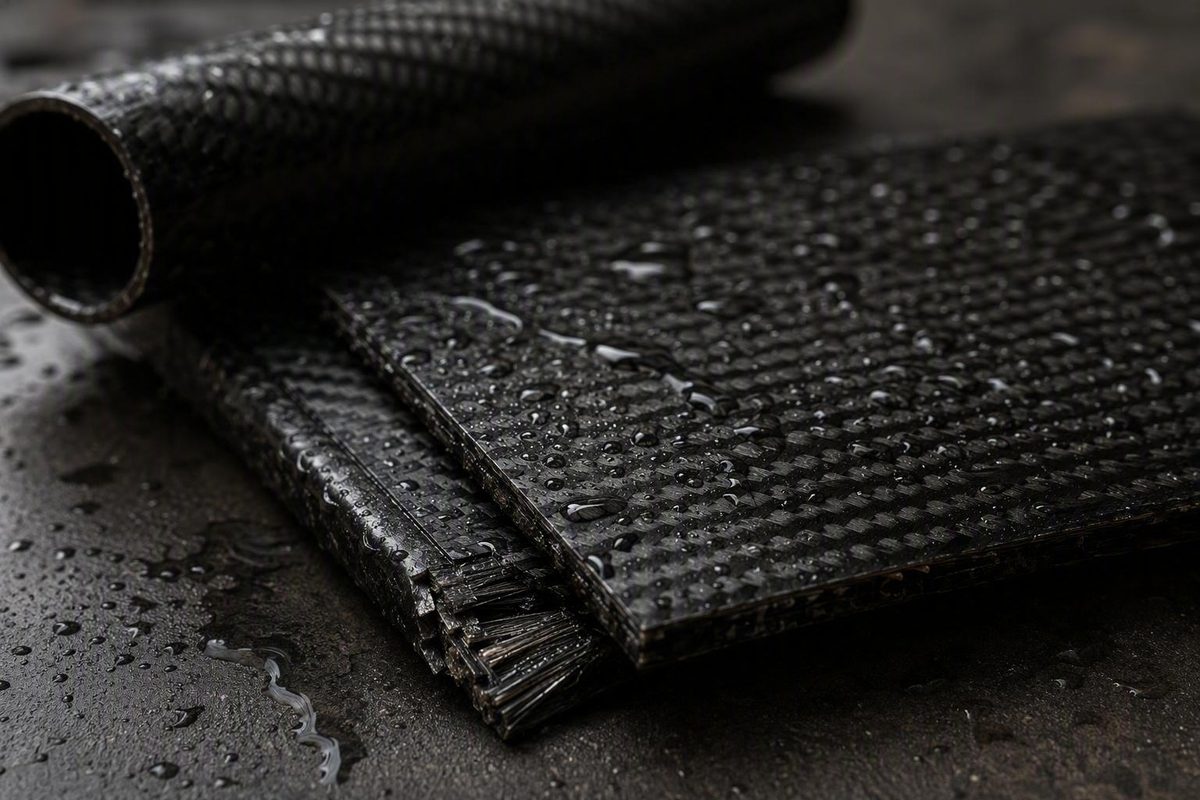
Moisture can weaken a cured carbon-fiber composite, but it does not substantially weaken the carbon filaments themselves. Absorbed water primarily plasticizes the polymer matrix and damages fiber–matrix interfaces. In the tested aerospace carbon/epoxy laminates, final moisture content—not the particular temperature or humidity used to reach it—best predicted the loss of compressive performance (primary study).
A brief rain shower is not equivalent to moisture saturation. The outcome depends on how much water enters, the resin, layup, manufacturing quality, exposure duration and temperature, and whether the part is loaded while hot or wet. No universal saturation time or safe moisture percentage is available for all carbon-fiber parts.
Select the environment, construction, resin, and part role to identify the relevant exposure paths and next actions.
This is a triage tool, not a strength calculator. The studies do not provide enough material data to calculate a universal saturation date or remaining-strength percentage.
Indoor storage, a mixed continuous-fiber layup, epoxy, and a cosmetic role do not establish damaging moisture uptake. Keep coatings and edges intact and investigate any known prolonged wetting.
Estimated saturation timeline: — Not calculable from environment and resin labels alone. Diffusivity, thickness, exposed geometry, temperature, coating condition, and initial moisture content are required.
- Inspect coating chips, cut edges, holes, and penetrations.
- Do not treat a dry-looking surface as a measurement of internal moisture.
- Use manufacturer limits before applying heat to dry the part.
| Selection | Moisture Path | Evidence-Based Concern | Response |
|---|---|---|---|
| Garage | Ambient humidity; occasional wet storage | No universal uptake rate is available | Preserve coatings and dry storage |
| Bathroom | Repeated humidity and condensation | Vapor can diffuse into polymer over time | Check edges, penetrations, and trapped moisture |
| Outdoor | Rain, wet–dry cycles, temperature, UV | Coating damage can increase access | Inspect barriers and weathered surfaces |
| Marine | Salt spray, immersion, crevices | Moisture plus galvanic risk at susceptible metals | Clean salts; inspect isolation, seals, and drainage |
| Mixed layup | Multiple fiber directions | Best strength retention among three tested layups | Do not generalize beyond the tested epoxy system |
| 0/90 layup | Faces, edges, ply boundaries | Response remains load- and sequence-dependent | Check the actual stacking sequence and load direction |
| ±45 layup | Matrix-mediated shear paths | Pronounced modulus loss in the aerospace tests | Escalate concerns involving axial load or compression |
| Printed composite | Bead boundaries, voids, interlayers | More interfaces increased diffusivity in the cited polyamide study | Use print-specific conditioning and property data |
| Epoxy | Diffusion through matrix and defects | 2026 study found 13% Tg reduction after ageing | Use the qualified epoxy system’s limits |
| Polyamide | Matrix and printed interfaces | Cited printed specimens showed permanent interface degradation after drying | Follow material drying and conditioning requirements |
| Other resin | System-dependent | No quantitative figure is supplied here | Obtain resin-specific absorption and retained-property data |
| Safety-critical | Any credible moisture path | Appearance cannot establish residual strength | Use manufacturer criteria or qualified engineering review |
Interpretation: “Routine,” “investigate,” and “engineering review” are triage categories, not measured damage levels or service limits.
Sources: Composites Part A (2026), DOI 10.1016/j.compositesa.2026.109665; cited additively manufactured short-carbon-fiber/polyamide study, PII S1359835X24005268.
The full matrix and default assessment remain visible without JavaScript.
The Resin And Interfaces Are What Moisture Weakens
“Carbon fiber” commonly describes a finished part, but the material is normally a carbon-fiber-reinforced polymer, or CFRP. Carbon filaments provide directional reinforcement. Cured resin holds those fibers in position, transfers loads among them, supports them under compression, and protects the internal structure.
The fiber–matrix interface is equally important. Strong filaments cannot carry a designed load if a weakened interface cannot transfer that load into and between them. Ply boundaries, resin-rich areas, voids, adhesive joints, coatings, machined edges, holes, and inserts create additional regions where moisture transport or damage may differ from the bulk laminate.
Understanding Carbon Fiber Is Made in Five Stages helps separate the reinforcement from the finished composite. The relevant material questions are not merely whether a part contains carbon fiber, but which resin it uses, how it was cured or printed, how the fibers are oriented, and where water can enter.
Common matrices include epoxy, polyamide, polyester, vinyl ester, and polyurethane. They do not absorb or respond to water identically. Resin-to-hardener accuracy, degree of cure, porosity, consolidation, fiber sizing, coating integrity, and edge sealing also affect environmental durability (resin-selection guide).
This prevents direct numerical comparison among an aerospace prepreg laminate, a filament-wound tube, a vinyl-ester marine panel, and a printed short-carbon-fiber nylon bracket. Their polymer chemistry, fiber length, interfaces, pore structure, and load paths are different.
Absorbed Water Plasticizes The Matrix
Moisture-related degradation begins when water diffuses into the polymer rather than when droplets first touch the surface. Once absorbed, water can plasticize the matrix, reducing its resistance to deformation without visibly dissolving or cracking it.
Glass-transition temperature, or Tg, is one indicator of that change. In the 2026 aerospace study, dynamic mechanical analysis showed a 13% reduction in Tg after ageing. X-ray computed tomography and scanning electron microscopy also identified void growth, microcracking, and deterioration at fiber–matrix interfaces.
These changes can reduce the matrix’s ability to transfer loads, support fibers under compression, and resist shear. Cracks may connect through resin-rich or interfacial regions, while debonding and delamination may become easier. Damage can therefore alter both the amount of load a part carries and its eventual failure mode.
Strength and modulus do not necessarily decline together. Modulus measures resistance to elastic deformation in a specified direction and loading mode. Strength describes the stress or load at failure. The aerospace tests found that strength sometimes fell more sharply than modulus.
Some plasticization may be reversible when moisture is removed. Microcracks, delamination, chemical degradation, and damaged interfaces are not repaired merely by drying. A dry surface also does not prove that the interior has returned to its original moisture state.
Moisture Content And Temperature Play Different Roles
The aerospace study tested [0/90]8s, [45/−45]8s, and [0/90/45/−45]4s carbon-fiber/epoxy laminates. Specimens were conditioned at 60°C or 80°C and 90% or 100% relative humidity.
For those laminates, final absorbed moisture content governed the measured compressive strength and modulus degradation. Specimens that reached comparable moisture contents responded similarly even when the conditioning routes differed. A Monash University report summarizes the finding as total moisture uptake being more predictive than the precise ageing temperature or humidity.
That does not make heat or humidity irrelevant. The variables have separate roles:
| Variable | Practical Meaning | Effect In The Study |
|---|---|---|
| Absorbed moisture | Water present inside the material | Best predictor of degradation |
| Conditioning heat | Temperature during exposure | Accelerated moisture uptake |
| Test temperature | Temperature while loaded | Magnified matrix softening |
Humidity supplies water at the material boundary. Temperature affects how quickly that water moves into the laminate. Temperature during loading then affects how the moisture-conditioned matrix responds, particularly when absorbed water has lowered Tg.
The finding is specific to the tested aerospace epoxies and compression tests. It does not establish that final moisture content is the only relevant variable in every polymer, adhesive, printed composite, or long-term exposure. Hydrolysis, swelling mismatch, manufacturing defects, cyclic loading, and irreversible interface damage may make the route and duration of exposure important in other systems.
The Largest Reported Losses Require Their Test Conditions
The aged aerospace specimens lost up to 35% of compressive strength when tested at 80°C. This was the maximum reported loss across particular aerospace-grade laminates, layups, conditioning regimes, and elevated-temperature compression tests. It is not a general reduction to apply to a wet bicycle frame, car panel, drone arm, or tool.
The study also reported more than 90% compressive-strength loss when aged specimens were tested at 200°C. The reported dry Tg was 185°C, so this test was conducted above that transition temperature. The result combines moisture ageing with extreme hot testing; it is not the expected consequence of rain or room-temperature immersion.
| Test Condition | Reported Result | Essential Limitation |
|---|---|---|
| Aged and tested at 80°C | Up to 35% strength loss | Aerospace epoxy compression tests |
| Aged and tested at 200°C | More than 90% loss | Test exceeded 185°C Tg |
| Moisture ageing | 13% Tg reduction | Tested material system only |
| Multiple hot tests | Modulus fell gradually | Does not cover every property |
The tests do not establish retained tensile, flexural, fatigue, impact, or shear performance for unrelated components. Nor do they provide field acceptance limits, replacement thresholds, or a universal moisture derating factor.
A glossy surface cannot settle the issue. Internal moisture, interface deterioration, void growth, and microcracking may exist below an intact coating. A Materials Performance summary likewise notes that subsurface degradation complicates condition assessment.
Mixed Layups Performed Better Than Pure Angle Plies
Composite response is directional. Fibers carry loads most efficiently along their axes, while transverse and shear behavior depends more heavily on the resin and interfaces. Moisture damage therefore matters most when the critical load path relies strongly on matrix shear or interlaminar transfer.
A [0/90] laminate places fibers along two principal directions. A [45/−45] laminate under axial loading depends substantially on in-plane shear and matrix-mediated load transfer between angled fibers. Plasticization can consequently produce a pronounced change in its global modulus.
Among the tested designs, the mixed [0/90/45/−45]4s laminate retained more strength. The pure [45/−45]8s laminate showed pronounced modulus loss associated with its reliance on matrix shear stiffness. This ranking applies to those designs and tests, not to every possible stacking sequence.
Ply percentages, sequence, thickness, free edges, loading direction, impact history, and failure criterion can all change the result. A mixed layup is not automatically safe, and a ±45° ply is not inherently defective. The finding shows why layup must be included when assessing moisture exposure rather than treating every carbon/epoxy panel alike.
Manufacturing architecture also changes transport. A consolidated continuous-fiber laminate does not have the same pathways as a printed composite containing bead boundaries, short fibers, interlayer interfaces, and print-induced voids.
A separate study of additively manufactured short-carbon-fiber-reinforced polyamide found that moisture diffusivity increased with the number of interlayer interfaces. Printed specimens degraded more than injection-molded specimens. Under that study’s conditions, yield stress and tensile modulus decreased by up to 59% and 79%, while shear modulus fell by up to 63% in printed polyamide and 74% in printed short-fiber-reinforced polyamide (printed-polyamide study).
Those percentages cannot be ranked directly against the aerospace study’s 35% compression loss. The studies used different resins, reinforcement lengths, processes, architectures, conditioning methods, and mechanical tests. Their shared lesson is that environmental performance belongs to the complete composite system, not the carbon reinforcement alone.
Surface Wetting Is Not Moisture Saturation
Brief rain or washing usually produces surface wetting, particularly when an intact coating limits access. Prolonged humidity allows slower vapor diffusion. Immersion maintains liquid contact at faces, cut edges, holes, bondlines, and defects. Hot-and-humid exposure accelerates uptake and is closer to the conditioning used in the aerospace tests.
No defensible saturation timeline can be calculated merely from labels such as “outdoor,” “marine,” or “epoxy.” A useful calculation would require at least the material’s measured diffusivity and saturation uptake, laminate thickness, exposed geometry, temperature, boundary condition, coating condition, and initial moisture content. The available evidence supplies no universal values for those inputs.
Outdoor service adds wet–dry cycling, temperature swings, and possible UV damage to the coating. Marine service adds salt contamination, persistent spray or immersion, crevices, and contact with metal hardware. Carbon composites do not rust like steel, but conductive carbon reinforcement can participate in a galvanic couple when it is electrically connected to a susceptible metal in a wet electrolyte.
Electrical isolation, compatible hardware, sealed interfaces, drainage, and salt removal can reduce assembly-level risks. Cleaning away salt does not demonstrate that a laminate has retained its structural properties.
Open sandwich edges, drilled holes, cracked coatings, damaged adhesive joints, impact sites, porous printed regions, and trapped water deserve more attention than an intact exterior face. Repeated exposure also differs from a single event because absorption and drying can impose dimensional changes while existing defects provide continuing transport paths.
Drying Does Not Necessarily Restore The Part
Removing absorbed water may reverse some matrix plasticization, but it cannot reconnect a debonded interface or close structural cracks. In the printed short-fiber polyamide study, tensile and shear moduli did not recover after drying; the authors attributed this to permanent interface degradation. That result applies to the tested printed polyamides and should not be generalized to every cured epoxy laminate.
An improvised high-temperature bake can create additional problems. A drying procedure must account for the actual resin, adhesive, coating, core, geometry, allowable temperature, and moisture escape path. The evidence does not provide a universal drying temperature or duration.
For a meaningfully exposed part:
- Identify the resin, reinforcement architecture, process, coating, repair history, and manufacturer limits.
- Record the liquid, humidity, temperature, exposure duration, cycling, and whether the part was loaded.
- Examine cut edges, holes, inserts, bondlines, impact sites, coating breaks, drainage paths, and adjacent metals.
- Remove compatible surface contamination without treating cleaning as proof of structural recovery.
- Use a validated manufacturer or engineering drying procedure rather than adding unqualified heat.
- Apply the governing inspection and return-to-service criteria for that component.
Visual inspection can reveal blistering, cracks, exposed edges, delamination, distortion, coating damage, or corrosion around hardware. It cannot quantify absorbed moisture or residual strength. A superficial stain also does not prove structural damage.
For flight hardware, pressure structures, primary vehicle parts, lifting equipment, or highly loaded sporting components, substantial immersion, unusual heat, repeated cycling, or trapped water warrants manufacturer guidance or qualified engineering assessment. Depending on the component, evaluation may involve exposure records, dimensional checks, moisture measurement, nondestructive examination, and structural analysis.
The available studies provide no universal moisture threshold, inspection interval, drying schedule, repair limit, or replacement criterion. Those values must come from qualification data for the actual material and part.
Practical Answers For Common Exposures
Rain Usually Means Surface Wetting, Not Immediate Strength Loss
A short rain event should not be assigned the aerospace study’s elevated-temperature compression losses. An intact, coated part may absorb little water during brief contact. Damaged coatings, open edges, trapped water, heat, porosity, and repeated exposure increase concern.
Bare Carbon Filaments Are Largely Moisture-Resistant
The available evidence identifies the polymer matrix, interfaces, voids, and cracks as the principal sites of moisture-related degradation. Carbon filaments may carry sizing or surface treatments relevant to bonding, but ordinary water does not produce the same demonstrated weakening mechanism in the carbon itself.
Heat Accelerates Uptake And Can Worsen Hot Performance
Higher conditioning temperature accelerated moisture absorption in the aerospace study. Elevated temperature during loading also softened the conditioned matrix, especially after moisture reduced Tg. Conditioning temperature and mechanical test temperature must therefore be considered separately.
Hidden Damage Is Possible
Moisture and interface damage can develop beneath an intact-looking surface. Surface inspection remains useful for finding access paths and obvious defects, but it cannot establish internal moisture content or retained mechanical properties.
The defensible verdict is specific: absorbed water can weaken a cured carbon-fiber composite by changing its resin and interfaces, while the carbon filaments remain largely unaffected. Total uptake controlled degradation in the tested aerospace epoxies, and layup changed the response. Applying that evidence to a real part requires its material system, architecture, exposure history, temperature, and structural role—not a generic percentage for anything sold as carbon fiber.