
How to Inspect Carbon Fiber Prepreg Before Layup
Check carbon-fiber prepreg identity, exposure history, visible defects and handling behavior, then choose the tests needed for material acceptance.
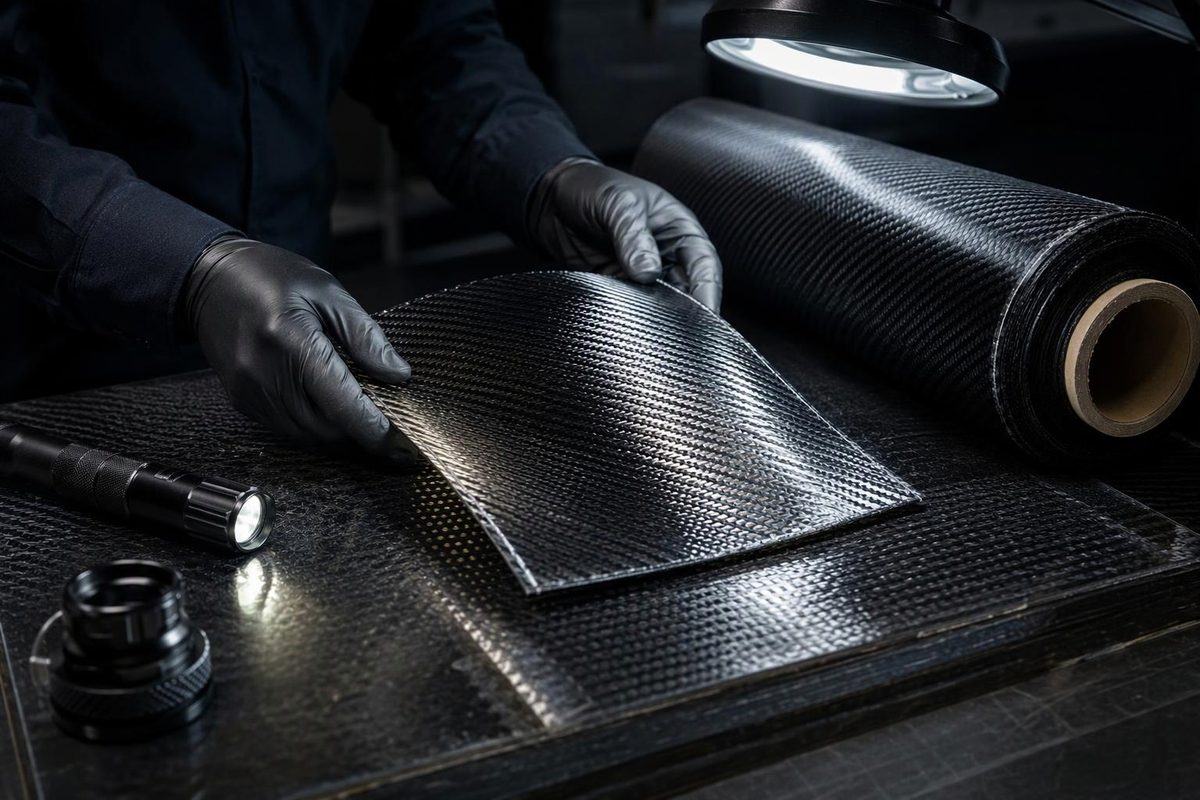
Inspect carbon-fiber prepreg in three layers: verify its identity and exposure history, examine the uncured material, and complete the acceptance tests required by its specification. A roll that looks clean and feels tacky has not, by those observations alone, demonstrated correct resin content or cure behavior.
This checklist concerns uncured carbon-fiber/epoxy prepreg—not thermoplastic prepreg or inspection of a finished laminate.
1. Establish what “acceptable” means
Before opening the roll, identify the governing material specification, purchase requirements and current product datasheet. Those documents should determine defect limits, sampling, test methods and acceptance values. Do not turn another prepreg’s limits into a universal shop standard.
For example, NCAMP’s March 2025 NMS 765 specification for Park Aerospace E765 prepregs treats visual requirements, uncured-material tests and cured test-panel properties separately. Its requirements also differ between unidirectional tape and woven material. It is a useful model for an inspection plan, but its numerical limits belong to the materials it covers.
At receiving, check:
- Identity: manufacturer, full material designation, resin system, fiber grade and reinforcement form.
- Traceability: batch and roll numbers, manufacture date and matching certification/test reports.
- Quantity and dimensions: ordered width, length or net weight, including the treatment of selvages and marked defective areas.
- Exposure history: shipping records, storage conditions and accumulated out-time—including any distributor cutting or repackaging.
- Remaining life: labeled storage expiry and the exposure allowance remaining under the actual product’s requirements.
- Packaging: moisture-proof bag integrity, roll/core damage and supplied defect or splice logs.
NMS 765 explicitly requires receiving verification of identity, quantity, test data, certification and shipment temperature exposure. It also requires distributors to document out-time accumulated during warming, re-spooling and repackaging. A newly packaged small roll therefore does not necessarily have a fresh exposure allowance. Source: NMS 765, sections 3.6.3 and 4.5.
Hold material with unresolved identity or exposure records out of production. Looking at it cannot reconstruct its temperature history.
2. Open it without creating an inspection defect
Allow cold prepreg to reach room temperature while still sealed before opening the moisture-proof bag. Hexcel specifies this precaution to prevent condensation in its M77 user guide. Follow the conditioning instructions for the actual product rather than assuming every roll needs the same thawing time.
Support the roll through its core, use a clean inspection surface, and follow the product safety data sheet for gloves and other handling precautions. Keep protective backing in place except where examination or sampling requires removal.
Record inspection exposure. Storage life, tack life and out-life are different. In Hexcel’s terminology, storage life applies to continuous storage in a sealed moisture-proof bag at the specified freezer temperature; tack life describes useful adhesion for layup; out-life is the maximum accumulated room-temperature time allowed before cure. Returning a roll to the freezer does not make accumulated out-time disappear. Source: Hexcel’s prepreg technology guide. Follow the actual specification’s definitions and exposure limits, including separate handling and staging limits where applicable.
3. Examine the material as it is unrolled
Check the exposed material, edges and backing-release behavior. Continue inspection during cutting: examining the beginning of a roll does not establish the condition of every subsequent meter.
| Check | What to flag for assessment |
|---|---|
| Fiber continuity | Cut or broken fibers, missing tows, gaps, loose tows or crossovers |
| Fiber direction | Local waviness or misalignment in UD tape; distorted warp/weft alignment in woven prepreg |
| Flatness | Wrinkles, folds, puckers or folded selvages extending into usable material |
| Resin distribution | Unexpected resin-rich patches, unwetted regions, hard resin particles or unusually stiff areas |
| Cleanliness and moisture | Foreign material, visible moisture or contamination |
| Backing and edges | Resin lifting with the backing, tearing, fiber movement, damaged edges or width outside tolerance |
These categories reflect the visual and handling requirements in NMS 765, sections 3.4 and 3.6. They are inspection prompts, not automatic rejection limits for every product. Measure each indication against the applicable specification.
Do not classify every dry-looking region as defective. Some out-of-autoclave prepregs are intentionally partially impregnated: dry fiber paths permit air evacuation during cure. CompositesWorld’s explanation of prepreg impregnation describes this distinction. Compare the appearance with the supplier’s intended material construction, not with a fully impregnated autoclave prepreg.
Log the roll number, location, defect type, dimensions and a photograph with scale. Keep supplier-marked defects and splices identifiable during cutting. Do not pick out contamination, flatten suspect fibers or add resin unless an authorized procedure permits that action.
4. Check tack and drape—but do not use feel as certification
Use representative coupons and the specified procedure to assess adhesion to a clean surface or another ply, backing removal and ability to bend without cracking or fiber damage. NMS 765’s tack and drape procedures illustrate these checks without establishing universal acceptance grades.
Keep test conditions consistent: Hexcel notes that environmental conditions affect both prepreg handling and laminate quality in its M77 guide.
Low tack may interfere with placement; excessive tack may make separation difficult. Neither observation alone establishes resin content or remaining cure capability. Compare handling behavior with the product’s specified grade or an accepted reference under matching conditions—not simply with how a different resin system feels.
5. Use tests to answer what appearance cannot
The acceptance plan may require laboratory testing in addition to visual checks:
- Constituent content and fiber areal weight: determine whether the fiber/resin balance matches specification. ASTM D3529 covers these measurements. Its removal procedure must remove the matrix without changing reinforcement mass; a generic burn-off procedure cannot be assumed suitable for carbon reinforcement.
- Resin flow: measure flow under defined temperature and pressure. ASTM D3531/D3531M-24 explains that flow varies with resin content, volatiles and epoxy advancement. Specimen geometry also affects the result, so an improvised squeeze test is not interchangeable with the specified method.
- Volatiles, gel time and thermal analysis: use the required tests and limits to assess processing and reaction behavior. NMS 765 includes differential scanning calorimetry measurements of exotherm peak temperature and total heat of reaction, alongside other uncured-material checks.
- Cured acceptance panels: where required, verify cured ply thickness, glass-transition temperature and mechanical properties using the prescribed fabrication process—not merely whether a scrap coupon becomes hard. Source: NMS 765, Table 1 and section 3.5.
Sampling matters. NMS 765 specifies left, center and right specimens across the prepreg width for several tests; it also distinguishes supplier batch-release testing from purchaser receiving inspection. Use the sampling plan and method revisions applicable to your material. Source: NMS 765, Table 1 and section 4.5.
Release, hold or reject
Release material only when records, inspected areas and required tests meet the applicable acceptance plan. Hold unresolved exposure, unexpected handling behavior or ambiguous indications for supplier/quality review. Reject or exclude nonconforming material as the specification directs, preserving traceability for any retained portion.
For a small shop, documented identity and exposure history plus visual inspection while unrolling are starting checks, not a substitute for required acceptance tests. If structural acceptance requires tests the shop cannot perform, use an appropriate laboratory; do not replace them with a tack check. Material acceptance is one control within the broader carbon-fiber manufacturing process, not proof of finished-part performance.