
Choose the Quickest Epoxy That Still Gives You Time to Do the Job
Pot life, tack-free, demold and full cure are separated, with temperature, batch mass and thickness kept visible for a defensible choice.
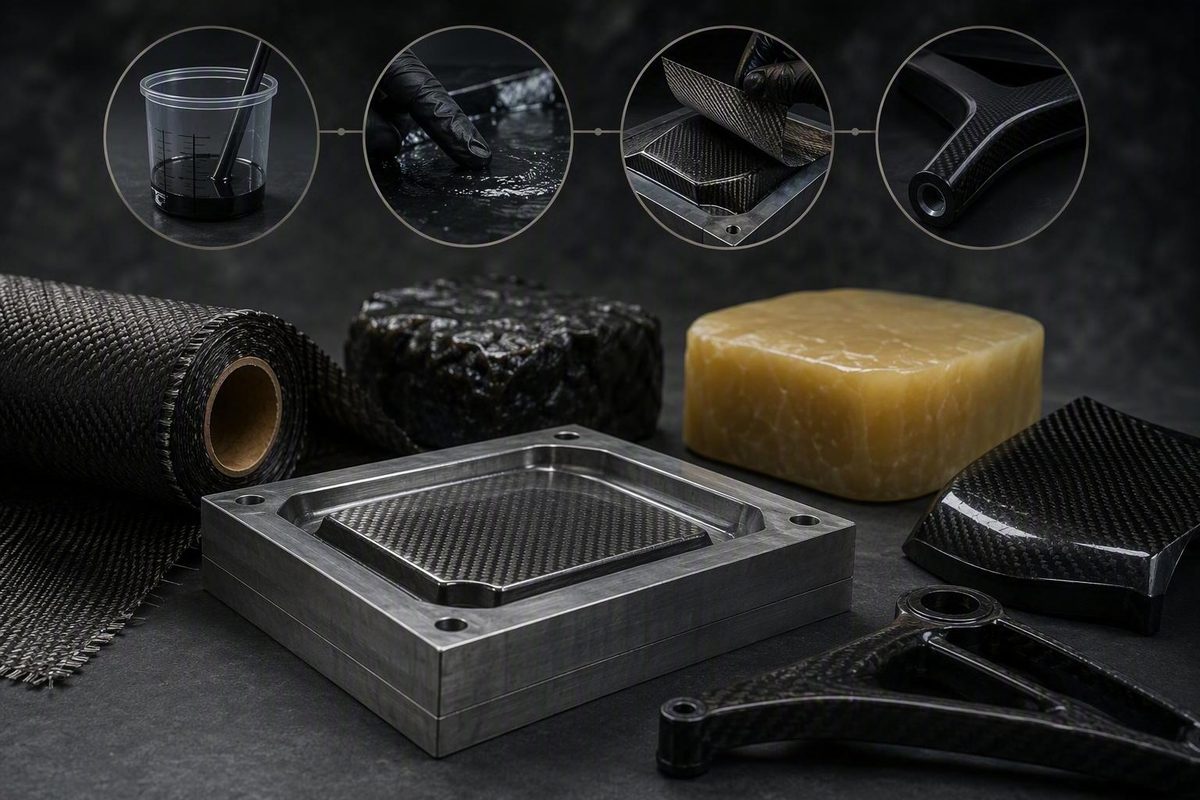
Choose a fast-curing resin by the earliest documented cure state that satisfies the job—not by the shortest number on the label. A coating may only need to become tack-free, a casting must be safe to demold, a repair may need to carry load, and a composite laminate must reach specified structural and thermal properties. Compare working time, cure endpoint, temperature, batch mass, thickness, activation method, and final service requirements before selecting a product.
This guide covers epoxy systems. Its conclusions should not be generalized to every resin chemistry.
Quick selection guide: match cure speed to the job
There is no universal “fastest” epoxy because suppliers report different endpoints under different conditions. A one-hour demold claim cannot be ranked directly against a six-hour cure-to-solid time or a 24-hour full cure.
| Task | Type to consider | Documented example | Main selection limit |
|---|---|---|---|
| Thin decorative coating | Fast ambient-cure coating epoxy | KSRESIN Liquidy Split: 15-minute working time, 3–4 hours tack-free, 24-hour full cure | Maximum stated depth is 1/8 inch |
| Small, shallow casting | Fast craft or mold epoxy | Promise Fast Cure Resin: approximately one-hour “demold or cure” claim | 75–80°F, no more than 85% humidity, and a 1/2-inch depth limit |
| Quick repair or bond | Compatible resin with a fast hardener | WEST SYSTEM 105 Resin with 205 Fast Hardener: approximately 9–12 minutes pot life and 6–8 hours to solid in one guide | Confirm substrate compatibility, placement time, and load-ready state |
| Structural composite work | Qualified laminating or structural epoxy | Select by wet-out time, bond data, complete cure schedule, Tg, and service limits | Fast gel can prevent complete fiber wet-out and placement |
| Heated production molding | Rapid-cure industrial molding system | Heated RTM, compression molding, or prepreg system | Requires controlled material handling, tooling, temperature, and cycle validation |
For a thin tumbler, canvas, or similar coating, Liquidy Split is a documented product-specific example rather than a universal benchmark. Its supplier does not state the temperature, humidity, or batch mass behind the published schedule.
Promise Fast Cure Resin is similarly conditional. Its “demold or cure” wording does not establish that a part has reached full mechanical properties in one hour. Before selecting it, determine what operations are permitted after demolding and when the part may enter service.
For general bonding or repairs, WEST SYSTEM 105 Resin with 205 Fast Hardener illustrates a different kind of schedule. Its short pot life may suit a simple repair, but only if there is enough time to prepare, apply, align, clamp, and clean the joint before viscosity rises.
Structural and elevated-temperature applications need more than a fast handling time. Compare documented bond properties, the entire cure and post-cure schedule, glass-transition behavior, environmental exposure, and operating-temperature limits. Seconds- or minutes-scale industrial cycles belong to a separate process category and are not ambient-cure equivalents.
What “fast curing” actually means
“Fast curing” has little practical meaning until the supplier identifies the milestone being timed. Keep these terms separate:
- Pot life: How long a defined quantity of mixed epoxy remains liquid under stated test conditions. It is commonly used to compare hardener speeds.
- Usable working time: The practical period available to spread, inject, wet out, place, tool, or correct the epoxy.
- Tack-free time: The point when the surface no longer feels sticky under the stated test.
- Set or fixture time: The point when an assembly can remain positioned without its original support or clamping arrangement, when the documentation defines it that way.
- Demold time: The earliest point at which a casting can be removed from its mold under specified conditions.
- Cure to solid: A solid-stage milestone that does not necessarily imply final properties.
- Load-ready time: The stated point when a bonded or molded part may accept a defined load.
- Full cure: The manufacturer’s endpoint for reaching its specified final cure state under a stated schedule.
These milestones are not interchangeable. A part can be tack-free, solid, or removable from a mold while it is still developing hardness, strength, or chemical resistance.
The distinction is clear in the WEST SYSTEM user manual. For 105 Resin with 205 Fast Hardener, it lists approximately 9–12 minutes of pot life, 60–70 minutes of thin-film working time, and 6–8 hours for thin-film cure to a solid state at room temperature. The container test and the spread-out film therefore have different useful clocks.
Greenlight provides another example. Its seller guidance reports 75 minutes to two hours of drying at 75°F for Extra Fast Hardener, but approximately seven days for full cure. In that system, “drying” means becoming tack-free and suitable for light handling, not reaching final mechanical strength or chemical resistance (Greenlight Surf Supply).
A product name such as “Five-Minute” is equally incomplete. Unless current technical documentation expressly defines five minutes as full cure under the applicable conditions, treat that wording as a product identifier or early-set claim—not proof of five-minute service readiness.
Use a comparison template that keeps every milestone separate:
| Field | Candidate A | Candidate B | Candidate C |
|---|---|---|---|
| Intended application | |||
| Mix ratio and method | |||
| Pot life | |||
| Usable working time | |||
| Tack-free time | |||
| Set or fixture time | |||
| Demold time | |||
| Cure to solid | |||
| Load-ready time | |||
| Full cure | |||
| Temperature and humidity | |||
| Batch mass and thickness | |||
| Activation or post-cure | |||
| Service limits |
Enter “not stated” rather than converting one milestone into another or estimating a missing endpoint.
Conditions-visible comparison of documented fast epoxies
The following figures are manufacturer- or seller-reported, not results from an independent head-to-head test. The products have not been normalized to one temperature, geometry, batch mass, or cure endpoint. Instead, their stated conditions and omissions remain visible.
Because a usable comparison needs more fields than a single readable table can hold, the information is divided into three coordinated tables.
| Product or system | Intended use | Mix ratio | Evidence type |
|---|---|---|---|
| KSRESIN Liquidy Split products | Coatings and shallow decorative work | 1:1 by volume | Manufacturer ecommerce collection page |
| LET’S RESIN Fast Curing Epoxy | Small, shallow craft projects | 1:1 by volume | Commercial product page |
| Promise Fast Cure Resin | Jewelry, coatings, doming, tumblers, and coasters | 1:1 | Manufacturer product page |
| WEST SYSTEM 105/205 | Repairs, coating, bonding, and compatible composite work | 5:1 by volume | Manufacturer manual and selection guide |
| Master Bond EP65HT-1 | Specialized industrial bonding, sealing, and related work | Not stated on cited category page | Manufacturer category page |
The next table separates early processing milestones. “Not stated” means the cited page does not provide that particular endpoint.
| Product or system | Pot or working time | Tack-free or set time | Demold or solid time |
|---|---|---|---|
| KSRESIN Liquidy Split | 15-minute working time | 3–4 hours tack-free | Not stated |
| LET’S RESIN Fast Curing Epoxy | Not stated | Endpoint unclear | Page uses 4-hour, 4–10-hour, and 8-hour wording without consistently defining the milestone |
| Promise Fast Cure Resin | Not stated | Not stated | Approximately one-hour “demold or cure” claim |
| WEST SYSTEM 105/205 | Approximately 9–15 minutes pot life across two documents | Not stated | Roughly 5–8 hours to solid across two documents |
| Master Bond EP65HT-1 | Not stated | 3–5-minute set for a 10–20 gram mixed mass | Not stated |
Full cure, environmental conditions, and geometry restrictions must remain separate from those early milestones:
| Product or system | Full cure | Stated conditions | Depth or batch limit |
|---|---|---|---|
| KSRESIN Liquidy Split | 24 hours | Temperature, humidity, and batch mass not stated | Maximum depth 1/8 inch |
| LET’S RESIN Fast Curing Epoxy | Not consistently defined | Recommended 75–85°F | Maximum depth not stated |
| Promise Fast Cure Resin | Not clearly separated from its one-hour wording | 75–80°F; humidity no more than 85% | Not for large table coatings or pours deeper than 1/2 inch |
| WEST SYSTEM 105/205 | Not stated in the cited comparison entries | Figures vary slightly by document; temperature and thickness affect cure | Not stated |
| Master Bond EP65HT-1 | Not stated on the cited category page | Set figure applies to a 10–20 gram mixed mass | 10–20 gram condition applies to the set-time claim |
LET’S RESIN is especially difficult to compare. Its page uses 4-hour, 4–10-hour, and 8-hour descriptions without consistently identifying whether they mean demolding, handling, or full cure. The defensible entry is therefore “endpoint undefined,” not whichever number appears shortest.
The WEST SYSTEM differences are less fundamental. One manufacturer document gives 9–12 minutes of pot life and 6–8 hours to solid, while another gives 10–15 minutes and 5–7 hours at its stated test conditions (WEST SYSTEM hardener selection guide). Record the document, test temperature, and geometry that apply to the job instead of averaging the figures into an apparently more precise number.
Master Bond EP65HT-1 shows why batch mass belongs beside cure time. Its 3–5-minute figure is a set time for a 10–20 gram mixed mass, not permission to assume that an arbitrary batch will set—or fully cure—on the same schedule.
Working time, temperature, thickness, and exotherm
Observed cure time depends on both formulation and process. Ambient and material temperature, mixed batch mass, layer or laminate thickness, ratio accuracy, mixing quality, and—when the manufacturer specifies it—humidity can all affect the result.
Warmer conditions generally accelerate epoxy curing, while cooler conditions slow it. Product-specific documentation must override that general rule because formulations have different operating ranges and temperature responses.
Geometry changes the clock as well.
This is why fast systems generally fit small, simple work better than large or intricate jobs. Every minute consumed by measuring and mixing reduces the time available for:
- Fiber wet-out and laminate consolidation
- Adhesive placement and joint alignment
- Mold filling and flow through narrow features
- Bubble release or removal
- Surface leveling and edge work
- Correction of wrinkles, dry spots, movement, or contamination
A resin that becomes handleable quickly is not operationally fast if the crew cannot complete the layup before viscosity rises. The relevant question is not merely “When does it set?” but “Can the process be completed correctly before it sets?”
Before opening the containers, complete a pre-mix worksheet:
| Record before mixing | Project value |
|---|---|
| Room temperature | |
| Resin, hardener, mold, and substrate temperature | |
| Intended mixed batch size | |
| Coating depth, casting thickness, or laminate geometry | |
| Minimum required working time | |
| Earliest handling or demold point | |
| Planned load date | |
| Full-service date | |
| Required cure or post-cure equipment |
Mix ratios are product-specific. The documented examples include equal-volume craft systems as well as WEST SYSTEM resin-and-hardener combinations with substantially different ratios. Do not substitute a familiar ratio, combine components from incompatible systems, or assume that every fast epoxy mixes the same way.
The advertised cure schedule also assumes that the product has been measured and mixed as directed. A fast formulation does not compensate for inaccurate proportions or incomplete mixing.
Selection rules for coatings, castings, repairs, and composite parts
For a coating or small craft casting, check:
- Approved layer or pour depth
- Practical working time
- Time available for bubble release
- The supplier’s definition of demold
- Recoat requirements
- Required surface finish
- Time before trimming, handling, or service
A quick demold is of little value if the part cannot yet be trimmed, loaded, coated again, or exposed to its operating environment.
For a deep casting, reject a shallow coating resin unless current technical documentation expressly approves the intended depth and batch volume. The consumer examples in this comparison include maximum depths of 1/8 inch and 1/2 inch. Do not exceed a documented per-pour or project limit unless the current manufacturer instructions explicitly authorize the intended staged-pour method and schedule.
For a repair or adhesive bond, prioritize:
- Compatibility with both substrates and any existing matrix resin
- Time needed to prepare, apply, align, clamp, and clean the joint
- Cure state required before removing clamps or fixtures
- Documented schedule before loading
- Moisture, chemical, and environmental exposure
- Operating-temperature requirements
- Required bond-property and failure-mode data
Decorative product descriptions do not establish structural suitability. The available evidence does not establish the listed craft coating epoxies as suitable for structural bonding or deep pours.
For a carbon-fiber laminate, require enough working time to wet every ply, position reinforcement, fit consumables, close the mold or vacuum bag, and correct defects. A faster hardener becomes counterproductive if viscosity rises before the fibers are adequately wetted and the laminate is consolidated.
The process itself should determine the minimum working window. A small patch prepared by an experienced operator may tolerate a short window. A multi-ply layup, complex mold, infusion setup, or job involving several operators may require a slower system even when the desired demold time is short.
For structural service, “solid” is only an intermediate description unless the technical data explicitly ties that state to the required properties. Work backward from the date and conditions of loading, rather than forward from the advertised demold or handling time.
Use this go/no-go checklist before purchase:
- [ ] The product is intended for the application category.
- [ ] The planned depth, batch size, and laminate geometry are approved.
- [ ] The working window is long enough for the actual process.
- [ ] Cure temperature, humidity, and other relevant conditions are known.
- [ ] Required demold, handling, loading, and full-cure milestones are documented.
- [ ] Final thermal, mechanical, and environmental service limits are suitable.
- [ ] Resin, hardener, pumps, fillers, and additives are confirmed compatible.
- [ ] Current technical and safety data sheets are available and understood.
If one of these checks fails, a shorter headline cure time does not rescue the selection.
Cure speed is not the same as final thermal performance
Glass-transition temperature, or Tg, is a reported point representing a transition range in which cured epoxy changes from relatively rigid and glass-like toward softer, more rubber-like behavior. Although data sheets commonly report one value, the underlying transition occurs over a range.
Tg does not measure cure speed. A rapid ambient cure does not automatically produce a high Tg, and a high-Tg formulation does not necessarily cure quickly at room temperature.
A peer-reviewed study of three commercial structural epoxies found that measured Tg can depend on curing, specimen age, temperature history, heating rate, the ultimate test temperature, and the evaluation method. The study therefore cautions against treating Tg as one immutable material value; results obtained under different cure and test conditions may not be directly comparable (Composites Part B: Engineering).
That study concerns structural strengthening epoxies rather than the craft products compared earlier. Its useful lesson is methodological: a Tg number needs its specimen cure history and test method.
Elevated-temperature curing can shorten the time required to develop a target strength or stiffness and may produce a higher measured Tg. That does not demonstrate fast room-temperature performance. It describes a cure schedule in which added heat changes reaction rate and potentially the resulting crosslinked network.
For a structural or high-temperature part, compare the complete schedule:
- Ambient dwell before movement or demolding
- Time and temperature required before loading
- Any required ramp, oven cure, or post-cure
- Tg test method and specimen cure history
- Continuous and short-duration operating temperatures
- Required mechanical properties after environmental exposure
Do not assume that a faster hardener either preserves or reduces final mechanical properties. That conclusion requires product-specific comparative data for the exact resin, hardener, cure schedule, specimen preparation, and test method.
When rapid cure requires UV light or heated production equipment
Ambient fast epoxies must be separated from systems accelerated by UV exposure, ovens, heated molds, direct electrical heating, microwave heating, induction, or radio-frequency heating. In those processes, cure speed belongs to the complete manufacturing system—not to the resin alone.
Historical automotive examples show the distinction. In 2018, suppliers reported a Hexion system curing in 50 seconds at 135°C, a Huntsman system curing in as little as 30 seconds at 140°C depending on mold temperature and part size, and SolvaLite 730 prepreg curing in one minute at 170°C or three minutes at 150°C. These were supplier-reported figures published in historical trade coverage, not independent room-temperature comparisons; present specifications, commercial status, and availability require confirmation with the suppliers (CompositesWorld).
Those cycles cannot be compared directly with a craft resin’s demold time. They depend on high mold temperatures, controlled part dimensions, dedicated material handling, and validated tooling. The reported Hexion and Huntsman figures also applied to particular molding systems and processing conditions, not to arbitrary epoxy batches.
The central industrial trade-off is straightforward: the resin must remain fluid long enough to mix or condition, travel through the delivery system, inject, and fill the mold. It must then react rapidly after filling. Excessive reactivity can cause premature curing in runners or injection ports. Part thickness, injection rate, temperature uniformity, tool design, and process control therefore become part of the material specification.
Process acceleration extends beyond conventional heated molds. A 2022 review examined direct electric or Joule-effect heating, microwave heating, induction, and radio-frequency heating for carbon-fiber composites. It identified potential benefits including high heating rates, improved throughput, exotherm control, and lower power consumption, while noting that uniform degree of cure and ease of use remain adoption challenges (Composites Part C: Open Access).
These methods do not eliminate the need to verify cure state. Faster heating still has to produce the required degree and uniformity of cure throughout the part.
The final decision rule is simple: if the published schedule does not identify the relevant cure milestone, conditions, geometry, and service limits, the fast-cure claim is incomplete. Select the quickest documented system that leaves enough time to perform the work correctly and reaches the properties the finished part actually needs.