
Is It Clear-Coated Carbon, Patterned Vinyl, or Something Else?
Distinguish decorative transparent vinyl from real carbon fiber under clear resin, then match wrapping, laminating or UV protection to the job.
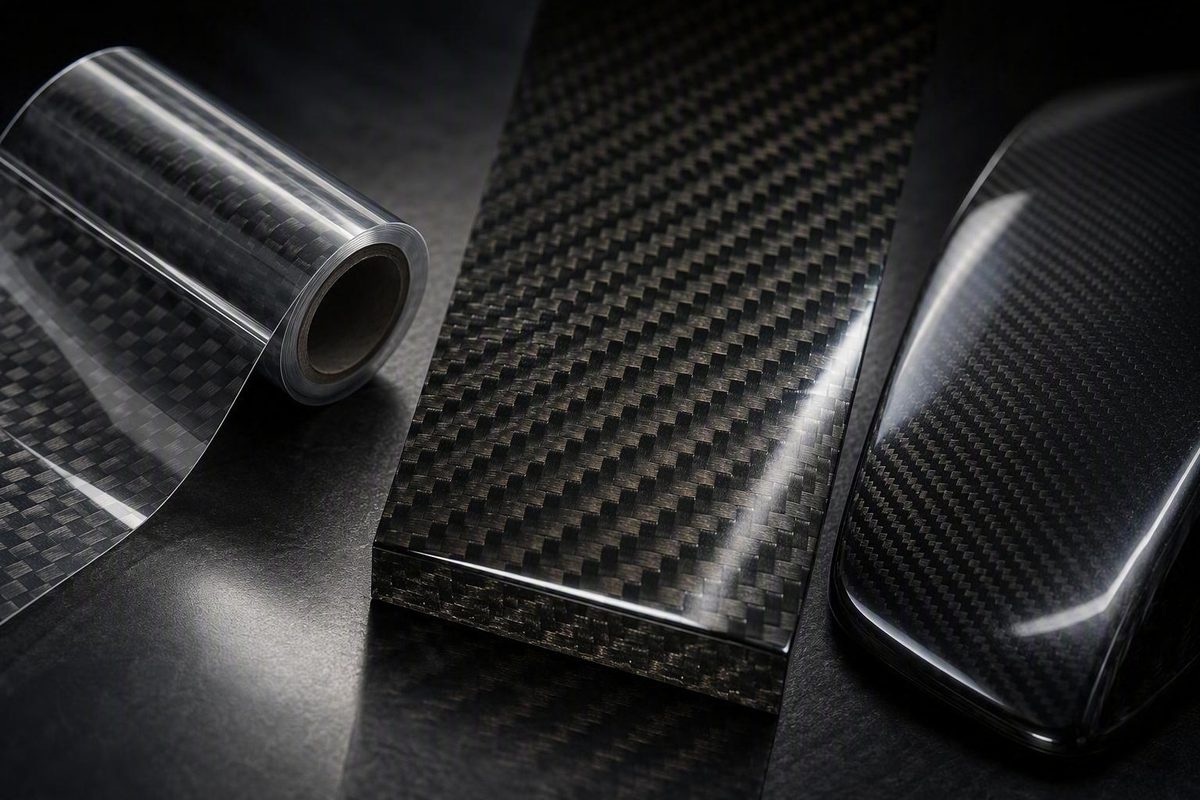
Choose vinyl for an adhesive cosmetic effect, a compatible resin-and-coating system to display actual weave, and application-specific composite engineering guidance when the part carries structural loads. A clear finish preserves visibility of the weave; that appearance is not evidence that the carbon fibers themselves have become transparent.
The short answer: three meanings to separate
- Transparent carbon-fiber-pattern vinyl: An adhesive decorative film that overlays a simulated weave while allowing some of the substrate to show through.
- Real carbon fiber under clear resin or clearcoat: Carbon reinforcement remains visible through the surrounding matrix and protective surface finish.
- A structural composite requirement: A load-bearing laminate designed around fiber grade, orientation, resin system, manufacturing process, temperature, fatigue and other engineering requirements.
The first category is easy to misidentify because sellers use phrases such as “3D carbon fibre” and “carbon fiber finish.” For example, the VViViD transparent wrap is listed as vinyl, despite its carbon-fiber finish description. That listing establishes what the specific product is made from; it does not provide evidence of structural carbon reinforcement. The VViViD product details identify the material as transparent vinyl.
The second category contains real carbon fiber, but the visual effect comes from seeing the weave through the surrounding resin and surface coating. A transparent topcoat can then protect and refine the surface without concealing the pattern.
The third category cannot be selected by appearance alone. Decorative vinyl provides no carbon-fiber reinforcement.
Decision table: wrap, clear resin, or clearcoat
| Option and actual material | Is real carbon fiber present? | Primary purpose and installation | Reversibility and principal limits |
|---|---|---|---|
| Transparent patterned vinyl: adhesive polymer film | Not established by a carbon-look description | Adds a simulated weave over an existing surface; positioned and adhered according to the product instructions | It remains a separate adhesive film rather than a cured composite matrix. Removal behavior and substrate effects depend on the product and surface. It adds no reinforcement. |
| Clear laminating or surface epoxy: thermoset resin and hardener | Yes, when used around actual carbon reinforcement | Wets and binds fibers or creates a clear resin surface; mixed, applied and cured to a specified schedule | Once cured, it is not readily reversible. Results depend on mixing, wetting, adhesion, bubble control, cure conditions, hardness and color stability. |
| Clear protective coating: acrylic, polyurethane or another specified coating chemistry | Only if the underlying part contains carbon fiber | Protects and refines a prepared surface; applied according to its technical data | It becomes part of the finish system. It is not reinforcement and cannot repair damaged fibers, delamination or major voids. |
Transparent vinyl can allow the substrate color to influence the result because it is not fully opaque. Do not assume that the same film will look equally dark, bright or three-dimensional over every surface. The appearance depends on the film, substrate and lighting.
Clear epoxy has a different job. In a laminate, it forms the matrix around the reinforcement. As a surface resin, it may provide a smooth visible-weave layer. Suitability depends on whether the resin can wet the fibers, adhere to adjacent materials, control trapped air, cure evenly and reach the required hardness without unacceptable color change.
Clearcoat is a protective and cosmetic layer over a prepared surface. It may provide gloss, satin or matte appearance and protect the resin beneath it.
Before buying anything labeled “clear carbon fiber,” check:
- Listed material: Is it vinyl, epoxy, polyurethane, acrylic or a reinforced composite?
- Presence of reinforcement: Does the specification identify actual carbon fiber, or only a carbon-fiber-style finish?
- Intended function: Is the product made for wrapping, laminating, surface coating or refinishing?
- Substrate compatibility: Is it approved for the particular cured resin, existing finish or painted substrate?
- Current documentation: For chemical products, obtain the latest technical data sheet and safety data sheet rather than relying on front-label language.
What makes real carbon fiber look clear and well defined
A clean visible weave depends as much on processing as on nominal resin clarity. Relevant variables include:
- Resin transparency and resistance to color change
- Wetting of fiber bundles and individual filaments
- Viscosity and flow for the selected process
- Adhesion to reinforcement and adjacent layers
- Bubble release and void control
- Accurate resin-to-hardener measurement
- Pot life and cure behavior
- Final hardness and surface quality
According to JINHUA’s resin-selection guidance, poor wetting can be associated with dry fibers, cloudy or white patches, voids, weak bonding between layers and possible delamination. The same manufacturer guidance identifies dust, moisture and release-agent residue as potential adhesion problems, while incorrect resin-to-hardener ratios can contribute to tackiness, uneven cure or inadequate hardness. These are possible process-related causes, not a way to diagnose every defective part from appearance alone. JINHUA discusses these resin-selection and processing factors in its composite epoxy guide.
For a new laminate, the practical objective is controlled wet-out without shifting the weave or trapping excessive air. For a cosmetic surface-resin layer, the priority shifts toward leveling, clarity, pinhole control and compatibility with the intended protective finish.
Keep the cure milestones separate:
- Pot life is the usable working period after mixing.
- Touch-dry describes a surface condition at a particular stage.
- Handling readiness means the part can tolerate the degree of movement or assembly specified by the manufacturer.
- Full cure is a manufacturer-defined milestone under stated conditions.
- Final property development may take additional time before all mechanical, thermal or chemical properties stabilize.
A part that feels firm is not necessarily ready for heat, aggressive chemicals, sanding or service loads.
Treat “non-yellowing” language cautiously. Color stability depends on formulation, processing, exposure and topcoat protection. Select a resin for resistance to color change under the intended conditions rather than assuming that any clear epoxy will remain permanently colorless.
For structural, fatigue-critical, high-temperature or safety-critical laminates, visual clarity is not an adequate selection criterion. The complete system needs suitable engineering data for the reinforcement, process, geometry, service environment and required properties.
Why outdoor carbon-fiber finishes need UV protection
Clear epoxy alone is generally not the complete outdoor finish system. Sunlight can degrade exposed epoxy even while the dark carbon weave remains visually prominent.
WEST SYSTEM recommends applying a finish coating over epoxy to protect it from sunlight and extend the life of the epoxy moisture barrier. Its guidance describes clear two-part linear polyurethane as providing excellent UV protection, gloss retention, abrasion resistance and compatibility with cured epoxy. It also states that two-part epoxy paints can be durable and chemical resistant but provide less UV protection than linear polyurethane. WEST SYSTEM explains these finish-coating distinctions and recommends compatibility testing.
That is manufacturer guidance rather than an independent comparative weathering study. It does not establish one universally best clearcoat for every carbon-fiber part.
Compatibility deserves particular attention. WEST SYSTEM notes that some one-part polyurethane coatings may be incompatible with amine-cured epoxy. Even a coating category commonly used over epoxy is not automatically compatible with every resin, gel coat, release-agent residue or previous finish. Follow the substrate and coating manufacturers’ instructions and test the complete preparation-and-coating sequence on a representative panel.
Claims about resistance to scratches, fuel, chemicals, heat or long-term weathering should remain product-specific. Seller descriptions may help shortlist a coating, but they do not replace relevant test data or approval for the intended service.
A bounded workflow for clearcoating a cosmetic carbon-fiber part
This is a selection and control workflow for a part believed to have a cosmetic surface problem. It is not a substitute for the selected product’s technical and safety instructions, and it does not establish that a laminate is structurally sound.
- Screen for reasons to stop. Visible broken or exposed fibers, cracks, lifted layers, soft areas, major voids or impact damage are reasons not to proceed as a cosmetic refinishing job. Visual inspection cannot rule out hidden damage.
- Consider the part’s function and history. If it is load-bearing, safety-critical, impacted or of uncertain condition, obtain qualified assessment before sanding or coating.
- Verify cure status. Use the underlying resin or coating’s specified cure schedule. Do not infer readiness from surface firmness alone.
- Identify the substrate and finish system. Confirm the cured resin, existing coating and proposed replacement coating as far as practical.
- Use the manufacturer’s preparation method. Contamination removal, abrasion and cleaning must follow the selected system’s instructions rather than a universal solvent or grit recommendation.
- Address visible pinholes or voids. Use only a compatible clear epoxy or designated pinhole filler when the coating documentation calls for it.
- Make a representative test panel. Reproduce the substrate, preparation and coating sequence before committing to the actual part.
- Apply only under the documented conditions. Film build, coat count, flash time, recoat window and cure schedule must come from the current technical data.
- Refer the application when necessary. If the required equipment, environment or safety controls in the technical and safety documents are unavailable—or if the coating chemistry or substrate remains uncertain—use a suitably equipped professional refinisher.
A carbon-specific clearcoat seller recommends starting with a good surface finish and filling clearly visible pinholes or voids with clear epoxy or pinhole filler before coating. The seller says its coating may cover small pinholes or microporosity, but should not normally replace the final smooth resin layer. That is a useful boundary: clearcoat may improve minor surface texture, but it should not be expected to level major resin defects.
As a product-specific example, the FANTOM CLEAR CX listing calls for three to four coats, a 10-minute flash-off period, 60-minute touch-dry time and 24-hour full cure at 20°C. It also lists a 48-hour working time after activation. Those values apply only to that product under its stated conditions; they are not a general clearcoating recipe. Easy Composites provides the product specifications and preparation limits for FANTOM CLEAR CX.
Safety: FANTOM CLEAR CX is classified as dangerous goods for transport, and its seller requires users to read the current safety and technical data sheets before storage or use. Chemical coating and composite-surface work must follow the controls specified for the actual products and process. If those requirements cannot be identified or implemented, do not spray or sand the part yourself; refer it to a suitably equipped professional. See the seller’s current documentation and safety notice.
Restoring yellowed or peeling clear-coated carbon fiber
A failed surface finish may sometimes be removed and replaced while leaving the weave visible, provided the problem is genuinely cosmetic and the work stops before the reinforcement is reached. That decision is especially important on a load-bearing component, where appearance alone cannot rule out hidden damage.
A documented automotive project refinished an APR Performance GTC-200 wing with a severely degraded clear finish. The author removed the old coating, leveled and cleaned the surface, and then applied an automotive-grade clearcoat. For that wing, 320-grit abrasive was used to remove the failed coating and 400 grit to finish and level the surface. The Kanga Motorsports case study documents the sequence and sanding-residue warning.
Those grit numbers are not a general specification. Abrasive selection depends on the existing coating, its thickness and condition, the underlying surface and the replacement coating’s instructions.
Residue color provided a useful warning in the case study. Yellow or white residue was associated with the old clear finish, while black residue was treated as a sign that sanding might have reached the carbon weave. Black residue alone does not prove structural damage, but it is a reason to stop immediately and inspect the area rather than continuing to remove material.
A structural or safety-critical component requires qualified assessment rather than a coating intended to conceal its condition.
The wing tutorial used two coats, while the FANTOM CLEAR CX example specifies three to four. Their abrasion instructions also differ. This is why coat count, grit, flash time and cure schedule must come from the selected coating system rather than a universal “carbon-fiber clearcoat” recipe.
Do clear carbon-fiber-look vinyl wraps contain real carbon fiber?
Products described as “3D carbon fibre vinyl” or “carbon fiber finish” may simply be patterned adhesive films. If the listed material is vinyl, treat the product as a decorative wrap rather than a structural composite.
Can clearcoat fill pinholes in a carbon-fiber part?
Some clearcoats are marketed as capable of covering small pinholes or microporosity, but clearly visible pinholes and voids may need to be filled first with compatible epoxy or a designated pinhole filler. Clearcoat should not replace a properly leveled resin surface, and it cannot correct major voids or laminate defects.
Does touch-dry mean a clear finish is fully cured?
No. Touch-dry describes the surface at one stage. Recoat readiness, handling readiness, stated full cure and development of final mechanical, thermal or chemical properties may occur at different times. Follow the selected product’s current technical data and specified temperature conditions.
Use transparent patterned vinyl for an adhesive visual effect, a compatible resin and protective clear system to display real weave, and a product-specific refinishing process for a sound cosmetic surface. Verify the listed material, test compatibility and follow current technical and safety documents. If fibers may be damaged or structural deterioration is possible, do not conceal the condition with clearcoat—refer the part for qualified assessment.