
What the Manufacturing Method Really Tells You About a Carbon-Fiber Part
Vacuum infusion belongs to the wet-resin family but offers substantially different process control from basic hand wet lay-up during part fabrication.
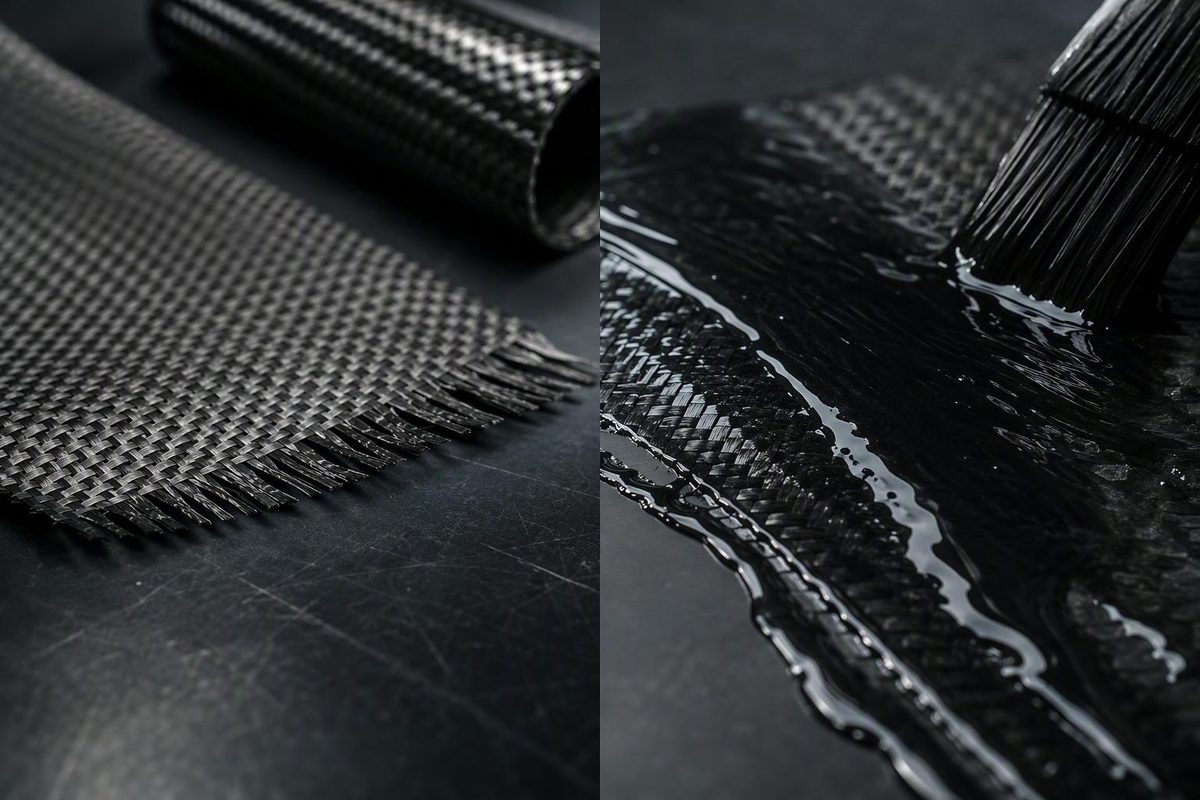
The familiar dry carbon vs wet carbon comparison sounds like a choice between two material grades. It is not. The terms usually describe when and how resin enters the reinforcement, but they do not establish the quality or performance of a finished component.
“Dry carbon” commonly means prepreg: reinforcement supplied with uncured resin already incorporated. “Wet carbon” commonly means liquid resin is introduced to initially dry reinforcement while the part is being fabricated. Vacuum infusion belongs within that wet-resin family, although it offers substantially different process control from basic hand wet lay-up.
Prepreg can provide tighter control of initial resin content, consolidation, and curing. That may make low-mass, repeatable laminates easier to produce. It does not guarantee that every prepreg part is lighter, stronger, safer, or better made than every wet-process part.
The more useful comparison is therefore prepreg vs vacuum infusion vs hand wet lay-up. The right choice depends on the laminate design, materials, workmanship, loads, consequences of failure, weight target, production volume, documentation, and price—not the marketing label or surface finish alone.
The available comparisons cited here are largely manufacturer and retailer guides rather than independent standards or controlled comparative studies. They support a practical introduction to the processes and buyer questions, but they should not be treated as design approval, inspection criteria, or proof that a safety-relevant component is fit for service.
Start With the Terminology: Both Types of Carbon Contain Resin
A finished carbon-fiber-reinforced polymer contains two essential constituents:
- Carbon fibers, which provide reinforcement in their aligned directions
- A cured polymer matrix, which binds the fibers, supports their position, transfers loads within the laminate, and gives the part its physical form
Neither dry carbon nor wet carbon is literally dry after manufacture. Both contain cured resin. In this context, dry means the fabricator is not separately applying liquid resin to dry reinforcement during lay-up.
In most commercial discussions, dry carbon means a part made from pre-impregnated reinforcement, usually shortened to prepreg. The fabric or unidirectional material arrives with uncured resin already distributed through it. Fabricators cut and place the prepreg, consolidate the laminate, and cure it under the conditions specified for the material and process.
Wet carbon usually means a part made by introducing liquid resin to initially dry reinforcement during fabrication. The resin may be brushed or rolled into the cloth by hand, or drawn through an arranged reinforcement stack under vacuum. A manufacturer’s comparison of wet and prepreg processing includes both hand lay-up and vacuum-assisted infusion within the wet-process category.
These terms are informal, not complete technical specifications. A “dry carbon” description does not identify:
- Fiber type, grade, or modulus
- Woven, braided, chopped, or unidirectional reinforcement
- Fiber orientation
- Ply count or stacking sequence
- Resin chemistry
- Core, adhesive, backing, or insert materials
- Cure route or cure quality
- Finished thickness and mass
- Fiber-resin balance
- Defects or dimensional tolerances
- Mechanical properties or load rating
The same limitation applies to “wet carbon.” The label does not tell you whether the part came from a basic open-mold lay-up, a manually wetted laminate later placed under vacuum, or a planned vacuum-infusion process.
Sellers also classify infusion inconsistently. Some call it wet carbon because liquid resin enters during part fabrication. Others group it with dry methods because the reinforcement is placed in the mold before resin arrives. Describing the process as vacuum infusion is more informative than trying to force it into a shopping category.
It also helps to distinguish carbon-fiber production from composite-part fabrication. Carbon fiber begins as filaments grouped into tow. The tow can become woven cloth, unidirectional tape, or another reinforcement form, and it may then be supplied dry or converted into prepreg. A part exists only after reinforcement is combined with resin and cured. Carbon Reference’s overview of carbon-fiber manufacture explains the progression from tow to fabric, tape, prepreg, and finished composite.
The practical takeaway is straightforward: dry and wet are process clues, not material grades. They are useful opening questions but poor final answers.
The Useful Comparison Is Prepreg vs Infusion vs Hand Wet Lay-Up
Treating every carbon part as the product of one of two equivalent process families hides important differences. A better framework compares hand wet lay-up, vacuum infusion, and prepreg processing.
Hand wet lay-up
In hand wet lay-up, the fabricator prepares a mold and positions dry reinforcement. Liquid resin is mixed and applied using brushes, rollers, squeegees, or similar tools.
The operator has to wet the reinforcement while preserving its intended placement. Air removal, fiber alignment, resin application, ply position, working time, and laminate thickness must all be managed during fabrication. The laminate may cure in an open mold or be placed under a vacuum bag, depending on the chosen process.
Once cured, the part is demolded, trimmed, drilled or machined where necessary, inspected, and finished.
Hand lay-up can produce serviceable and attractive parts. Its principal limitation is not that quality is impossible, but that several important variables depend heavily on materials, setup, and operator execution. Applying too much resin can add unnecessary mass; incomplete impregnation or poor air removal can create defects.
Vacuum bagging may improve consolidation, but “vacuum-bagged” does not identify how the resin entered the laminate. A manually wetted part can be vacuum-bagged, just as prepreg commonly is.
Vacuum infusion
Infusion is a wet-resin process because resin enters during part fabrication. It should not, however, be treated as equivalent to the least-controlled form of hand wet lay-up. Reinforcement preparation, vacuum integrity, resin behavior, flow arrangement, inlet position, temperature, and timing can be planned and monitored.
When the setup is properly designed and executed, infusion can provide more controlled impregnation and consolidation than basic manual wetting. It may also reduce the need to spread liquid resin manually across every area of the laminate. Those are process-control advantages, not proof that an infused part will match a prepreg part in mechanical performance.
Infusion remains sensitive to execution. Inadequate flow or sealing can result in incomplete impregnation or uneven resin distribution. Vacuum by itself is not a quality guarantee.
Prepreg processing
Prepreg reinforcement arrives with uncured resin already incorporated. Fabricators cut the material and position each ply according to the laminate schedule. The stack may be compacted during lay-up and is commonly enclosed in a vacuum bag before cure.
The laminate is then cured under the temperature, time, vacuum, and pressure conditions selected for the material and manufacturing route. It is not part of a universal definition of prepreg, however. Controlled oven, press, closed-mold, and other out-of-autoclave routes also exist.
Prepreg removes the need to meter and spread liquid resin over every ply during lay-up, but it does not eliminate process sensitivity. Storage, handling time, contamination control, ply placement, bag integrity, compaction, and cure execution can all affect the result. A supplier guide to prepreg and wet lay-up identifies cold storage, vacuum bagging, controlled curing, specialized tooling, and tighter process control as common prepreg requirements.
Process comparison
| Consideration | Hand wet lay-up | Vacuum infusion | Prepreg |
|---|---|---|---|
| When resin enters | Applied manually to dry reinforcement during lay-up | Drawn through arranged dry reinforcement during fabrication | Incorporated into reinforcement before lay-up |
| Material storage | Dry fabric and liquid resin stored separately | Dry fabric and liquid infusion resin stored separately | Commonly requires controlled cold storage and handling |
| Primary consolidation | Manual rolling or squeegeeing; vacuum bagging may be added | Atmospheric pressure across a sealed vacuum bag | Vacuum bagging, often with external pressure or closed tooling |
| Cure route | Ambient or heated cure, depending on the resin | Ambient or heated cure, depending on the resin | Specified controlled cycle in an autoclave, oven, press, or other suitable equipment |
| Process sensitivity | Resin application, air removal, fiber placement, and ply control | Preform preparation, sealing, flow planning, and resin management | Storage, handling, ply placement, bagging, and cure execution |
| Equipment burden | Generally the lowest entry barrier | Vacuum equipment, consumables, resin-delivery setup, and process planning | Cold storage, vacuum consumables, controlled cure equipment, and potentially more demanding tooling |
| Typical production fit | Prototypes, repairs, one-offs, and simple or cosmetic low-volume parts | Larger panels and controlled low-to-medium-volume work | Weight-, repeatability-, or documentation-sensitive components |
These are broad tendencies rather than fixed boundaries. Resin chemistry, tooling, geometry, scale, automation, inspection requirements, and production volume can change the most suitable route.
Why Process Control Can Affect Weight, Voids and Repeatability
Prepreg is often described as lighter or more consistent than wet-laid carbon. The defensible explanation is not that “dry carbon is better.” It is a chain of process relationships:
- Resin introduction affects the starting fiber-resin balance.
- Consolidation affects fiber packing, trapped air, laminate thickness, and resin distribution.
- Fiber placement and impregnation affect defects and load paths.
- Cure execution affects whether the resin reaches its intended processed state.
- Together, these variables influence mass, dimensions, consistency, and performance potential.
Carbon fibers provide the reinforcement. Resin binds and supports them, but excess resin does not add more reinforcing fiber. A resin-rich laminate can therefore become heavier or thicker without receiving a corresponding increase in fiber-directed reinforcement.
The opposite extreme is not desirable either. A laminate still needs adequate impregnation and bonding. Dry fibers, poorly bonded plies, or incomplete cure can compromise the component. The correct target is the fiber-resin balance required by the laminate design—not simply the smallest possible amount of resin.
Prepreg offers an advantage at the starting point because resin content is established during material production instead of being manually determined across a mold. This removes one source of fabrication variation and can make consistent thickness and mass easier to achieve when the material is stored and processed correctly.
Consolidation and cure then matter. Vacuum, external pressure, or closed tooling can compact a laminate, while a controlled cure cycle governs the processing conditions applied to the resin. These controls can reduce defect risk and improve repeatability when the material, tooling, bagging arrangement, and cure route work together as intended.
More informative quality measures include:
- Fiber-resin balance
- Resin distribution
- Void content
- Fiber alignment and waviness
- Ply orientation and sequence
- Laminate thickness
- Cure state
- Dimensions and tolerances
- Porosity, delamination, inclusions, and other defects
- Finished part mass
A carefully controlled infusion process can reduce some of the variation associated with basic manual wetting. It does not automatically produce the same laminate as prepreg, and no general equivalence should be assumed without like-for-like evidence.
Conversely, prepreg can be mishandled. Poor storage, contamination, inaccurate ply placement, bridging, inadequate compaction, bag leaks, or an unsuitable cure can undermine its process-control advantage. Commercial comparisons likewise qualify prepreg’s benefits by pointing to fiber alignment, consolidation, resin content, cure, and workmanship rather than the label alone (manufacturer process comparison).
This is why universal weight-saving percentages, void ranges, or strength gains should be treated skeptically. A meaningful number requires equivalent geometry, fibers, resin requirements, laminate targets, cure state, finish, conditioning, and test methods. The available sources do not provide a controlled basis for one universal figure.
Strength and Stiffness Depend on the Laminate, Not Just the Label
No—dry carbon is not automatically stronger or stiffer than wet carbon.
Prepreg can provide a more controlled route to a high-performing laminate. That describes process potential and repeatability, not the verified properties of an individual component.
Carbon composites are directional. Their behavior depends heavily on where the reinforcing fibers run relative to the applied loads. A laminate designed primarily around one load direction may be much less capable under another. Adding a decorative woven outer ply does not correct an unsuitable internal laminate.
Relevant variables include:
- Fiber type and mechanical properties
- Woven, braided, chopped, or unidirectional form
- Fiber orientation in each ply
- Ply count and stacking sequence
- Resin chemistry and cure state
- Fiber-resin balance
- Core, adhesive, inserts, and backing materials
- Component geometry and local thickness
- Joints, holes, edges, and mounting details
- Consolidation and fiber waviness
- Voids, porosity, delamination, and inclusions
- Load direction and service conditions
It is also important to distinguish absolute performance from mass efficiency.
A fair process comparison would hold geometry, fibers, orientations, laminate targets, conditioning, and test methods constant. Comparing a thin prepreg cover with a thick wet-laid panel reveals little about the intrinsic capability of either manufacturing route.
The visible weave is especially uninformative. It may be only the outer cosmetic ply. Beneath it could be unidirectional carbon, more woven plies, a core, fiberglass, adhesive, or another substrate. A neat twill pattern shows that the visible layer was positioned neatly; it does not disclose the load-bearing architecture.
The wet-or-dry label also cannot establish fatigue life, impact tolerance, heat response, moisture behavior, ultraviolet durability, or service life. Those outcomes depend on the material system, laminate, geometry, defects, coatings, loading, and environment.
Structural claims therefore require evidence about the actual component. Depending on the application, useful evidence may include material and laminate specifications, dimensional inspection, process records, inspection results, or testing representative of the intended use. A more controlled process can improve consistency, but it does not replace engineering substantiation.
Why Prepreg Usually Costs More—and When That Cost Matters
The retail price of a carbon component is not simply the price of the fibers. Total production cost can include:
- Reinforcement and resin or prepreg
- Controlled material storage
- Tooling and molds
- Vacuum bags and other consumables
- Cure equipment and energy
- Labor and training
- Process monitoring
- Inspection and documentation
- Trimming, machining, and finishing
- Scrap, rework, and yield losses
- Production volume and scheduling
Prepreg commonly requires controlled storage, often refrigeration, to limit premature reaction of the uncured resin. Handling history can matter because the material may be subject to storage and out-of-storage limits established for the product and process.
Controlled curing also adds capital and operating burden. An autoclave, oven, press, or closed mold must be suitable for the part, tooling, material, and selected cure cycle. Tooling must tolerate the processing conditions without unacceptable movement or leakage. Equipment operation, maintenance, monitoring, and energy use add costs beyond the prepreg itself.
Hand wet lay-up generally has a lower equipment barrier. It can be practical for prototypes, one-offs, repairs, simple shapes, cosmetic components, and low-volume production where more specialized cure equipment would be difficult to justify.
Lower equipment cost does not necessarily mean low total cost. Manual resin application, air removal, trimming, sanding, coating, rework, and inspection can consume substantial labor. Variable output can also increase scrap or finishing work.
Infusion often occupies useful middle ground. It requires vacuum equipment, sealed consumables, resin-delivery arrangements, and careful setup, but it may improve process control without duplicating every requirement of autoclaved prepreg. Commercial manufacturing guides commonly position infusion between basic hand lay-up and prepreg in equipment burden and process control (process overview).
The prepreg premium is easiest to justify when one or more of the following has practical value:
- Saved mass matters to the system
- Tight thickness or dimensional tolerances are required
- Parts need to be consistent across a production run
- Materials and processing must be documented
- Inspection and acceptance requirements are defined
- Structural performance must be substantiated
- Finishing or rework variation would be costly
For a decorative cover, interior trim piece, or lightly loaded panel, the premium may provide little practical benefit if a well-made wet-process part already meets the required fit, finish, stiffness, durability, and weight. Paying more for prepreg makes sense when its process control addresses a real requirement—not simply because dry carbon sounds more exclusive.
Choose by Function: Structural Parts, Panels, Trim and Prototypes
The process should follow the component’s job. The following matrix is a screening tool, not a substitute for component-specific engineering.
| Selection criterion | Lower-demand case | Higher-demand case | What to prioritize |
|---|---|---|---|
| Load severity | Cosmetic or lightly loaded | Primary or highly loaded structure | Defined laminate and substantiated capacity |
| Failure consequence | Mainly cosmetic or inconvenient | Could contribute to injury, loss of control, or major damage | Qualified design, traceability, inspection, and relevant validation |
| Weight sensitivity | Modest mass differences have little value | Small mass differences materially affect the system | Controlled fiber-resin balance and verified finished weight |
| Consistency | One-off variation is tolerable | Interchangeability and repeatability are essential | Stable process, tolerances, and quality controls |
| Production volume | Prototype or one-off | Repeated manufacture | Tooling and process chosen for total production economics |
| Budget | Low setup budget | Assurance or performance justifies greater cost | Total cost rather than material price alone |
| Documentation | Basic supplier description | Traceability or process records required | Identified materials, records, inspection, and test evidence |
| Appearance | Finish is the primary goal | Appearance is secondary to function | Specify cosmetic finish separately from structural construction |
Structural and safety-relevant parts
For a structural, highly loaded, or safety-relevant component, do not rely on a prepreg label as evidence of suitability. Ask what materials, orientations, backing or core, cure route, inspection, acceptance criteria, and validation apply to the delivered component.
Prepreg is often marketed for these applications because its resin content and processing can be closely controlled. That does not prove correct storage, placement, bagging, cure, inspection, or fitness for a particular installation. Commercial supplier guidance similarly recommends looking beyond the label to laminate details, process records, and quality controls (supplier selection guide).
The same caution applies to high-speed aerodynamic components such as wings, splitters, diffusers, and their mounts. Vendor guides recommend prepreg or otherwise controlled manufacture for loaded aerodynamic applications, but those recommendations are not independent engineering validation of a specific part (automotive application guide). Suitability should be established for the actual geometry, mounting system, loads, and service conditions by a qualified party.
Body panels and street-vehicle components
For a hood, fairing, fender, trunk panel, or similar component, compare actual finished specifications:
- Verified part weight
- Fit and dimensional consistency
- Required stiffness
- Full-carbon construction or another backing material
- Core construction, if present
- Mounting points and inserts
- Edge quality
- Surface protection and finish
- Installation requirements
- Supplier warranty and quality response
A prepreg panel may offer lower mass or more repeatable thickness. An infused or wet-laid panel may be the better purchase if the weight difference is unimportant and the part reliably meets its functional requirements.
Calling a body panel “non-structural” does not establish that installation failure would be inconsequential. If detachment or interference could create a hazard, mounting and installation need component-specific assessment rather than assumptions based on the lamination label.
Interior trim and appearance-led components
Interior trim, covers, bezels, mirror caps, and similar cosmetic parts rarely justify a process premium solely for structural performance. A well-made wet-process laminate may offer better value where visual quality, fit, and price matter more than minimum mass or tightly repeated properties.
Backing material may be more relevant than the dry-or-wet label. A cosmetic carbon outer ply over fiberglass or another substrate can be suitable for an appearance-led part if the construction is disclosed and appropriate for the installation. It should not be represented as a full-carbon laminate.
Prototypes, one-offs, and large low-volume panels
Hand wet lay-up can be attractive when the immediate objective is to prove shape, fit, or manufacturing feasibility without investing heavily in controlled cure equipment. Infusion may provide additional process control for larger parts or later development stages.
These processes offer flexibility, not an exemption from quality requirements. If a prototype will be load-tested or used in a consequential application, its laminate, manufacture, and test conditions still need to match the purpose of the evaluation.
Bicycle frames and fatigue-sensitive products
A bicycle frame or another repeatedly loaded product should not be selected solely because it is advertised as dry carbon. Joints, inserts, local reinforcement, fiber orientation, cure quality, manufacturing defects, and intended use all matter.
A bicycle-frame manufacturer’s comparison favors controlled prepreg processing for performance frames but also emphasizes fiber direction, resin control, molding pressure, and cure execution rather than the marketing label alone (frame-manufacturing comparison). That is vendor guidance, not proof that any particular frame is suitable for a given rider or use. Product-specific validation and credible supplier documentation remain more informative than the term dry carbon.
Higher-volume components
Not every carbon component fits the dry-versus-wet shorthand. Higher-volume products may use compression molding, resin-transfer molding, discontinuous reinforcement, automated lay-up, or hybrid processes.
Its production advantages and resulting component architecture cannot be reduced to a simple wet-or-dry shopping label.
The better question is not “Which label wins?” It is “Which material-and-process system meets the part’s functional, production, assurance, and cost requirements?”
How to Verify a Carbon Part Without Trusting Its Finish
Gloss, satin, or matte finish cannot prove how a carbon component was manufactured. Clear coats, surface resin, mold finish, sanding, polishing, paint, and matting systems can alter the appearance of either prepreg or wet-process laminates. A wet-versus-dry finish explanation likewise notes that gloss, satin, and matte finishes can be applied independently of the lamination route.
Other suggested identifiers are clues at most:
- Uniform visible weave
- Thin or clean edges
- Surface feel
- Tap sound
- Apparent wall thickness
- Finished weight
- Retail price
- Appearance of the backside
Each can be affected by variables unrelated to resin introduction. A heavy part might contain a core, inserts, thick coating, extra plies, or fiberglass backing. A light part may simply be thin.
One useful distinction is whether the component is a full carbon laminate or a cosmetic carbon outer ply over fiberglass or another substrate. Review the product specification, cut edges, existing holes, backside construction, and supplier description. If the construction remains unclear, ask directly. Do not damage a finished component merely to identify it.
Basic supplier checklist
Ask the seller or manufacturer for:
- Exact manufacturing method
- Fiber type and reinforcement form
- Resin system
- Laminate schedule or a suitable non-proprietary summary
- Principal fiber orientations
- Core, backing, adhesive, and insert materials
- Cure method
- Finished weight
- Nominal thickness and tolerances
- Intended function
- Any stated load rating and its basis
- Installation and mounting requirements
- Surface coating or environmental protection
A supplier may reasonably protect proprietary design details. It should still be able to provide enough information to establish what the part is, how it was made, and what use it is intended to serve.
Higher-assurance questions
For controlled, structural, or safety-sensitive parts, possible questions include:
- Are the material batches traceable?
- Are storage and handling records maintained where relevant?
- Are cure records connected to the production batch?
- What quality-control procedures are used?
- What dimensions are inspected?
- Are defect acceptance criteria defined for the part?
- Can inspection reports be connected to the delivered component?
- What mechanical or component-level testing supports the stated use?
- Is there a serial or batch identifier connecting the component to its records?
These are suggested questions, not universal requirements. The appropriate documentation depends on the component and the consequences of failure. Records also need to be credible and connected to the delivered part; a generic material datasheet or unrelated cure chart does not establish the quality of a specific component.
A manufacturer guide lists ultrasonic C-scan, X-ray inspection, and mechanical testing as possible higher-assurance methods (verification guide). Inspection or testing for consequential parts should be selected by a competent engineer or qualified inspection professional for the specific component.
The practical rule is to choose a supplier that can explain and substantiate the laminate—not one that merely repeats the phrase dry carbon.
Common Myths About Dry and Wet Carbon
Myth: Dry carbon contains no resin. Prepreg contains uncured resin before lay-up, and the finished part contains a cured resin matrix. “Dry” indicates that the fabricator is not manually adding liquid resin to dry reinforcement during lay-up.
Myth: Matte means dry carbon, and glossy means wet carbon. Finish is a separate manufacturing and design choice. Either construction can be matte, satin, or glossy after molding, sanding, coating, or polishing.
Myth: Every prepreg part is autoclaved. Autoclave curing is common, but prepreg may also be formulated for controlled oven, press, closed-mold, or other out-of-autoclave routes. The material and process specification determine the required cure method.
Myth: Autoclave curing guarantees a void-free, structurally sound part. An autoclave provides controlled heat and pressure. Inspection and component-specific substantiation may still be necessary.
Myth: Every wet-carbon part is low quality. Basic hand wet lay-up and planned vacuum infusion are meaningfully different processes. Materials, operator skill, vacuum integrity, resin flow, consolidation, cure, and inspection can matter more than the market label.
Myth: Forged carbon is automatically dry or wet. The central point is narrower: forged carbon does not independently identify when resin entered the reinforcement. Ask what feedstock, molding process, cure route, and validation apply to the finished part.
Myth: A perfect cosmetic weave proves structural quality. The visible ply does not reveal the internal orientations, stacking sequence, backing, joints, defects, or load capacity. Important unidirectional reinforcement may sit beneath a cosmetic woven layer.
Myth: One fixed percentage describes the dry-carbon weight or strength advantage. There is no credible universal percentage in the supplied evidence. Meaningful comparisons require like-for-like geometry, materials, laminate targets, finish, conditioning, and test methods.
Frequently Asked Questions
Does dry carbon always require an autoclave?
No. Dry carbon usually refers to prepreg, and autoclaves are commonly used to cure prepreg under controlled heat and external pressure. Some prepreg systems instead use controlled oven, press, closed-mold, or other out-of-autoclave routes.
Ask for the specific material and cure method. “Prepreg” identifies how resin was incorporated into the reinforcement; it does not by itself name the curing equipment.
Is vacuum-infused carbon considered wet carbon or dry carbon?
It is most accurately described as a wet-resin process because liquid resin is introduced to dry reinforcement during part fabrication. Some sellers classify it differently because the reinforcement is arranged dry before resin enters.
The clearest description is vacuum-infused carbon. That distinguishes it from both manually wetted hand lay-up and prepreg processing.
Can a well-made wet-carbon part be stronger than a poorly made prepreg part?
Yes. A properly designed and manufactured infused or wet-laid laminate can outperform prepreg that was mishandled, contaminated, misaligned, poorly consolidated, or incorrectly cured. Manufacturer comparisons explicitly qualify prepreg’s potential advantages by the quality of storage, lay-up, consolidation, and cure (process-quality comparison).
That does not erase prepreg’s process-control advantages. It shows why process choice must be considered alongside fiber orientation, laminate schedule, resin system, geometry, cure quality, defects, and inspection.
Can gloss, matte finish, weave, or weight identify dry carbon?
Not conclusively. Coatings can make either process glossy or matte, while visible weave says little about internal construction. Weight becomes useful only when comparing equivalent parts with known geometry, laminate, backing, inserts, and finish.
Edges, backside construction, tap sound, surface feel, price, and weave appearance may help generate questions, but none independently proves the manufacturing route. A manufacturer’s identification guide likewise treats these observations as clues to combine with supplier documentation rather than definitive tests (buyer verification guidance).
Is forged carbon inherently a dry-carbon process?
No. The term does not, by itself, establish whether the feedstock was pre-impregnated, combined with liquid resin during molding, or processed by another route.
Ask what reinforcement or molding compound was used, how resin was introduced, how the part was molded and cured, and what evidence supports its intended performance.
The Bottom Line
Prepreg’s most defensible advantage is tighter process control and the potential for greater repeatability—not automatic superiority.
Hand wet lay-up offers low setup barriers and flexibility but places substantial control in the fabrication stage. Vacuum infusion remains a wet-resin process while providing a more planned route to impregnation and consolidation. Prepreg controls resin earlier and supports closely specified processing, but it still depends on correct storage, lay-up, consolidation, cure, inspection, and design.
Choose according to the component’s loads, failure consequences, weight target, production volume, budget, and documentation needs. For a cosmetic or lightly loaded part, a well-made wet-process laminate may offer better value. For a structural, weight-critical, or safety-relevant component, prioritize an engineered laminate, traceable materials, controlled processing, appropriate inspection, and relevant test evidence over the dry carbon label.