
Chopped Carbon Fiber Trades Continuous Load Paths for Moldability
Understand chopped carbon fiber, how length and sizing affect performance, where molding and printing fit, and what to specify before buying.
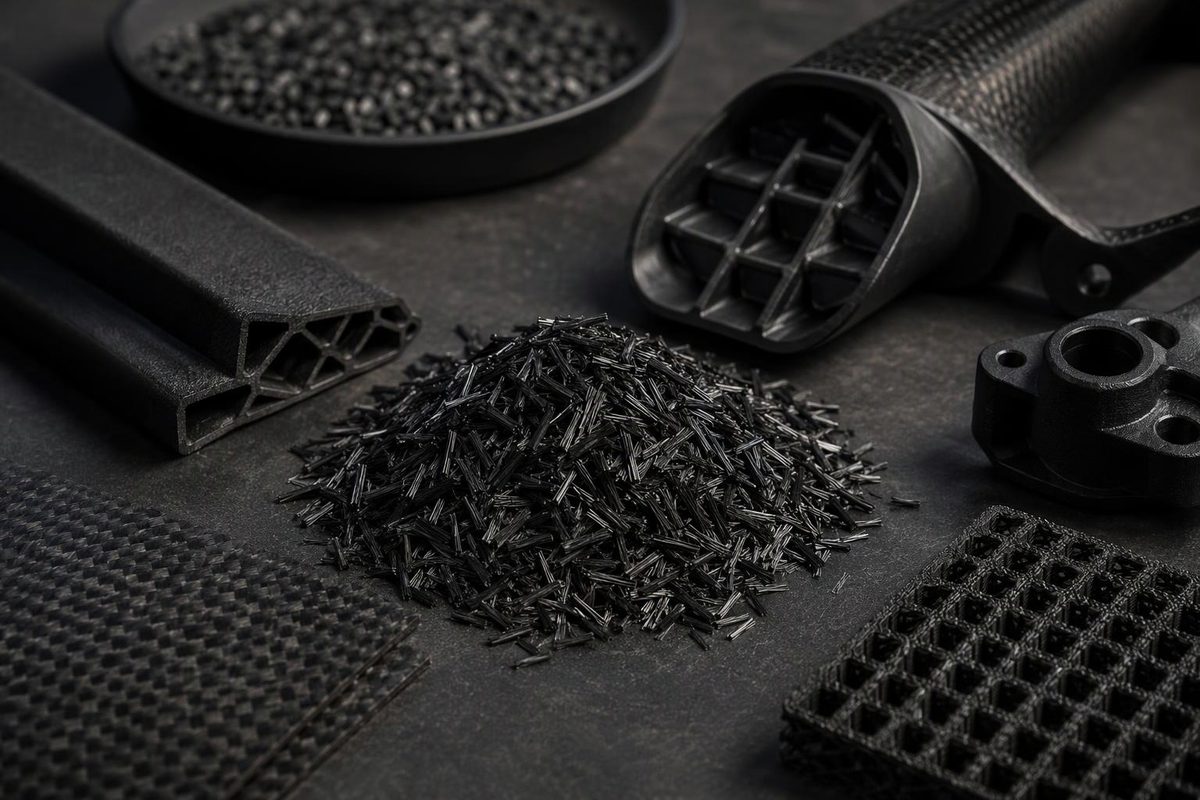
Chopped carbon fiber is carbon-fiber reinforcement cut into finite lengths rather than kept continuous in tow, fabric or tape. For polymer-composite parts, it is mixed with a matrix or supplied already combined with resin for molding. The useful trade-off is easier processing into complex shapes, but less control over continuous, direction-specific load paths.
It is not one material grade, and it has no single tensile-strength value. Fiber length, orientation, resin, bonding and processing determine what the finished composite can do.
What exactly are you buying?
Three forms need separating:
- Dry chopped fiber: cut strands or bundles that need a matrix. Sizing—a surface coating—can hold filaments together for feeding and handling, then allow them to separate during processing. Hexcel’s 2016 HexTow datasheet, for example, describes sized flakes with a nominal cut length of 6.4 mm (¼ inch). That is a product example, not a universal chopped-fiber length. HexTow datasheet
- Discontinuous molding compound: fiber already combined with resin. These materials can use much longer reinforcement than a short-fiber plastic compound. Hexcel’s HexMC, for example, uses 50 mm carbon fibers and is designed for compression molding. HexMC product guidance
- Milled carbon fiber: finely ground reinforcement, often sold as powder. A published review defines milled fiber as less than 1 mm for its analysis, while noting that terminology is inconsistent. Do not substitute a powder for a chopped-tow product based on the word “carbon” alone. Milled-fiber review
“Chopped” also does not mean “recycled.” Both virgin and recovered carbon fiber can be shortened. With recovered material, ask whether the product is separated fiber or a mechanically recycled mixture containing old resin and fillers; both forms exist. Recycling and fiber-form review
Why length, orientation and sizing matter
The matrix transfers load into discontinuous fibers through the fiber–matrix interface. Effective reinforcement therefore depends on both fiber length and bonding—not simply the strength of the original carbon filaments. The milled-fiber review identifies length as important to reinforcement and documents how surface treatments can improve or worsen performance depending on the polymer involved. Review of length and interfacial effects
Use the length remaining in the part, not just the nominal feedstock length. In injection molding, fibers shorten as material passes through the screw and flow restrictions. Research covering carbon- and glass-fiber thermoplastics also shows that processing parameters and tooling influence orientation and fiber-length attrition. A longer starting fiber is therefore not a guarantee of equivalent reinforcement in the finished part. Fiber-length measurement research
Nor does “random chopped fiber” guarantee equal properties in every direction. Flow during molding changes fiber orientation; measurements in long-carbon-fiber thermoplastic parts show distinct shell/core orientation structures. Evaluate the molded architecture and loading direction rather than assuming isotropy from the feedstock description. PNNL process and orientation research
Sizing matters for both feeding and compatibility with the matrix. Hexcel lists different sizing systems for different polymers and explicitly describes the listed compatibility as theoretical, not guaranteed. Ask for the sizing designation and evidence in your actual resin—not merely an “epoxy-compatible” label. HexTow sizing guidance
Suitable chopped-fiber compounds can provide higher stiffness and strength, lower shrinkage and thermal expansion, and improved wear resistance. They can also provide electrical and thermal conductivity. These are potential composite benefits, not properties guaranteed by adding an arbitrary amount of loose fiber to resin. HexTow molding-compound guidance
Processing routes and useful applications
Compounding and injection molding
Carbon fiber is incorporated into thermoplastic feedstock and molded into a part. This route supports repeat production of complex components, including automotive structures. Moldability still has limits: PNNL’s long-carbon-fiber trials encountered incomplete filling of thin ribs and poor fiber wet-out in some parts. The report linked these issues to material viscosity, rib thickness, sizing and processing. Carbon content alone does not establish that a compound will fill your tool successfully. PNNL molding trials
Compression molding
A fiber/resin charge is loaded into a mold and consolidated as the tool closes. Commercial molding compounds target complex three-dimensional shapes, thickness changes and integrated inserts. Hexcel identifies automotive, sporting-goods, marine and industrial applications, alongside aerospace connector parts. HexMC applications
Small-shop versions may use dry chopped tow wetted with epoxy in the mold. Charge quantity, wet-out, placement, tool closure and cure still need control. Easy Composites’ process tutorial stresses calculated fiber loading and demonstrates adding aligned continuous tow to improve reinforcement in a principal load direction. That illustrates an important option: a hybrid of chopped and continuous reinforcement, rather than treating them as mutually exclusive. Compression-molding guidance
For parts marketed as “forged carbon,” request the actual fiber architecture, resin and molding specification. The name alone is not a structural qualification.
Carbon-filled 3D-printing filament
Carbon-filled filament is another polymer-composite route, not a substitute for a continuous-fiber laminate. Prusa warns that filled filaments can have worse layer-to-layer adhesion and lower impact resistance, and require an abrasion-resistant nozzle. Some carbon-filled products are intended mainly for appearance. Prusa material guidance
For printing-specific thermal treatment, see whether annealing carbon-fiber filament makes it stronger.
What to specify before buying
Request:
- Fiber grade and origin: virgin, production scrap or recovered fiber; identify residual resin or fillers.
- Length and form: nominal cut length, length distribution, bundle form and expected retained length after processing.
- Sizing and matrix: coating designation, compatible resin and validation data.
- Fiber content: state whether the percentage is by mass or volume.
- Process requirements: feeding, drying where required, consolidation and cure conditions.
- Finished-composite evidence: test method, specimen direction, conditioning and manufacturing route—not bare-fiber strength presented as part strength.
Choose chopped reinforcement when moldability and manufacturing economics help meet the part requirements. Where directional load carrying is central, compare it with a continuous-fiber or hybrid design. For a load-bearing part, qualify the actual molded component, including its inserts and joints; a strong coupon or an attractive mottled surface does not establish component performance.