
What You’re Actually Buying When Carbon Fiber Comes in Color
Color may come from colored companion yarn, a fiberglass ply, resin pigment, clear coat, paint, printing, proprietary treatment or carbon-free vinyl.
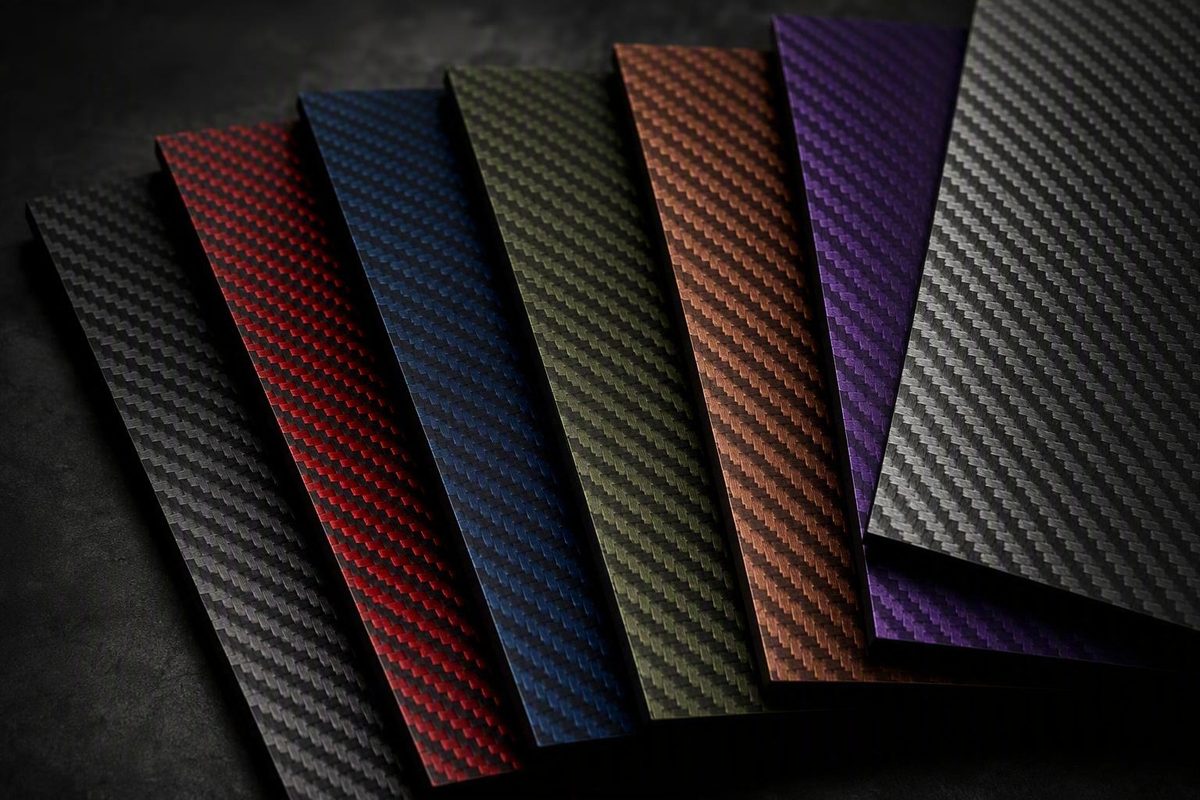
“Colored carbon fiber” sounds like a straightforward material description. In practice, it is a broad sales label covering several fundamentally different products.
The visible color might come from yarn woven beside black carbon, a colored fiberglass surface ply, pigment in the resin, translucent clear coat, opaque paint, printed graphics, a proprietary fiber treatment, or vinyl film containing no carbon fiber at all. Some products can contribute reinforcement. Some are primarily cosmetic laminates. Others only imitate the appearance of a composite.
That distinction matters because color says almost nothing about how a part carries load. Before comparing products, separate two questions:
- What fibers and laminate plies perform the structural work?
- What material or process creates the visible color?
A useful purchase specification answers both.
What “colored carbon fiber” actually means
Conventional carbon fiber is black or dark gray and is difficult to color using ordinary textile-dyeing methods. Commercial products therefore create bright red, blue, green, silver, gold, or multicolor appearances through several constructions rather than simply dyeing standard carbon tow. For background on how conventional tow becomes fabric, prepreg, and cured composite, see this overview of carbon-fiber manufacturing from precursor to finished part.
The principal colored-product categories are:
- Proprietary colored-carbon material: A supplier applies or embeds color using a process associated with the carbon reinforcement.
- Carbon-containing hybrid weave: Black carbon is woven with polyester, aramid, fiberglass, Innegra, metal wire, or another contrasting yarn.
- Colored surface ply over carbon: A visible glass or decorative fabric covers underlying carbon plies.
- Tinted resin or clear coat: Translucent color is added around or above conventional black carbon.
- Painted, coated, or printed composite: A cured carbon part receives an opaque or translucent finish, graphic, logo, pattern, or identification mark.
- Carbon-look film: Textured or printed polymer film creates the appearance of carbon fiber without supplying composite reinforcement.
A product can therefore contain genuine carbon fiber without being made entirely from colored carbon filaments. A red-and-black carbon/aramid cloth may be a genuine carbon-containing reinforcement, for example, but the red yarn is not necessarily carbon. Likewise, a sheet can have structural carbon plies beneath a colored fiberglass face.
The practical authenticity test is not simply, “Is it real carbon fiber?” Ask instead:
- What carries the load?
- What produces the color?
- Is the visible layer part of the structural stack, a cosmetic outer ply, a coating, or a separate film?
- What evidence supports the claimed performance?
This is especially important in online marketplaces. A title such as “colored carbon fiber sheet,” a recognizable twill photograph, or placement in a carbon-fiber retail category does not establish fiber composition, resin system, layup, or structural capability. For example, an Amazon listing from Venom Carbon identifies a blue twill resin kit but does not disclose the complete fiber blend, resin specification, laminate construction, or mechanical properties (Amazon listing, accessed August 19, 2026).
Treat “colored carbon fiber” as the beginning of an investigation, not the answer.
The main ways carbon-fiber products receive color
Each coloring route leaves different evidence in the finished part. Some methods preserve a woven pattern because color is incorporated into the textile. Others leave the underlying weave visible through a translucent finish. Opaque paint can hide the weave almost completely.
The comparison below describes typical constructions, not universal performance. Most available method descriptions come from suppliers or retailers rather than controlled, cross-product testing.
| Color source | Typical construction | Weave visibility | Likely role | Finish options | Principal limitations | Evidence quality |
|---|---|---|---|---|---|---|
| Colored companion yarn | Black carbon woven with polyester, aramid, fiberglass, Innegra, wire, or another yarn | High | Cosmetic outer ply or reinforcement-capable hybrid | Commonly clear-coated; gloss, satin, or matte possible | Properties differ from an equivalent all-carbon fabric; cutting and edge behavior can change | Composition is often disclosed, but laminate test data are uncommon |
| Colored glass surface ply | Dyed, coated, or otherwise colored glass over underlying carbon plies | High if woven | Decorative face over a carbon laminate | Clear, gloss, satin, matte, or metallic | Visible face is not carbon; sanding may expose black underlying plies | Construction is commercially documented; performance depends on the complete laminate |
| Metallic-coated glass | Aluminum-coated fiberglass, including Texalium-type material | High and reflective | Decorative surface ply | Reflective silver or color-treated metallic effects | Frequently mistaken for “silver carbon”; not carbon reinforcement | Basic composition is documented; finished-laminate data vary |
| Tinted resin or clear coat | Pigment or dye in matrix resin, binder, or transparent topcoat | Medium to high | Integrated color or post-cure cosmetic finish | Translucent, candy, gloss, satin, or matte | Dark carbon can mute the color; consistency depends on material and process control | Method is commercially described, but comparative durability data are limited |
| Paint or surface coating | Opaque or translucent coating on a cured composite | Low to high, depending on opacity | Controlled cosmetic finish and color matching | Gloss, matte, satin, metallic, or textured | Adds finishing operations and mass; may scratch or chip; can obscure weave | Common process, but product-specific durability must be verified |
| Hydrographic printing | Patterned film transferred to a prepared cured surface | Usually simulated or partly visible | Detailed decorative pattern | Normally protected by clear coat | Pattern alignment can be difficult on large or complex geometry | Commercially described; long-term results are system-specific |
| Direct printing | Inkjet, UV, or another printing process on a cured surface | Depends on graphic coverage | Logos, serial data, or graphics | Clear-coated or otherwise protected | Better suited to flat or gently curved areas; protection may be needed | Adhesion and aging evidence is product-specific |
| Proprietary colored-carbon process | Supplier-specific treatment or embedded-color system | Usually intended to remain high | Visible composite reinforcement | Supplier-dependent | Process details and independent comparisons may be unavailable | Predominantly supplier and retailer claims |
| Carbon-look film | Embossed or printed polymer film applied to a substrate | Simulated weave | Removable or replaceable cosmetic finish | Matte, gloss, metallic, color-shifting, or forged-look | No carbon-fiber reinforcement | Composition and nonstructural role are generally clear |
Hybrid weaving is one of the most common routes. Carbon may run in one direction while the colored yarn runs in the other, or the fibers may be arranged to produce alternating bands, checks, or diagonal highlights. Polyester can provide bright color, aramid can produce strong contrast, Innegra or fiberglass can create light-colored sections, and copper or stainless-steel wire can introduce metallic highlights.
The visual label does not reveal the engineering consequence. Replacing some carbon yarn with another fiber changes the reinforcement architecture.
A second route uses colored fiberglass or metallic-coated glass as the visible surface ply. This can preserve a woven appearance while leaving conventional carbon plies underneath. It may be appropriate where the outer layer is primarily cosmetic, but drawings and bills of material should not identify that glass face as carbon.
Texalium is a common source of confusion in the silver category. It is a fiberglass-based fabric with a thin aluminum coating, not silver carbon fiber. The relevant purchasing fact is the glass substrate, regardless of the informal label used in a product title (SMI Composites’ explanation of Texalium).
Tinted resin and tinted clear coat can preserve the recognizable black weave while adding a translucent hue. The result depends on pigment concentration, resin or coating thickness, fiber density, cure, substrate darkness, and final finish. Because the carbon substrate is dark, translucent colors may appear darker or less saturated than expected.
Paint and surface coatings offer a direct route to controlled opaque color. They can also produce gloss, matte, satin, metallic, or textured surfaces. The tradeoff is that the coating may partly or completely obscure the weave. It also introduces preparation, application, curing, inspection, and eventual repair operations.
Hydrographics and direct printing are better understood as graphic processes than as fiber-coloring methods. Hydrographics can transfer complex repeated patterns but may be difficult to align over abrupt geometry. Direct printing can add logos, serial information, or detailed artwork, particularly on flat or gently curved surfaces.
Proprietary colored-carbon offerings require careful wording. Hypetex is advertised by a retailer as using an embedded, water-based coloring process and is sold in colored woven formats. The accessible listing does not disclose enough process detail or comparative laminate data to establish performance equivalence with a conventional carbon laminate (Composite Envisions’ Hypetex listing, accessed August 19, 2026).
Research and patent disclosures have explored additional routes. A trade review describes colored prepreg resin, masking scrims, hybrid yarns, tinted coatings, and proprietary developments. Those disclosures show that other mechanisms have been investigated; they do not establish current commercial availability, production maturity, or validated structural performance (CompositesWorld’s review of colored-carbon approaches).
Fabric, veneer, sheet, prepreg, or finished part: choose the right form
Color method is only half the purchasing decision. The product form must also match the manufacturing route.
Dry woven fabric contains reinforcement but no cured matrix. It can be cut and placed in a mold, laminated over an existing substrate, or used as a visible outer layer. Decorative dry fabrics are commonly positioned as:
- The first ply placed against a mold surface
- A cosmetic skin over a core or existing component
- A visible outer ply over structural reinforcement
- A localized overlay or repair material
- Part of a hand-laminated, infused, or vacuum-bagged stack
As listed on August 19, 2026, Easy Composites’ decorative range included colored carbon/polyester hybrids specified as 210 g/m², 3K, 2×2 twill, and 1,000 mm wide. The category identified hand laminating or repair, resin infusion, and vacuum bagging as suitable uses while warning that decorative reinforcement may accept some mechanical compromise for appearance (Easy Composites’ decorative reinforcement listings).
Those process labels are not universal approvals. A retailer’s statement that a fabric is suitable for infusion does not establish compatibility between every colored yarn, sizing, coating, binder, and resin system. Confirm the exact product designation, resin chemistry, cure conditions, and process window.
Spread-tow fabric uses flattened bands that create a larger visual grid and fewer interlacing points than conventional narrow-tow fabric. Unidirectional material places most or nearly all reinforcement in one direction rather than producing a balanced woven appearance. Supplier copy for Hypetex mentions spread-tow, 3K twill, and unidirectional formats, although the retail category checked on August 19, 2026 displayed spread-tow fabric and a 260 g/m² 3K 2×2 twill, not a unidirectional product.
Prepreg is reinforcement pre-impregnated with a controlled resin system. A colored-prepreg specification should cover storage, out-time, shelf life, cure schedule, pressure or vacuum requirements, tooling compatibility, and visible-face construction. Do not assume a dry colored fabric is available as prepreg or that a prepreg uses the same visible construction as similarly named retail cloth.
Cured veneer is a thin decorative laminate intended to be bonded to an existing substrate. A veneer should not be treated as structural plate merely because it contains carbon.
Thicker cured plate may be machined into brackets, panels, covers, or inserts, but suitability depends on its complete layup. A thick sheet with a colored face could contain quasi-isotropic carbon plies, a simple woven stack, glass-rich layers, a core, or another construction. Thickness alone does not identify the load-bearing architecture.
Protech’s colored category illustrates the range that can appear under one retail heading. As listed on August 19, 2026, displayed products included carbon/Kevlar and carbon/fiberglass constructions, generally with high-gloss surfaces and thicknesses from 0.35 to 0.90 mm. The supplier also advertised options including custom dimensions, machining, finishes, adhesive backing, and molded parts; those are supplier-specific services rather than features of colored composites generally (Protech Composites’ colored-sheet category).
Resin kits package some combination of fabric, resin, hardener, or other consumables, but the title may omit important details. Verify the cloth composition, resin type, hardener, mix ratio, quantity, cure conditions, and whether the package contains enough material for the intended process.
Finished molded parts shift more manufacturing responsibility to the producer, but buyers still need a defined laminate, visible-face requirement, finish, dimensions, tolerances, environmental requirements, and acceptance criteria.
Another directional hybrid example comes from Venom Carbon. Its collection, checked on August 19, 2026, listed 3K, 5.7 oz twill hybrid cloth in 12-inch and 50-inch widths and described color in the weft with carbon in the warp. That directional disclosure is more useful than the generic phrase “colored carbon” because it begins to identify which yarn performs which role (Venom Carbon’s hybrid-fabric collection).
Do not transfer a service temperature, nominal thickness, cure recommendation, or processing method from one category to another. A dry polyester/carbon hybrid, aluminum-coated glass face, tinted prepreg, cured veneer, and painted molded component may have entirely different limits.
Decorative versus structural: what color does and does not tell you
Appearance cannot establish structural capability.
A laminate’s performance depends on factors including:
- Fiber types and grades
- Percentage of each fiber
- Fiber orientation
- Layup sequence and symmetry
- Resin system
- Fiber volume
- Consolidation and void content
- Cure cycle and degree of cure
- Ply drops, holes, inserts, and edge details
- Part geometry and tolerances
- Manufacturing defects
- Temperature, moisture, chemicals, and aging
- Load direction, magnitude, frequency, and impact conditions
A colored hybrid may reinforce a component without matching an equivalent all-carbon laminate. If colored polyester replaces carbon yarn in one direction, stiffness or strength in that direction may change. If aramid, glass, or another fiber is introduced, damage and failure behavior may also change. General statements about a companion fiber cannot predict the behavior of a particular laminate.
Easy Composites describes its decorative fabrics as adding structural strength while acknowledging that mechanical properties may be compromised somewhat in favor of appearance. That is a useful bounded supplier description: the material is not necessarily decorative-only, but it should not be substituted for an engineering-grade all-carbon reinforcement without validation (supplier statement on decorative reinforcement).
The same caution applies to proprietary colored-carbon systems. Claims that a process retains or improves performance remain supplier claims unless supported by comparable tests using defined fibers, resin, layup, cure, conditioning, specimen geometry, and test methods. A comparison with an unspecified “standard carbon” control is not enough.
A practical classification system is more useful than a single colored-carbon label:
| Classification | What it means | Appropriate evidence |
|---|---|---|
| Structural candidate with documented laminate data | The complete laminate and manufacturing process are defined, with properties relevant to the intended loads and environment | Material certificates, laminate test reports, process controls, inspection requirements, and engineering validation |
| Reinforcement-capable hybrid requiring validation | The fabric contains carbon and can contribute load capacity, but companion yarns alter the architecture | Exact fiber composition, orientation, resin compatibility, laminate tests, and application-specific analysis |
| Decorative composite or outer ply | Genuine composite material supplies appearance and perhaps local reinforcement, but primary structural credit is assigned elsewhere | Construction disclosure, adhesion and environmental tests, cured-sample approval, and damage or repair criteria |
| Nonstructural imitation | Film, print, or molded texture creates a carbon look without carbon reinforcement | Finish, adhesion, installation, aging, and removability requirements—not carbon-fiber mechanical properties |
For primary structure, safety-critical components, or tightly controlled performance requirements, request laminate-specific tensile, compression, shear, flexural, fatigue, impact, and environmental data as applicable. The necessary evidence depends on the actual load case; not every project requires every test.
One useful design strategy is to separate appearance from primary structure. An engineering laminate can carry the load while a thin decorative surface ply provides the color. That surface ply still requires compatibility and damage assessment, but it does not silently redefine the main structural stack.
How weave, resin, finish, and lighting change the final appearance
The same nominal color can look different in dry cloth, after wet-out, after cure, and after clear coating.
Plain weave creates a tight, regular checkerboard with frequent yarn interlacing.
A 2×2 twill creates a diagonal pattern and the shifting light bands associated with many cosmetic carbon parts.
Spread tow produces a larger checkerboard or ribbon pattern. Color may appear in broad blocks rather than as narrow yarn highlights.
Forged or chopped patterns replace a continuous woven repeat with irregular flakes or short-fiber patches. Color may come from tinted resin, metal leaf, colored companion fibers, printing, or a surface coating. “Forged” does not identify one standardized colored construction.
Finish changes the result again:
- High gloss increases reflections, contrast, and apparent depth.
- Satin reduces sharp reflections while retaining some depth.
- Matte suppresses reflections and can make the pattern appear flatter or softer.
- Metallic finishes create strong directional highlights and may shift significantly with angle.
- Textured finishes scatter light and may reduce the apparent precision of the weave.
A colored yarn may deepen or darken, while translucent tint over black carbon may look muted. Sanding can alter gloss or expose different layers in the surface system.
For appearance-critical work, approve the material at five checkpoints:
- Dry material: Verify yarn color, weave, defects, visible face, and orientation.
- Wet-out sample: Observe color shift, transparency, print-through, and trapped-air visibility.
- Cured laminate: Evaluate the actual resin, cure, consolidation, and tooling surface.
- Sanded surface, if applicable: Confirm that preparation does not expose or damage the colored layer.
- Final coated finish: Approve color, gloss, depth, texture, and viewing-angle effects.
Online photographs are weak acceptance standards. Lighting color temperature, exposure, white balance, viewing angle, background, screen rendering, and gloss all affect perceived color. A blue twill photographed under diffuse studio lighting may appear nearly black under different indoor lighting.
Projects requiring brand matching or batch consistency should use:
- An approved physical master sample
- Defined illumination and viewing geometry
- A named gloss level and measurement method
- A specified color space and measurement instrument
- An objective allowable color difference
- A rule for directional or metallic finishes
- Batch-retention samples and replacement-batch criteria
The supplied commercial evidence does not provide a reliable cross-method comparison for ultraviolet fading, resin yellowing, color shift, or batch-to-batch Delta E. Those remain matters for product documentation and project-specific testing.
Commercial listings show bright red, blue, lime, orange, jewel tones, camouflage, metallic-looking styles, and glow-in-the-dark effects. Similar-looking products may obtain those appearances from entirely different fibers or surface systems. A color name is therefore not a sufficient technical specification.
Fabrication, machining, finishing, and repair considerations
Dry decorative fabrics are commonly marketed for hand layup, skinning, repair, infusion, and vacuum bagging. That establishes common intended uses, not blanket approval for every resin and process.
Before lamination, confirm:
- Resin chemistry and sizing compatibility
- Whether coated or metallic yarns wet out normally
- Required cure temperature and pressure
- Maximum permitted processing temperature
- Expected resin uptake
- Consolidated thickness
- Whether the visible fabric tolerates debulking or compaction
- Whether the color system can bleed, shift, wrinkle, or print through
- Whether a gel coat, surface film, or clear layer is required
Visible weaves add alignment challenges. Tight curves, corners, changing section thickness, and complex mold geometry can distort the pattern. A technically acceptable laminate may still fail cosmetic inspection if diagonal lines wander, tow spacing changes, or colored yarns become asymmetric around a feature.
Plan seams and orientation before cutting. Identify the visible face and warp direction. If opposite sides of a part must correspond, specify whether the weave should be mirrored, book-matched, or run continuously in one global direction.
Aramid-containing hybrids need particular attention during cutting. Aramid can fuzz rather than fracture cleanly, so tooling, support, feed, and edge-finishing methods should be trialed before production. A supplier-authored buying guide specifically flags fuzzy aramid edges and the need to consider tooling and finishing (colored-composite fabrication guidance).
For cured colored laminates, machining inspection should consider:
- Delamination at holes and edges
- Frayed or pulled companion fibers
- Chipped paint, metallic coating, or printed finish
- Surface scratches caused by fixtures or swarf
- Local heat damage or resin discoloration
- Breakout on the exit face
- Acceptable exposure of underlying black plies
- Edge-seal appearance and adhesion
- Pattern alignment around cutouts
Repair strategy depends on the source of color.
A colored surface ply may be sanded through during preparation, exposing black carbon or another layer.
Printed and hydrographic finishes generally require a protective topcoat.
Use representative process coupons before committing to production. A coupon program can evaluate:
- Dry handling and cutting
- Resin wet-out
- Vacuum or pressure consolidation
- Cure-related color shift
- Surface texture and pinholes
- Sanding response
- Clear-coat compatibility
- Drilling and trimming
- Edge sealing
- Repair preparation and color matching
- Exposure to relevant cleaners, heat, moisture, or chemicals
These checks are not substitutes for supplier safety data, cure instructions, ventilation requirements, dust controls, or personal-protective-equipment guidance. Those requirements are specific to the selected resin, coating, adhesive, and manufacturing process.
Selecting a method for the actual use case
The best colored construction depends on what the part must do. Start with the project goal, not the supplier category.
| Project goal | Likely route | Why it may fit | Main checks |
|---|---|---|---|
| Cosmetic skinning or visible mold surface | Carbon/colored-yarn hybrid fabric | Preserves a genuine woven composite appearance and can be placed as the visible ply | Cured sample, resin compatibility, drape, alignment, yarn composition, and sanding allowance |
| Recognizable weave with translucent color | Tinted resin, binder, or clear coat | Adds color while allowing the black pattern to remain visible | Substrate darkening, film thickness, consistency, adhesion, aging, and repair |
| Exact opaque brand color | Paint or opaque coating | Offers a comparatively controllable route to solid color | Added operations and mass, preparation, scratch or chip criteria, and reduced weave visibility |
| Logo, serial number, or detailed graphic | Direct printing | Supports precise local graphics and variable information | Surface geometry, adhesion, resolution, protective finish, abrasion, and fading |
| Repeating graphic over a molded part | Hydrographic printing | Can transfer complex patterns over three-dimensional surfaces | Pattern stretch, seam placement, alignment, topcoat, and repair method |
| Reflective silver woven appearance | Texalium or another coated-glass face | Produces a bright metallic weave | Confirm the glass substrate, define underlying structural plies, and inspect coating and edges |
| Load-bearing visible component | Documented structural laminate, potentially with a separate decorative ply | Keeps engineering requirements ahead of color selection | Full laminate data, process validation, structural analysis, inspection, and environmental testing |
| Reversible vehicle appearance change | Carbon-look vinyl | Changes appearance without molding or replacing the underlying component | Treat as cosmetic film; define finish, installation, substrate compatibility, and removal expectations |
For automotive trim, hybrid fabric, veneer, coating, or film may all be viable depending on whether the goal is a molded part, bonded overlay, exact painted color, or reversible finish.
For marine products, evaluate appearance alongside moisture, saltwater, cleaners, fuel, abrasion, and repair requirements. Appearance in an automotive example does not establish marine suitability.
For sporting goods, distinguish grip-zone decoration from the primary load-bearing structure. A colored outer ply may be acceptable without assigning it the design allowables of the structural laminate.
For luxury products and consumer accessories, surface quality, tactile finish, scratch behavior, edge appearance, and batch consistency may dominate. If carbon is expected to contribute stiffness or reduce weight, that role should still be documented rather than inferred from the weave.
For industrial covers and equipment panels, chemical resistance, cleanability, dimensional stability, identification colors, and replacement may matter more than maximum specific stiffness. Paint or printed graphics may be more practical than a complex colored weave.
If the requirement is a reflective silver fabric, explicitly ask whether it is Texalium, another coated glass, a carbon/metal-wire hybrid, or a printed metallic finish. “Silver carbon” is not a complete material description.
For a load-bearing visible part, select the structural laminate first. A decorative outer ply can then be evaluated for adhesion, strain compatibility, impact response, processing, and repair. If the decorative material must carry design load, include it in the tested laminate rather than assigning it generic carbon-fiber properties.
Carbon-look vinyl belongs in a separate category. It is a multilayer polymer film patterned or embossed to resemble woven or forged carbon. It may be offered in multiple colors, gloss levels, and textures, but it provides no carbon-fiber structural benefit (distinction between carbon-look wrap and structural composite).
A buyer’s specification and sample-approval checklist
A quotation request should define the material well enough that competing suppliers are quoting comparable products.
Product form and construction
- Dry fabric, prepreg, veneer, plate, resin kit, adhesive-backed laminate, or finished molded part
- Actual fiber types
- Percentage of carbon and each companion fiber, where available
- Fiber grade or supplier designation
- Exact source of visible color
- Whether color is in the yarn, surface ply, matrix, clear coat, paint, print, or film
- Weave or reinforcement architecture
- Warp and weft composition
- Tow size
- Areal weight
- Roll width, sheet dimensions, or part dimensions
- Nominal thickness and allowable variation
- Visible-face designation
- Pattern and fiber orientation
Resin and processing
- Resin chemistry and product designation
- Sizing and resin compatibility
- Mix ratio, where applicable
- Prepreg resin content, storage, shelf life, and out-time
- Cure schedule
- Pressure, vacuum, or consolidation requirements
- Processing-temperature limit
- Maximum service conditions supported by product-specific evidence
- Fiber volume where structurally relevant
- Layup schedule and ply sequence
- Tool-side and bag-side finish expectations
Surface and bonding
- Gloss, satin, matte, metallic, or textured finish
- Measured gloss level and test geometry
- Clear-coat, paint, gel-coat, or surface-film system
- Coating thickness or allowable range
- Adhesive type and backing thickness
- Substrate preparation
- Bondline thickness
- Peel liner and storage requirements
- Visible edge treatment
Structural evidence
For structural work, request data relevant to the design rather than generic carbon-fiber brochure values. Depending on the load case, that may include:
- Tensile properties by direction
- Compression properties
- In-plane and interlaminar shear
- Flexural behavior
- Bearing and open-hole behavior
- Impact and damage tolerance
- Fatigue
- Environmental conditioning
- Batch and process variability
- Test standards, specimen construction, and failure modes
- Quality-control records and material traceability
The test laminate should match the proposed fiber blend, orientation, resin, fiber volume, cure, and surface construction. Data for a black all-carbon laminate do not automatically qualify a colored hybrid.
Environmental requirements
Specify only the exposures relevant to the application, but do not leave them implicit:
- Ultraviolet exposure
- Maximum and minimum temperature
- Thermal cycling
- Moisture and immersion
- Saltwater
- Fuel, oil, hydraulic fluid, or solvents
- Cleaners and disinfectants
- Acids, alkalis, or process chemicals
- Abrasion
- Scratch and chip resistance
- Outdoor weathering
- Color shift and gloss retention
Claims such as “UV stable,” “chip resistant,” or “weather resistant” should be tied to a defined material system, test method, exposure duration, conditioning procedure, and acceptance limit.
Machining and edge quality
- Dimensional and geometric tolerances
- Hole diameter and position
- Countersink or counterbore requirements
- Edge perpendicularity and breakout limits
- Acceptable delamination
- Acceptable fraying of companion yarns
- Allowable coating chipping
- Burr and splinter criteria
- Edge sealing
- Exposed-ply limits
- Inspection method and sampling plan
Appearance requirements
- Physical color master or recognized color standard
- Instrumental measurement method
- Acceptable color difference
- Approved lighting and viewing conditions
- Weave pattern
- Warp direction and visible-face orientation
- Pattern centering and alignment
- Gloss level
- Texture
- Surface-defect limits
- Acceptable pinholes, print-through, waviness, scratches, or inclusions
- Batch-to-batch consistency
- Rules for replacement parts
A digital image or color name is not enough for brand-critical work. “Red,” “cobalt,” “lime,” and “silver” can describe substantially different appearances.
Sample approval
Request a representative sample or small production batch before a bulk order. Inspect:
- Dry color and yarn composition
- Wet-out appearance
- Cured color
- Weave alignment
- Surface finish
- Thickness
- Edge quality
- Machined holes and cutouts
- Coating adhesion
- Adhesive backing
- Repair response
- Appearance under intended lighting
Retain an approved sample and record its material lot, resin batch, cure, coating system, and measurement results. A sample without traceable process information is useful as a visual reference but weak as a production control.
Commercial and supply questions
- Minimum order quantity
- Standard and custom widths or sheet sizes
- Lead time
- Custom-color development requirements
- Tooling or setup charges
- Sample policy
- Replacement-batch policy
- Shelf life and storage
- Technical documentation
- Certificates of conformity
- Lot traceability
- Change-notification policy
- Packaging and surface protection
Do not compare advertised prices until area, thickness, quantity, fiber composition, resin content, surface finish, adhesive, machining, packaging, and selected variant have been normalized. A small veneer, a linear metre of dry cloth, a prepreg roll, a resin kit, and a machined plate are not comparable merely because each is listed under “colored carbon fiber.”
The compact authenticity checklist is:
- What carries the load?
- What produces the color?
- What evidence supports the claimed performance?
Approve a cured sample and a written construction specification before purchase. Whenever a part will carry meaningful load, require engineering evidence for the actual laminate—not a photograph, product title, or generic carbon-fiber datasheet.
Frequently asked questions
Can carbon fiber itself be dyed red, blue, or another bright color?
Conventional carbon fiber is black or dark gray and does not accept ordinary textile dyes in the way many colored companion fibers do. Most bright commercial effects therefore come from hybrid yarns, colored surface plies, tinted resin, coatings, printing, or proprietary treatments.
Specialized coloration and structural-color approaches have been explored, so it is unnecessarily absolute to say carbon can never display color. The purchasing point is narrower: do not assume that a bright woven product consists of conventionally dyed carbon filaments. Ask the supplier to identify the fibers and coloring process.
Is colored carbon fiber as strong as ordinary black carbon fiber?
Color alone cannot establish equivalent strength.
A hybrid weave may replace some carbon with polyester, aramid, glass, or another yarn, changing the reinforcement architecture. A colored surface ply may sit over an otherwise conventional structural stack. A proprietary system may make performance claims that still require verification.
Any conclusion of equivalence should come from comparable testing of the actual fibers, resin, layup, cure, conditioning, specimen design, and test methods—not from color or appearance.
What is the difference between silver carbon fiber and Texalium?
“Silver carbon fiber” is an informal visual description that can refer to several constructions. Texalium is a metallic-coated fiberglass fabric, not carbon fiber. It may be used as a reflective decorative face over a laminate that contains carbon elsewhere.
Another silver product might use metal wire woven with carbon, a metallic coating, a printed finish, or a different coated-glass fabric. Require the supplier to state both the visible-yarn composition and the underlying laminate.
Can colored carbon-fiber fabric be used with resin infusion or vacuum bagging?
Some decorative carbon-containing fabrics are explicitly marketed for resin infusion and vacuum bagging. That establishes that suitable products exist, but it is not universal approval for every colored fabric.
Confirm the specific cloth’s sizing, companion-fiber composition, coating, binder, resin compatibility, cure temperature, permeability, compaction, and appearance under the proposed process. Run a representative coupon before production, especially when metallic coatings, unusual yarns, translucent color, or demanding cosmetic requirements are involved.
Is colored carbon-fiber wrap real carbon fiber?
Usually, “carbon-fiber wrap” means patterned or embossed vinyl film applied over an existing surface. It may imitate woven, forged, matte, gloss, metallic, or colored carbon, but it does not provide carbon-fiber reinforcement.
The term is occasionally used loosely for a cured composite veneer intended to skin a substrate, so verify the construction. Vinyl is an adhesive polymer film; genuine veneer is a cured fiber-and-resin laminate. Neither should receive structural credit without engineering evidence for the installed system.