
What the Blue Material Really Is—and How to Choose the Right Form
A cured veneer containing carbon is not automatically a structural sheet, while blue carbon-pattern vinyl has no carbon reinforcement. The form must fit the job.
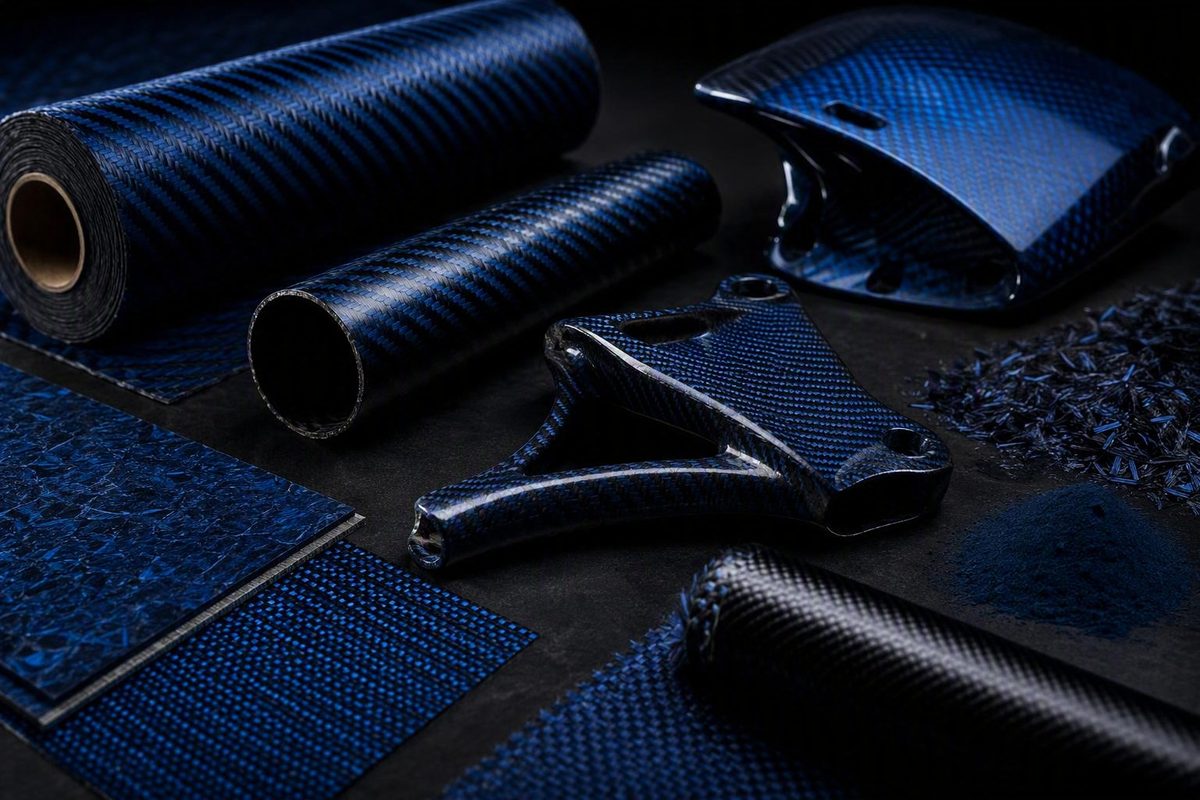
“Blue carbon fiber” is not one material specification. It is a retail and design term applied to fundamentally different products: dry hybrid reinforcement, carbon laminates with colored surface plies, black carbon beneath a tinted finish, cured decorative veneers, and films that merely reproduce a carbon weave.
Raw carbon fiber is normally black or dark gray. In conventional commercial blue products, the carbon filaments generally have not been dyed blue. The color usually comes from a second yarn, an outer ply, resin, coating, applied graphic, or lighting effect.
That distinction matters. A fabric containing genuine carbon can have a substantially different composition from an all-carbon reinforcement. A cured veneer containing carbon is not automatically a structural sheet, and blue carbon-pattern vinyl contains no carbon reinforcement at all.
The practical rule is to identify where the blue comes from, what form the product takes, and what the complete laminate must do before comparing appearance, specifications, or price.
What “blue carbon fiber” usually means
Most commercial blue carbon fiber falls into one of five categories:
- Blue yarn woven with black carbon. The colored yarn may be polyester, aramid, fiberglass, or another decorative filament.
- A blue decorative outer ply over carbon. The visible surface may be colored fiberglass or hybrid fabric, while the backing plies contain conventional carbon reinforcement.
- Black carbon beneath blue-tinted resin or clear coat. The carbon remains black; the transparent finish changes its apparent color.
- A cured hybrid veneer. Carbon and a colored fiber have already been impregnated, cured, and finished as a thin sheet for bonding or decorative fabrication.
- A simulated pattern. Vinyl wrap, printed film, hydrographics, digital textures, and blue lighting can imitate carbon without containing carbon reinforcement.
This taxonomy is more useful than the product name because it locates the color. Ask whether the blue resides in the woven yarn, outer laminate ply, resin or coating, applied film, or image itself.
Many products sold under the term are genuine carbon-containing composites. They are nevertheless hybrids, not uniformly blue all-carbon cloth. A black-and-blue fabric may place carbon in one yarn direction and a colored polymer or aramid in the other. A veneer may combine carbon with colored fiberglass. Both contain carbon, but neither should automatically be treated as equivalent to an all-carbon reinforcement.
Retail search results illustrate the ambiguity. In one reviewed Amazon search-page example, the query returned a prominently placed advertisement for black carbon-pattern vinyl rather than verified blue composite reinforcement. Search-result volume does not establish authenticity, availability, quality, or structural performance; it shows why buyers must verify the product form before ordering. See the reviewed retail search example.
The presence of real carbon establishes only that carbon appears somewhere in the product. It does not reveal:
- The percentage of carbon
- The carbon-fiber grade
- Which direction contains carbon
- The resin system or cure
- The finished fiber volume fraction
- The laminate thickness and stacking sequence
- Mechanical properties
- Environmental durability
- Suitability for a load-bearing part
“Contains carbon fiber” is therefore a composition clue, not a performance certificate.
Five ways manufacturers create a blue carbon-fiber appearance
The available methods differ in where they put the color and how much they alter the visible ply.
1. Carbon and blue-polyester hybrid cloth
In this construction, black carbon tows and blue polyester yarns are woven together. The blue is physically present in the weave rather than applied afterward.
Easy Composites provides a product-specific example: its black-and-blue cloth is listed as a 3K carbon/polyester hybrid with 50% colored-polyester yarn content. That percentage describes this fabric, not a universal formula for blue hybrids. The seller also states that the material does not have the same mechanical properties as 100% carbon-fiber fabric. Review the Easy Composites product specification.
Polyester can produce a strong color contrast and may suit decorative skins or mold-facing plies. The tradeoff is that positions occupied by polyester are not occupied by carbon. That changes the composition and may change laminate stiffness, strength, compression behavior, or other properties. The result must be evaluated as a particular laminate rather than inferred from its color.
2. Carbon and blue-aramid hybrid cloth
In documented products from Soller Composites and Fiberglass Supply, black 3K carbon is combined with seller-described blue “Kevlar” in a 2×2 twill. Fiberglass Supply further states that the carbon usually runs along the fabric length while the blue yarn runs across it.
That directional distinction matters. The visible fabric does not contain the same reinforcement material in both principal directions merely because its pattern appears balanced.
“Kevlar” is a brand name, although retail listings may use the word without identifying the manufacturer or fiber grade. If brand authenticity, grade, or traceability matters, request supporting documentation rather than relying on the product title.
3. Colored-fiberglass surface plies
Colored fiberglass can serve as the visible outer skin while conventional carbon plies remain underneath. This can produce a brighter blue than a tint applied over black carbon while retaining a woven appearance.
The decorative ply still becomes part of the laminate. It should not be treated as optically present but mechanically nonexistent.
This approach can be useful when appearance and primary reinforcement are specified separately: the blue fiberglass supplies the visible surface, while the carbon plies beneath it are selected for the intended directional reinforcement.
4. Blue-tinted resin or clear coat
A transparent blue resin or coating leaves the carbon itself black. Light passes through the tint, interacts with the carbon weave and surrounding surfaces, and returns through the colored layer.
The result depends heavily on tint concentration and film thickness. Too much tint can obscure the weave and make the surface nearly opaque. Too little may create a weak or uneven cast. Because the substrate is black, the finished blue can appear darker than a liquid tint sample suggests.
Color durability then becomes a coating-system question. It cannot be inferred from the word carbon. It depends on the pigment or dye, resin or clear coat, adhesion, cure, thickness, and service environment.
5. Decorative threads, flakes, and forged styling
Metallic yarns or fine decorative wires can be woven through black reinforcement to create colored highlights. Metallic flakes or colored leaf can also be dispersed into resin, particularly in products styled as forged carbon.
Forged-carbon appearance differs from a continuous twill hybrid. It generally uses chopped, irregularly oriented carbon in a resin matrix, creating a marbled rather than repeating woven pattern. Blue flakes or tint may color the matrix without changing the carbon fragments themselves.
Direct or structural coloration of carbon has also been researched. Supplier guides distinguish these research-focused approaches from the hybrid yarns, surface plies, coatings, and decorative finishes normally found in commercial colored-composite products. See the overview of commercial and research-focused coloring methods.
| Appearance route | Where the blue resides | Where actual carbon may reside | What a cross-section would show |
|---|---|---|---|
| Hybrid weave | Blue yarn inside the visible fabric | In the black tows crossing the blue yarn | Carbon and colored yarn interlaced within one dry ply |
| Colored outer ply | In blue fiberglass or another decorative surface fabric | In separate backing plies beneath the surface | A blue outer skin above one or more black carbon plies |
| Tinted finish | In transparent resin or topcoat | In the cured black reinforcement below | A thin colored coating over black carbon |
| Applied film | In printed or embossed polymer film | Possibly nowhere | Decorative film bonded to a non-composite substrate |
Visually similar blue surfaces can therefore have completely different cross-sections and functions.
Dry cloth, cured veneer, finished sheet, or imitation: know what you are buying
Before comparing prices or specifications, divide products by material form.
Dry reinforcement cloth
Dry cloth is uncured reinforcement. It still needs:
- A compatible resin
- Impregnation
- Placement and consolidation
- Cure
- Release or demolding, where applicable
- Trimming
- Surface finishing
Depending on the product, dry cloth may be used for wet lay-up, vacuum bagging, resin infusion, a decorative first ply in a mold, or skinning an existing component. It gives the fabricator control over the laminate but also transfers responsibility for resin selection, processing quality, thickness, and finish.
Dry cloth is not ready to bolt on, machine like a finished plate, or bond in place without first becoming part of a cured laminate.
Cured veneer
A veneer has already been impregnated and cured as a thin sheet. It is generally intended for bonding to a substrate or cutting into decorative overlays and inserts.
Protech lists glossy blue veneers combining carbon with blue aramid, woven blue fiberglass, or dyed fiberglass. The examples are approximately 0.5–0.85 mm thick, making them cured veneers rather than loose reinforcement cloth. Compare Protech’s listed blue hybrid veneers.
A thin veneer should not be assumed to carry a primary load merely because it contains carbon.
Finished or structural sheet
A thicker cured sheet may be intended for machining, brackets, panels, instrument faces, fixtures, or structural components. However, neither “sheet” nor “carbon fiber” proves suitability for a particular load.
For a load-bearing sheet, buyers still need its layup, resin, thickness tolerance, fiber orientation, test data, machining limits, and design review. A plate made largely from unidirectional carbon can behave very differently from a woven laminate or a decorative skin over another material.
Vinyl, hydrographics, and printed texture
Vinyl wrap is a polymer film with a printed or embossed carbon pattern. Hydrographic decoration transfers an image to a substrate. Printed laminates and digital textures reproduce the weave graphically.
These can be rational choices when the requirement is only color and pattern. They avoid the resin, tooling, and finishing requirements of composite fabrication. They do not provide carbon-fiber reinforcement.
Four-path decision tree
Use the intended fabrication route to choose the form:
-
Do you need to engineer a new laminate? Buy dry reinforcement—or another engineered reinforcement format—and specify the complete layup, resin, processing route, and validation plan.
-
Do you need a blue cosmetic face on a molded composite? Select a process-compatible decorative fabric as the mold-facing ply, then place the separately designed structural plies behind it.
-
Do you want to skin an existing part? Use suitable dry cloth and resin if you can perform the lay-up, consolidation, cure, trimming, and finish work. Confirm that the added skin, bond, edges, and thickness suit the substrate.
-
Do you want ready-cured decoration? Bond a veneer when its thickness, stiffness, finish, and forming limits fit the part. Use film when only the graphic effect is required.
Do not pay for reinforcement properties that a purely cosmetic project does not need. Conversely, do not replace a validated structural laminate with cosmetic fabric, veneer, or film because the surface patterns look similar.
How to read blue hybrid fabric specifications
Fabric specifications describe the reinforcement before cure. They do not, by themselves, describe the finished laminate.
3K tow
“3K” means that a carbon tow contains approximately 3,000 filaments, according to the Easy Composites product explanation cited above. It identifies bundle size, not a complete fiber grade or strength rating.
Two 3K fabrics may use different carbon grades, sizings, weave densities, companion yarns, and manufacturing controls.
2×2 twill
The cited products identify their weave as 2×2 twill. This designation describes the repeating woven pattern rather than the cured laminate’s mechanical performance.
A twill can provide a recognizable diagonal appearance and may be selected for its visual character or handling. The designation alone does not establish cured tensile strength, compression performance, impact resistance, or fatigue life.
Areal weight
Areal weight is the mass of dry reinforcement per unit area, commonly stated in grams per square meter or ounces per square yard. It helps estimate ply mass, material requirements, and approximate laminate build.
It is not finished laminate weight. Cured weight includes resin and may also include coatings, adhesives, fillers, core, and other plies.
Thickness
A listed fabric thickness generally describes the dry cloth unless the seller explicitly identifies a consolidated or cured value. The achieved cured thickness depends on resin content, compaction, pressure, cure, and measurement method.
Do not multiply nominal dry thickness by ply count and treat the result as an exact finished dimension.
Orientation
A woven fabric has yarns in two principal directions, commonly labeled 0° and 90°. In a hybrid, determine which direction contains carbon and which contains the blue yarn.
If carbon runs along the roll while aramid runs across its width, the directional composition differs even if the visual pattern appears balanced.
Width and linear sales units
A linear metre or running yard describes length along the roll. The supplied area depends on roll width:
Area = roll width × ordered length
A one-metre cut from a 1,000 mm-wide roll covers 1 m² before waste.
A one-yard cut from a 50-inch-wide roll is 3 feet long and 4.167 feet wide:
3 ft × 4.167 ft = 12.5 ft²
That is approximately 1.161 m² before cutting or process waste.
Dry-fabric comparison
| Seller-listed product | Composition | Weave and tow | Areal weight | Listed thickness | Width and sales unit | Listed use or process | Resin compatibility disclosed? | Major unknowns |
|---|---|---|---|---|---|---|---|---|
| Easy Composites black/blue cloth | Pyrofil TR30S carbon and blue polyester; seller states 50% colored-polyester yarn | 2×2 twill, 3K; 0°/90° | 210 g/m² | 0.3 mm | 1,000 mm; continuous linear metre | Decorative surface, skinning, wet lay-up, vacuum bagging, infusion | Epoxy, polyester, vinyl ester | Matched laminate-level mechanical data |
| Soller carbon/blue aramid | 3K carbon and seller-described blue Kevlar | 2×2 twill; approximately 13×13 yarns/in | 203 g/m² | 0.23 mm | 50 in/127 cm; running yard | Not specified on listing | Not disclosed | Fiber ratio, grades, sizing, processing guidance, cured properties |
| Fiberglass Supply carbon/blue aramid | 3K carbon in one direction and seller-described blue Kevlar in the other | 2×2 twill | Exact figure not supplied; nominal range 4–7 oz/yd² | Not disclosed | 50 in; linear yard | Primarily cosmetic | Not disclosed | Exact areal weight, fiber ratio and grade, thickness, cured properties, colorfastness |
The documented 203–210 g/m² cluster comes from selected products, not an industry specification for blue hybrid cloth. Other products may use different fibers, tow sizes, weave styles, weights, widths, or fiber ratios.
Appearance versus structural performance
Color alone does not determine mechanical performance. But changing the material used to create that color can change the laminate.
Both simplistic conclusions are wrong:
- “It is blue, so it is weaker” ignores the actual composition and laminate design.
- “Color is purely cosmetic and cannot affect performance” ignores cases in which colored yarn replaces carbon or a decorative ply changes the laminate.
A visible hybrid ply may contain less carbon than a comparable all-carbon ply. In the documented carbon/polyester example, the seller reports 50% colored-polyester yarn and explicitly states that the cloth does not have the same mechanical properties as 100% carbon fabric.
Seller descriptions also differ. Some decorative reinforcements are described as adding some reinforcement, while Fiberglass Supply describes its carbon/blue-aramid product as primarily cosmetic and supplies no cured-laminate mechanical test data on the cited page.
Those statements are not necessarily contradictory. A cosmetic ply can contribute some reinforcement without being suitable as the primary structural material. The problem is that promotional categories such as “structural,” “high performance,” or “cosmetic” do not quantify tensile, compression, impact, fatigue, or environmental performance.
The supplied product listings do not provide matched laminate data sufficient to rank blue-polyester, blue-aramid, and blue-fiberglass hybrids. Their effect in a part depends on:
- Fiber type and grade
- Ratio of carbon to colored fiber
- Warp and weft composition
- Fiber orientation
- Number and sequence of plies
- Resin formulation
- Fiber volume fraction
- Void content
- Cure temperature and schedule
- Consolidation pressure
- Finished thickness
- Part geometry
- Surface coating
- Manufacturing consistency
A defensible design approach is to separate appearance from primary load carrying. Use the blue hybrid as a decorative surface ply over a structural layup designed and validated independently. The decorative ply must still be included in the analysis, but the design no longer depends on undocumented cosmetic fabric to provide all required performance.
For load-bearing, safety-critical, marine, aerospace, or similarly demanding applications, obtain product-specific data and appropriate engineering review. A fabric photograph, generic strength statement, or retail product category is not enough to qualify a laminate.
Evidence status
Label Meaning Appropriate use Seller-listed specification A stated composition, width, weight, weave, or thickness Useful for initial comparison; confirm against current technical and order documentation Seller performance claim A statement such as “structural,” “UV stable,” or “high performance” Treat as unverified unless supported by relevant methods, specimens, conditions, and results Independently tested result Data produced or verified by a suitably independent laboratory using identified standards Potentially useful when the tested laminate matches the proposed construction and environment Unknown A fiber ratio, grade, resin, cure, tolerance, or property is not disclosed Do not fill the gap with assumptions; request documentation or test the proposed laminate No independently tested, matched laminate results were supplied for the blue products compared in this guide.
Resin, lay-up, curing, and finishing considerations
Processing determines both laminate quality and final appearance.
Confirm compatibility product by product
Do not generalize resin compatibility across all blue fabrics. Easy Composites specifically lists epoxy, polyester, and vinyl-ester compatibility for its documented carbon/polyester cloth, together with wet lay-up, vacuum bagging, and resin infusion. The same product is presented for use as a decorative first ply or skinning layer.
That statement applies to the documented fabric. Another hybrid may use different sizing, colored yarn, or surface treatment and may require different resin or process controls.
Estimate resin carefully
For its carbon/polyester fabric, Easy Composites suggests a wet-lay resin estimate of approximately the reinforcement weight plus wastage. This is a purchasing estimate, not a universal consumption figure and not a resin-to-hardener mixing ratio.
Actual demand depends on:
- Process efficiency
- Target fiber fraction
- Fabric absorbency
- Tool and peel-ply losses
- Roller and container waste
- Part geometry
- Number of plies
- Surface-coat requirements
- Operator technique
Follow the resin manufacturer’s mixing instructions independently of the quantity estimate. An estimate based on equal reinforcement and resin weights does not mean changing the resin-to-hardener ratio.
Expect the color to change during cure
Dry fabric scatters light between its yarns and may look brighter or chalkier than the finished laminate. Resin fills the gaps and changes the optical path, commonly making the carbon and colored yarn appear darker and deeper.
The perceived shade may also vary with:
- Tint concentration
- Resin or coating thickness
- Cure state
- Substrate color
- Weave angle
- Lighting direction and color temperature
- Gloss, satin, or matte finish
- Camera exposure and screen rendering
Gloss can increase reflections and apparent visual depth. Matte finish reduces sharp reflections and may make the weave look flatter or lighter. Neither dry cloth nor an online photograph reliably predicts the final result.
Make a small coupon with the intended fabric, resin, backing plies, cure, coating, and finish. Fully cure it and inspect it under consistent lighting before committing to bulk material or production tooling.
Plan for visible weave and edges
Alignment errors are conspicuous in a decorative ply. A skewed diagonal, local tow distortion, seam, wrinkle, or resin-rich patch can become the most visible feature of the finished part.
Plan the weave centerline and reference points before lay-up. Control fabric movement during placement and consolidation, particularly around corners and compound curvature.
Easy Composites warns that exposed polyester yarn can fluff during abrasive edge finishing. A colored-composite buying guide likewise notes that aramid hybrids can fuzz and be difficult to cut cleanly. These handling characteristics can affect tool selection, edge sealing, labor, and cosmetic acceptance.
Detailed cutting, sanding, extraction, dust-control, and personal-protective-equipment procedures should come from authoritative occupational-safety guidance and the relevant material and equipment manufacturers, not from a decorative-fabric sales page.
Evaluate heat and weathering as system properties
A category filter or dry-fabric listing should not be treated as a validated service-temperature limit. Resin selection, cure, post-cure, coating, adhesive, and load state are major controls on the finished part’s thermal capability.
The same principle applies to UV exposure, moisture, scratches, chemicals, coating adhesion, and colorfastness. A claim about carbon fiber does not automatically validate a blue polyester yarn, aramid dye, fiberglass coating, tinted resin, or clear coat. Request data for the actual system and intended exposure conditions.
Product examples and price comparison without false equivalence
Prices must be normalized by both area and material form. A running-yard price for uncured fabric is not directly comparable with the price of a small cured veneer.
All figures below are seller-displayed and may change with date, dimensions, quantity, currency, stock, tax or VAT, and shipping.
Dry fabrics
| Product | Form and width | Seller-displayed price | Area context | Important qualification |
|---|---|---|---|---|
| Easy Composites black/blue carbon-polyester | Dry fabric, 1,000 mm wide | €23.25 excluding VAT per linear metre | At exactly 1 m width, 1 linear metre equals 1 m² before waste | Seller states 50% colored-polyester yarn; continuous cuts and quantity discounts listed |
| Soller 3K carbon/blue aramid | Dry fabric, 50 in wide | $25.99/yd for 1–24 yd; $24.99 for 25–74; $23.99 for 75–99; $22.99 for 100+ | One running yard covers 12.5 ft², or approximately 1.161 m², before waste | Continuous cuts and 100-yard full rolls listed |
| Fiberglass Supply 3K carbon/blue aramid | Dry fabric, 50 in wide | $62.13/yd; $47.75 for 4–15; $44.47 for 16–50; $38.23 for 51+ | One running yard covers 12.5 ft², or approximately 1.161 m², before waste | Described as primarily cosmetic; exact areal weight, fiber ratio, and laminate test data are absent |
These figures do not establish that the fabrics are mechanically equivalent. They compare seller-displayed purchasing formats and prices only.
Cured veneers
| Protech-listed veneer | Seller-described construction | Listed thickness | Seller-displayed price range | Format context |
|---|---|---|---|---|
| Blue Kevlar veneer | Blue seller-described Kevlar and black carbon, 2×2 weave, gloss | 0.5 mm | $3.99–$64.99 | Cured veneer; range spans multiple size or configuration options |
| Bright Blue Fiberglass veneer | Woven blue fiberglass/carbon hybrid, gloss | 0.85 mm | $3.99–$620.99 | Cured veneer; range cannot be normalized without selected dimensions |
| Caribbean Blue veneer | Dyed fiberglass/carbon hybrid, high gloss | 0.5 mm | $7.99–$33.99 | Cured decorative veneer |
The same seller lists sample packs, custom sheets ranging from thin veneer to thicker plate, and in-house machining. These are purchasing features, not evidence that every veneer is structural or suitable for a specified tolerance or load.
Normalize area before comparing
For roll goods:
Purchased area = roll width × ordered length
Then estimate usable area:
Usable area = purchased area - cutting, alignment, defect, and process waste
Finally:
Material cost per usable area = material price ÷ usable area
For veneers, use the selected sheet dimensions rather than a product category’s broad price range. Include kerf, edge exclusion, pattern alignment, and rejected cosmetic regions when calculating usable yield.
A realistic project-cost comparison should include:
- Required net part area
- Roll or sheet yield
- Pattern-alignment waste
- Resin and hardener
- Surface coat or clear coat
- Release materials
- Peel ply, bagging film, breather, and sealant where applicable
- Adhesive for bonded veneer
- Tooling and consumables
- Trimming or machining
- Edge sealing
- Final sanding and finish
- Samples and test coupons
- Shipping
- Tax or VAT
- Minimum-order requirements
- Rework and rejected parts
When color matching matters, order samples. Cure dry fabric with the intended backing and finish rather than choosing from a dry swatch or online image alone.
A buyer’s verification checklist
A useful request for quotation should describe the application and ask for enough information to distinguish a decorative product from a validated material system.
1. Identify the exact form
Ask whether the offering is:
- Dry woven fabric
- Prepreg
- Cured veneer
- Structural sheet or plate
- Tinted resin system
- Clear coat or paint
- Hydrographic transfer
- Vinyl or printed film
Do not accept “blue carbon fiber” as the complete format description.
2. Confirm composition
Request:
- Identity of every fiber
- Percentage or ratio of each fiber
- Carbon-fiber manufacturer and grade
- Colored-yarn material and grade
- Warp and weft composition
- Which yarn runs along the roll
- Whether decorative metallic yarn or coating is present
- Whether the blue is woven in, laminated on, or applied as a finish
If a listing uses “Kevlar,” ask whether it is authenticated Kevlar-brand fiber and request the applicable grade or documentation when that distinction matters.
3. For dry fabric, request
- Tow count
- Weave
- Areal weight
- Roll width
- Dry thickness
- Orientation
- Ends and picks or weave density
- Standard and maximum roll length
- Sizing
- Compatible resin systems
- Recommended fabrication routes
- Storage requirements
- Lot and color-control information
A page that simultaneously describes a product as “100% carbon” and as a carbon/aramid hybrid is a warning sign. One supplier listing contains that contradiction, together with broad durability and strength comparisons unsupported by defined test conditions. Review the internally inconsistent supplier description.
4. For cured veneer or sheet, request
- Full ply schedule
- Fiber used in each ply
- Resin system
- Fiber volume fraction, if available
- Cure and post-cure process
- Total thickness
- Thickness tolerance
- Flatness
- Surface finish
- Back-surface condition
- Machining and dimensional tolerances
- Minimum bend radius or forming limits
- Recommended bonding process
A glossy surface and carbon-containing backing do not reveal the internal layup.
5. For structural use, request test context
Ask for mechanical values together with:
- Test standard
- Specimen dimensions
- Complete specimen construction
- Fiber direction
- Number and sequence of plies
- Resin and cure
- Conditioning
- Test temperature
- Sample count and variability
- Whether results are typical, minimum, or guaranteed
A generic claim that a fabric is “structural” is not a substitute for laminate data. Test results are most relevant when the tested construction and environment match the intended part.
6. For outdoor or demanding exposure, request
As applicable, ask for data concerning:
- UV and colorfastness
- Coating adhesion
- Scratch and abrasion resistance
- Moisture uptake
- Chemical exposure
- Thermal cycling
- Maximum and minimum service temperature
- Fire, smoke, or toxicity requirements
- Salt or marine exposure
- Cleaning-agent compatibility
The necessary evidence depends on the application. An interior decorative panel and an exposed marine component do not impose the same requirements.
7. Inspect samples and production material
Check:
- Shade under controlled lighting
- Color consistency across the width
- Weave alignment
- Tow spacing and distortion
- Surface pinholes or resin-rich regions
- Scratches and gloss variation
- Edge quality
- Thickness consistency
- Flatness
- Differences between the approved sample and production lot
Make acceptance criteria measurable where possible. “Match the photo” is not a reliable specification.
8. Watch for warning signs
Proceed cautiously when a seller provides:
- Contradictory composition claims
- No technical data sheet
- No identification of the colored fiber
- Undefined comparisons with steel or another material
- Universal UV, chemical, heat, or weathering claims
- A category-level temperature treated as a product limit
- Structural claims without test standards
- Photographs as the only evidence
- A product title that confuses cloth, sheet, veneer, and film
Choose by application:
- Purely cosmetic decoration: prioritize appearance, conformity, finish, handling, and installed cost.
- Mold-facing decorative ply: also verify resin and process compatibility, drape, consolidation, and cure behavior.
- Skinning or bonded veneer: verify adhesion, substrate compatibility, edge design, and dimensional build.
- Load-bearing component: specify and validate the complete laminate rather than selecting by color.
Buy by composition, format, laminate requirements, and verified data—not by the phrase “blue carbon fiber.” Request specifications, cure and inspect a representative sample, and calculate the complete installed cost. Treat blue as one design variable, not as proof of reinforcement or performance.
Frequently asked questions
Can carbon fiber itself be dyed blue?
Conventional carbon fiber is normally black or dark gray and is not dyed like ordinary textile yarn. Most commercial blue effects are produced indirectly with colored polyester, aramid, or fiberglass; a blue surface ply; tinted resin; clear coat; metallic decoration; or film. A manufacturer overview illustrates several of these indirect coloring methods. See Sinofibre’s overview.
Specialized direct-color and structural-color methods have been researched, but they should not be assumed to describe an ordinary retail blue hybrid fabric.
Is blue carbon fiber suitable for structural parts?
It can form part of a structural laminate, but the color and product name do not establish suitability.
A blue hybrid may contribute reinforcement, serve mainly as a cosmetic outer ply, or form part of a separately engineered laminate. Replacing carbon yarn with polyester, aramid, or fiberglass changes the composition and may change laminate behavior.
For structural use, verify the complete layup, fiber grades and ratios, orientations, resin, cure, fiber fraction, thickness, manufacturing quality, and relevant test data. For demanding or safety-critical use, obtain appropriate engineering review rather than relying on a seller’s “structural” label.
What is the difference between blue carbon/Kevlar and blue-tinted carbon fiber?
In a documented carbon/blue-aramid fabric, the blue is a yarn woven with black carbon. The visible ply therefore contains two fiber types, potentially in different directions. Soller’s example is listed as a 3K carbon/blue “Kevlar” 2×2 twill at 203 g/m², 0.23 mm thick, and 50 inches wide.
In blue-tinted carbon, the reinforcement remains black carbon beneath a transparent colored resin or coating. The blue is in the matrix or finish rather than in a second reinforcement yarn. Tint concentration and coating thickness influence how much of the black weave remains visible.
Should I buy dry blue fabric or a cured blue veneer?
Buy dry fabric when you need to make a laminate, place a decorative ply in a mold, or skin an existing component and have the capability to impregnate, consolidate, cure, trim, and finish it.
Buy cured veneer when you want a thin, ready-finished sheet that can be cut and bonded to a suitable substrate. Veneer reduces lay-up work but gives you less control over its existing layup, resin, thickness, and face finish.
If the part carries load, neither decorative cloth nor thin veneer should replace a validated structural laminate without supporting data.
Why can blue carbon fiber look different after it is cured?
Dry fabric contains air around the yarns and scatters light differently from resin-impregnated cloth. Once resin fills the weave, the material commonly appears darker and deeper. A tinted coating over black carbon can darken it further.
Cure, tint concentration, coating thickness, backing color, lighting, viewing angle, and gloss, satin, or matte finish can all alter the perceived shade. Excess tint may hide the weave; insufficient tint may appear weak or uneven. A supplier guide similarly notes that impregnation and finish affect appearance. See the discussion of resin, tint, and finish effects.
The reliable approach is to produce a fully cured coupon using the intended resin, layup, coating, and finish, then evaluate it under controlled lighting.