
Choose a Carbon Rod by Technique, Not the Label
Match length, power, action, line and lure ratings to your technique, then compare measured weight, balance, components, warranty and price.
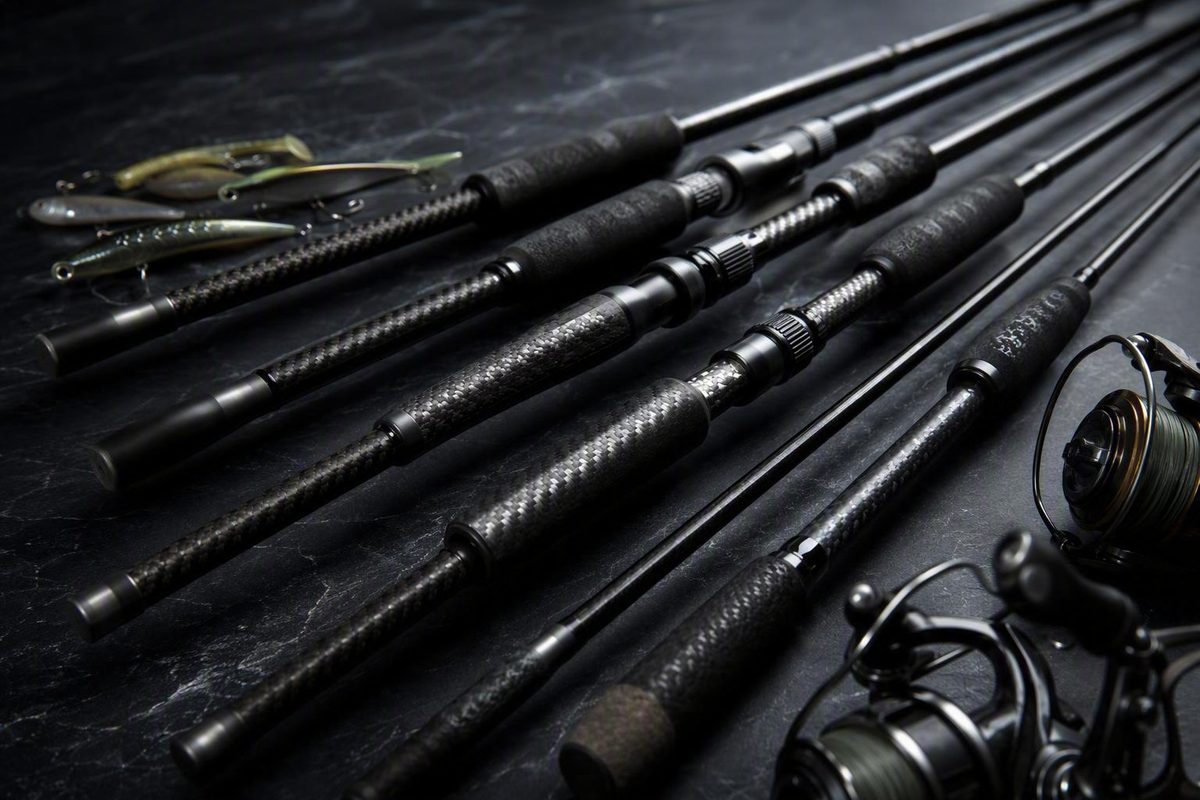
A carbon-fiber fishing rod is a strong candidate when low carried weight, responsive lure control, repeated casting, or subtle contact matters. Fiberglass may fit better when you want deeper flex, forgiveness, tolerance of rough handling, or a lower price. Mixed-material blanks can occupy the middle ground. No construction is universally best: match length, power, action, line rating, and lure rating to the technique first, then compare construction, measured weight, balance, components, warranty, and price.
The short answer: when a carbon-fiber rod makes sense
Fishing businesses commonly describe carbon rods as light, stiff, and sensitive, while describing fiberglass as heavier, more flexible, forgiving, impact-tolerant, and affordable. These are broad commercial characterizations, not independently measured advantages that apply to every finished rod. Retail guidance similarly presents mixed-material blanks as a possible compromise rather than an automatically superior choice (TackleDirect’s comparison of fishing-rod materials).
| Blank construction | Common commercial descriptions | Main trade-offs | Typical priorities |
|---|---|---|---|
| Carbon-fiber based | Lower weight and higher stiffness; commonly described as transmitting lure and bottom contact clearly | Often higher-priced and described as less tolerant of impacts or misuse | Active lure control, repeated casting, contact-oriented fishing |
| Fiberglass | More flexible, forgiving, impact-tolerant, and usually less expensive | Commonly described as heavier and less crisp | Deep loading, rough handling, smooth pressure |
| Mixed-material composite | Can combine carbon stiffness with glass reinforcement or flexibility | Results depend on the actual blend, placement, resin, and layup | Balancing responsiveness, forgiveness, and cost |
Choose carbon as a candidate—not a guarantee—for frequent jigging, bottom contact, active lure manipulation, or long sessions in which the rod remains in hand. Lower total mass may help the setup feel less burdensome, but the word carbon does not prove that one rod is lighter, better balanced, or more sensitive than another.
Consider fiberglass when deeper loading and forgiveness are more important than a crisp response, or when the rod will face frequent knocks, crowded storage, and rough boat use. A composite can also be appropriate if its design provides the required flex and backbone. The construction label remains secondary to the actual ratings and handling conditions.
What the label cannot tell you: “Carbon,” “high modulus,” “IM8,” “40-ton,” and similar terms do not establish the finished rod’s weight, balance, action, strength, impact tolerance, sensitivity, casting suitability, or durability. Those results depend on the complete blank and rod design.
What “carbon fiber” means on a fishing rod
Fishing terminology is inconsistent. Some businesses use graphite as a familiar name for carbon-fiber-based blanks. Other sellers place graphite and carbon fiber in separate marketing categories without defining a technical boundary. Neither convention reliably identifies how a particular blank was made.
Look for an explicit construction statement instead:
- Full carbon-fiber blank: The seller identifies the load-bearing blank as carbon-fiber based.
- Blended blank: Carbon is combined with glass or another reinforcement, either throughout the blank or in selected areas.
- Carbon component only: The rod has a carbon grip, handle component, or trim, but the listing does not establish that the blank is carbon-fiber based.
- Carbon-related model name: The word appears in the branding without a construction specification.
A finished blank is not bare carbon fiber. Resin, fiber orientation, material placement, wall thickness, taper, and manufacturing control all contribute to the result.
Retail listings often omit the fiber grade, resin system, fiber orientation, reinforcement schedule, wall thickness, fiber-to-resin ratio, and test method. When those details are missing, terms such as “high carbon,” “advanced graphite,” and “premium carbon” are incomplete descriptions rather than reproducible specifications.
Modulus, strength, tonnage, and IM labels decoded
Tensile modulus describes resistance to elastic stretching. A higher-modulus fiber stretches less under a given tensile load. Tensile strength concerns the stress sustained before failure. Stiffness and strength are different properties: a comparatively stiff fiber is not necessarily the strongest or most damage-tolerant option.
At the raw-fiber level, higher modulus may help a designer produce a stiffer-feeling structure. It does not establish that the complete rod is stronger, more sensitive, more durable, or better.
Toray’s technical manual demonstrates how much carbon-fiber grades can differ. Its listed products vary in tensile strength, tensile modulus, elongation, filament count, sizing, and processing characteristics, with some product families oriented toward strength and others toward modulus (Toray’s TORAYCA technical manual). These are raw-fiber data, not fishing-rod test results.
Do not assign those fiber properties to a rod unless its manufacturer identifies the material and construction. Raw-fiber figures also cannot be converted directly into casting distance, lifting capacity, suitable fish size, impact tolerance, or complete-rod durability.
IM labels need similar caution. Rod Forge identifies IM6, IM7, IM8, and IM9 as designations for particular Hexcel fibers rather than steps on a universal quality ladder; it also notes that carbon fiber is combined with resin to form the prepreg used in blanks (Rod Forge’s explanation of rod-blank fibers). A larger IM number therefore does not automatically establish higher modulus, strength, sensitivity, or quality.
Without that context, nominally similar 30-ton or 40-ton claims from different brands are not necessarily comparable.
Choose length, power, and action before comparing materials
Action and power describe different aspects of a rod.
- Action primarily describes how the bend is distributed along the blank under load. Fast and extra-fast rods concentrate more of the bend toward the tip; moderate and slower rods bend farther into the blank.
- Power describes the rod’s backbone or useful loading range. It affects the lure and hook sizes the rod can accommodate, how it handles a payload during casting, fish control, and how demanding the setup feels.
- Rod action is the speed at which a loaded rod returns to its normal state Fishing Rods Explained - Action, Power and More - Wired2Fish.
Industry guidance commonly associates fast and extra-fast actions with active lure manipulation and single-hook setting. Moderate actions are often associated with straight retrieves and many treble-hook presentations because they load more deeply. These are conventions, not tested prescriptions for every situation. The manufacturer’s lure and line ratings, the actual payload, hook design, line stretch, drag setting, and angler technique take priority.
The following matrix should therefore be used as a starting point, not as a species-based rule:
| Technique or environment | Specifications to prioritize | Material trade-off to investigate |
|---|---|---|
| Jigging or bottom contact | Correct lure rating and power, manageable weight, useful balance, generally faster action | Carbon may support a light, crisp build, but construction alone does not prove sensitivity |
| Treble-hook straight retrieves | Correct lure rating and a moderate bend profile | Fiberglass or a blend may provide deeper loading and forgiveness |
| Surf casting | Length, power, line rating, lure rating, joint design | Carbon may reduce carried mass, but does not prove casting suitability |
| Ice or crappie fishing | Technique-specific length, suitable light power, usable handle and guides | Short carbon models exist; correct loading matters more than premium fiber language |
| Rough use or heavy trolling | Suitable power, deeper loading where required, robust guides and handle | Fiberglass or a reinforced blend may better match rough handling priorities |
Do not buy by species label alone. Begin with lure, bait, jig, or sinker mass; hook style; line system; available casting space; transport needs; and expected loading.
Carbon-branded products cover radically different applications. One manufacturer collection listed lengths from 28 inches to 12 feet and powers from ultra light through heavy (Ugly Stik’s Carbon Collection). That range illustrates why “carbon rod” is not a useful recommendation on its own: an ice rod and a surf rod can share the label while addressing entirely different loading and handling requirements.
Why two carbon rods can feel completely different
A rod is a structural system. Its behavior reflects fiber orientation, resin, layup, taper, wall thickness, reinforcement, length, power, action, guides, handle, balance, manufacturing consistency, and quality control.
Manufacturers may orient fibers in different directions, cross-weave materials, blend carbon with glass, or add reinforcement around the butt, ferrules, and other loaded regions. A change in taper or wall thickness can alter the bend profile even when the nominal fiber grade remains unchanged.
Sensitivity is also a system-level result.
Descriptions of carbon as both strong and brittle are not necessarily contradictory. Performance under the intended distributed bending load is different from resistance to a sharp impact, crushing, excessive local bending, or damage already present in the laminate. Commercial rod descriptions may characterize these risks, but they do not quantify how a particular model will respond.
For the same reason, raw tensile properties must remain at material level. Without the resin system, laminate schedule, dimensions, workmanship, and complete-rod test conditions, they do not predict finished-rod performance.
A specification checklist for comparing rods
Use the same checklist for every candidate:
- Blank construction: Full carbon, carbon-and-glass blend, another composite, or unspecified?
- Actual rod weight: Is a measured value given for the exact length, power, and number of pieces?
- Balance: Where does the rod balance with the reel you expect to use?
- Length: Does it suit casting distance, leverage, clearance, transport, and technique?
- Power: Is the loading range appropriate for the actual payload and hook system?
- Action: Does the bend distribution suit the presentation?
- Line rating: Does it cover the planned line and leader system?
- Lure rating: Does it include the complete lure, bait, jig, or sinker mass?
- Pieces and ferrules: Does the transport advantage justify the additional joint?
- Guides: Are their frames, inserts, size, and spacing appropriate for the line and environment?
- Handle and reel seat: Are the shape, length, material, and contact points comfortable?
- Warranty: Which failures, owners, regions, and periods are covered?
- Replacement parts: Are model-specific tips or sections listed?
- Test data: Does the maker identify the model, setup, method, and comparison basis?
Flag a listing that uses carbon in the model name but never identifies the blank construction. A carbon grip, brand name, or retail-category placement is not evidence of a full carbon-fiber blank.
Do not use customer stars, review counts, bestseller badges, sale prices, or modulus language as substitutes for missing specifications. None establishes whether the rod matches the intended lure weight, line, action, or environment.
Use this purchase sequence when priorities conflict:
- Eliminate rods with unsuitable line, lure, length, or transport specifications.
- Select the required power and bend profile.
- Compare measured weight and balance with the intended reel.
- Assess construction and handling tolerance for the actual environment.
- Compare guides, handle, reel seat, ferrules, and other components.
- Use warranty and replacement support as tie-breakers.
- Compare price only among rods that have survived the earlier steps.
The sequence prevents a lower weight, premium component, or attractive price from overriding an unsuitable rating.
Three hypothetical needs show how the hierarchy changes:
- Frequent jigging with subtle bottom contact: Start with suitable power and lure rating. Then compare total weight, balance, bend profile, and handle contact. Carbon may help produce the desired package, but compare complete rods.
- Treble-hook straight retrieves: Start with the correct lure rating and a moderate bend profile. Deeper loading and forgiveness may outrank minimum weight, making fiberglass or a blended blank reasonable.
- Rough boat use: Start with appropriate ratings, robust components, handling tolerance, secure storage, and useful warranty support. A high-modulus claim should not outrank survivability in the actual environment.
The available listings and commercial guidance do not support a defensible “best carbon rod” ranking or prove measurable performance differences between price tiers.
Price ranges and what the evidence does not prove
The available prices are time-sensitive retail snapshots, but the capture date was not recorded. They should not be treated as current market averages.
The captured DICK’S Sporting Goods category included carbon-related rods listed near $64 and premium listings above $500 (DICK’S Sporting Goods’ carbon-related rod category). Category placement does not prove that every listed product had a full carbon-fiber blank.
Ugly Stik’s captured collection showed a rod at $59.95, standalone rods around $100, and rod-and-reel combinations reaching approximately $180 (Ugly Stik’s Carbon Collection). Prices, promotions, and availability can change.
BoneHead Tackle’s captured category showed rods beginning around $60, other carbon-fiber models around $110–$120, and replacement tips listed separately (BoneHead Tackle’s rod and replacement-tip listings). Stock, shipping, price, and exact compatibility remain model- and time-dependent.
These observations do not establish that a $250 or $500 rod produces a measurable advantage over a lower-priced model.
Pay more when the additional cost buys an identifiable feature you need: verified lower weight, better balance with your reel, appropriate guides, a preferred handle, stronger warranty terms, or documented replacement support. Do not pay solely for a larger modulus number or premium adjective.
Handling, inspection, and saltwater care
Carbon rods are neither inherently fragile under every load nor universally durable. Handling risk depends on the construction, loading direction, use, and damage history. Vendor-authored fishing guidance warns that carbon rods may crack after hard impacts, contact with obstacles, or excessive bending; it also recommends fresh-water rinsing after saltwater use (Topline Fishing Tackle’s carbon and fiberglass overview).
Protect the blank from point impacts and crushing in rod lockers, vehicle doors, racks, and around boat hardware. Use a sleeve or rigid case when transport conditions justify it, and avoid placing other equipment on top of the rod.
After a significant knock:
- Unload and clean the rod.
-
Inspect the blank and guides in good light.
-
Do not force a visibly damaged or questionable rod back into service.
- Ask the manufacturer or a qualified rod repairer to evaluate the exact model.
There is no supported universal field test here for clearing a knocked carbon rod as safe to use. Follow the manufacturer’s model-specific instructions and stay within its stated line and lure ratings.
These steps maintain the whole assembly rather than only the carbon-based blank.
Can a broken carbon-fiber rod tip be replaced?
Sometimes a model-specific replacement is available. BoneHead Tackle’s captured category, for example, listed replacement tips alongside some rods, but the page did not establish compatibility with every model or show that a replacement restores the original specifications.
Confirm the exact manufacturer, model, and part before ordering. Those questions require model-specific information from the manufacturer or repair provider.
Choose from the fishing task outward: establish length, power, action, line rating, and lure rating first. Then assess construction, measured weight, balance, components, warranty, replacement support, handling demands, and price. Carbon fiber can help produce a light, responsive rod, but the material label, modulus claim, IM number, and price cannot prove that the finished rod is right for the job.