
Which Material Fits the Load? A Practical Guide to CFRP and Steel
A composite replacement may require extra thickness, multiple ply directions, inserts, protective layers, larger joints, or a redesigned section.
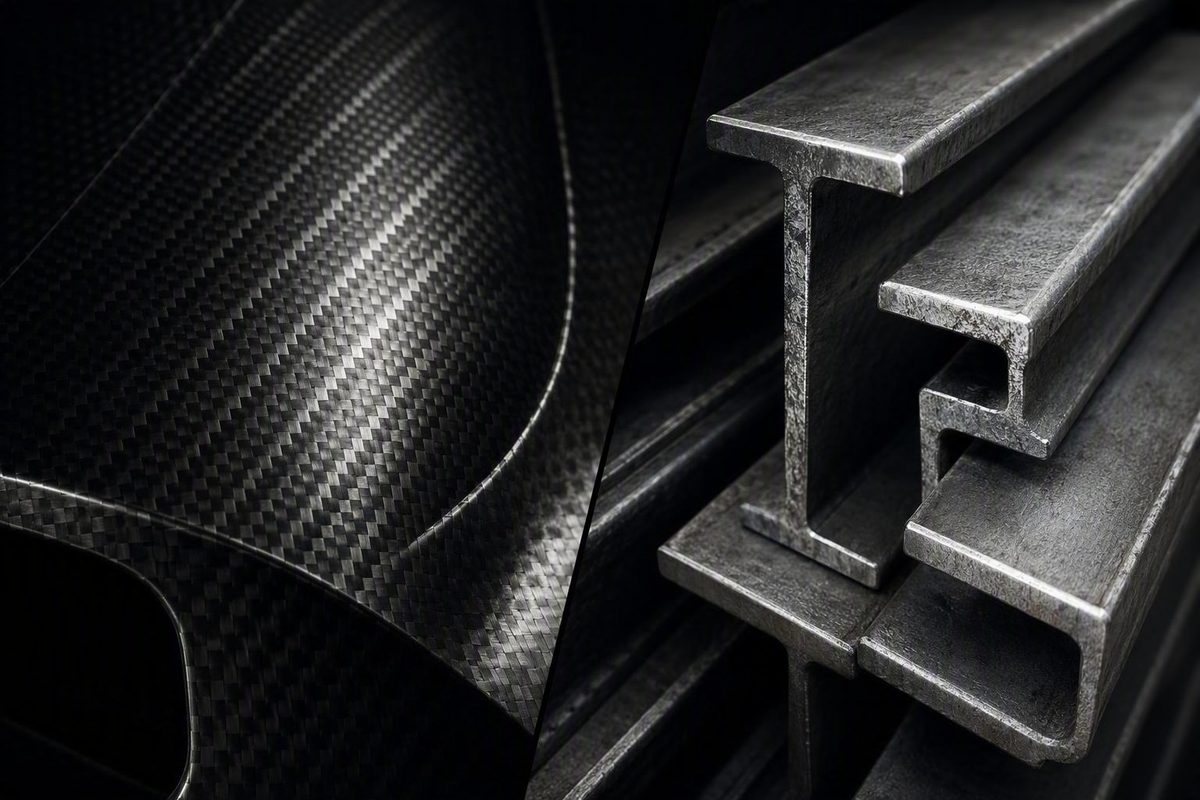
“Carbon fiber vs steel” sounds like a straightforward contest. It is not. Carbon-fiber-reinforced polymer can be exceptionally efficient when its fibers follow a known load and mass is tightly constrained. Steel remains difficult to beat when a design needs ductility, toughness, predictable behavior in several directions, economical high-volume production, conventional joining, or practical field repair.
The useful question is not “Which material is stronger?” It is:
Which specified material system best satisfies this component’s loads, geometry, environment, manufacturing route, inspection plan, failure criteria, and budget?
This article is a preliminary material-selection guide, not a source of design allowables. The available comparison evidence consists largely of commercial or general-interest publications rather than primary test reports, standards, or grade-specific qualification data. Safety-critical decisions therefore require named materials, applicable codes, validated properties, representative testing, and application-specific engineering approval.
Start With the Right Comparison: CFRP, Not Bare Carbon Fiber
Steel is a family of iron-based alloys, not one material with a fixed strength. Structural steels, automotive sheet grades, stainless steels, tool steels, spring steels, and heat-treated alloy steels can behave quite differently. Product form, thickness, heat treatment, processing history, and test direction can also affect the relevant properties.
Most finished products described as “carbon fiber” are actually carbon-fiber-reinforced polymer, or CFRP. Carbon fibers provide much of the load-carrying capacity in their intended directions.
Four material levels must be kept separate:
- Bare carbon fiber: Individual filaments or bundles before incorporation into a structural composite.
- Unidirectional material: Fibers arranged mainly along one axis, producing high longitudinal properties but much lower performance in other directions.
- Multidirectional laminate: Plies placed at selected angles to carry loads in several directions.
- Finished component: The laminate plus its geometry, joints, holes, inserts, adhesive bonds, surface protection, manufacturing variation, and service environment.
A tensile value for bare fiber or a unidirectional coupon cannot be assigned directly to a woven panel, quasi-isotropic laminate, drilled bracket, bonded reinforcement, or crash structure. Adding off-axis plies can improve multidirectional performance, but it also allocates material away from the principal load direction.
This is a fundamental difference between the material systems. Conventional steel products are broadly isotropic for many screening comparisons: their properties are comparatively consistent in different directions. CFRP is anisotropic. Its strength and stiffness depend heavily on fiber direction, ply sequence, resin, fiber content, cure quality, and load mode.
Anisotropy is both a limitation and CFRP’s central design opportunity. Material can be concentrated along the governing load paths rather than distributed uniformly. The designer is therefore selecting not just a material, but an internal architecture.
The governing comparison should be:
A specified CFRP laminate versus a specified steel grade under the same load mode, geometry, environment, temperature, boundary conditions, and failure criteria.
The relevant metrics include:
- Density and finished-component mass
- Tensile and compressive strength
- Elastic modulus and deformation
- Specific strength and specific stiffness
- Bending and buckling resistance
- Ductility, toughness, and impact response
- Fatigue and damage tolerance
- Temperature, fire, moisture, salt, UV, and chemical exposure
- Manufacturing consistency
- Joining, inspection, and repair
- Production and lifecycle cost
- Reuse and end-of-life recovery
Once those variables are defined, the comparison becomes an engineering decision rather than a contest between headline numbers.
The Short Answer: Each Material Wins Under Different Conditions
A well-designed CFRP laminate commonly offers high tensile strength and stiffness per unit mass along its intended fiber directions. That makes it attractive for weight-sensitive parts with clear, controllable load paths.
Steel often has advantages when the design requires ductility, impact tolerance, concentrated load transfer, compression resistance, complex loading, elevated-temperature capability, established manufacturing, low initial cost, or familiar repair methods.
The distinction between absolute performance and performance per unit mass is essential. A material can have an excellent strength-to-weight ratio without being the best choice for a complete component. The design may instead be governed by deflection, buckling, bearing at a fastener, local impact, manufacturing variation, or the joint between parts.
Several terms should also remain distinct:
- Strength describes the stress a material or structure can withstand before a defined failure.
- Stiffness describes resistance to elastic deformation.
- Toughness concerns the energy absorbed as damage develops.
- Ductility describes the capacity for plastic deformation before fracture.
A component can be strong enough not to break but too flexible to function. It can be stiff in normal service but unsuitable for impact. It can also have impressive coupon properties while failing at a hole, insert, weld, adhesive edge, or abrupt change in geometry.
CFRP’s low density does not mean it is automatically several times stronger than steel, nor does it establish the weight reduction of a functionally equivalent part. A composite replacement may require extra thickness, multiple ply directions, inserts, protective layers, larger joints, or a redesigned section.
A concise screening rule is:
- Consider CFRP when mass, directional tensile efficiency, corrosion resistance, or minimal reinforcement thickness dominates.
- Consider steel when predictable deformation, concentrated loads, compression, impact, heat, production scale, low initial cost, or field modification dominates.
- Consider a hybrid when one part of the structure benefits from CFRP’s low mass while another needs steel’s ductility, joining capability, or concentrated-load performance.
Quick qualitative comparison
| Attribute | CFRP | Steel | Important qualification |
|---|---|---|---|
| Density | Low | High | Finished mass also depends on geometry, joints, and design criteria |
| Directional tensile efficiency | Excellent when fibers follow the load | Good to excellent, depending on grade | CFRP off-axis properties can be substantially lower |
| Multidirectional predictability | Layup-dependent | Generally simpler | Steel is usually easier to characterize under changing load directions |
| Ductility | Limited and system-dependent | Generally higher | Exact behavior depends on the laminate or steel grade |
| Impact behavior | Must be deliberately engineered and verified | Often accommodates load through yielding | Purpose-designed composite crushing can also absorb energy |
| Corrosion | Does not rust, but other system elements can degrade | Depends on alloy, coating, detailing, and maintenance | Mixed-material interfaces require assessment |
| Heat and fire | Often limited by resin, adhesive, or protection | Often more suitable for elevated temperatures | Neither system is unaffected by fire |
| Joining | Adhesives, fasteners, inserts, co-curing | Welding and mechanical fastening are well established | Joint details may govern either design |
| Inspection and repair | May require specialist procedures | Usually more familiar in the field | Actual requirements depend on damage and access |
| Production scale | Highly process-dependent | Mature for high-volume production | Composite automation can improve the balance |
| Recycling | Possible but relatively difficult for thermosets | Mature, high-volume infrastructure | Recovered composite fibers may have different properties or uses |
No row establishes a universal winner. Each identifies a tendency that must be checked against the application.
Strength, Stiffness, and Weight: How to Read the Numbers
Numerical comparisons become misleading when bare fibers, unidirectional material, multidirectional laminates, and finished steel products appear as equivalent categories. Any useful table must identify the material form and direction.
The following values are illustrative screening ranges, not design allowables:
| Material category | Density | Elastic modulus | Tensile strength |
|---|---|---|---|
| Typical CFRP laminate | Approximately 1.5–1.6 g/cm³ | Approximately 70–150 GPa, directional | Approximately 600–1,600 MPa, directional |
| Structural steel such as S355 | Approximately 7.85 g/cm³ | Approximately 200–210 GPa | Approximately 450–600 MPa |
Qualification: These ranges come from a commercially interested carbon-fiber publisher whose comparison relies mainly on secondary references. They vary with steel grade and condition, fiber type and direction, resin system, ply schedule, fiber content, manufacturing process, specimen geometry, temperature, and test method. They must not be used as engineering design values. The same publisher reports much higher longitudinal values for high-strength unidirectional material, demonstrating why unidirectional material and practical laminates cannot be merged into one generic category in its CFRP and steel property guide.
Specific strength and specific stiffness
Specific strength is strength normalized by density. In plain language, it asks how much strength is available for a given material mass.
Specific stiffness is elastic modulus normalized by density. It asks how much resistance to elastic deformation is available for a given mass.
These metrics help explain why CFRP can be attractive even when a practical laminate’s absolute modulus is below that of steel. A laminate may be less stiff at the same dimensions but more efficient after mass is considered. Greater section depth, sandwich construction, ribs, or selective ply placement may convert that material efficiency into component performance.
That opportunity depends on geometric freedom. If a replacement must fit the same envelope, use the same small holes, carry the same bearing loads, and survive the same impacts, it may be difficult to realize the theoretical specific-property advantage.
Density is not a finished-part weight calculation
Density answers how much equal volumes of two materials weigh. It does not determine the mass of functionally equivalent components.
A CFRP replacement may require:
- Additional plies for off-axis loads
- Greater thickness to control deflection
- Reinforcement around holes and fasteners
- Metal inserts for threads or concentrated loads
- Adhesive overlap area
- Impact, UV, or fire protection
- Manufacturing and damage-tolerance margins
- A different section to resist local instability
Conversely, CFRP may enable a deeper, more efficient section without a large mass penalty. Simply replacing a steel sheet with an equal-volume laminate can miss that design opportunity.
Three different equivalence questions
A numerical comparison must identify what is being held equal.
1. Equal tensile capacity
For a straight tie carrying a stable axial load, the comparison may focus on tensile capacity, joint efficiency, and the required design margin. Strongly aligned CFRP can be especially mass-efficient in this case.
2. Equal bending stiffness
A beam or panel must control deformation as well as stress. Section depth, skins, cores, and local stability may matter more than tensile strength.
3. Equal buckling resistance
A shell, tube, web, or column can become unstable before its material reaches tensile failure.
These questions can produce different mass results for the same material pair. A broad statement that carbon fiber is a fixed number of times stronger than steel is therefore of little value for component selection.
Before accepting a numerical comparison, identify:
- The exact steel grade and product condition
- Whether the composite value describes fiber, lamina, laminate, or component
- Fiber direction and full ply schedule
- Resin system and fiber content
- Test temperature and moisture condition
- Load mode: tensile, compressive, shear, bending, or impact
- Specimen dimensions and geometry
- Test method and statistical basis
- Whether the number is an average, minimum, or allowable
- Whether joints and manufacturing defects are represented
Without that information, the figures are screening data at best.
Tension, Compression, Bending, Impact, and Failure
The preferred material can change with the load case. Selection should begin with the governing load path and acceptable failure mode, not a general material ranking.
Tension
CFRP is particularly efficient when continuous fibers can follow a primary tensile load. A straight tie, strap, shell skin, or bonded reinforcement can place a large share of its fibers along the governing direction.
The advantage diminishes when loads change direction, enter through small fasteners, or create transverse and interlaminar stresses. Adding plies in several directions improves robustness but reduces the amount of material aligned with the principal tensile axis.
A steel tie is denser, but changing load directions, threads, holes, and conventional connections may be easier to accommodate. In either system, the connection can govern before the base material reaches its ideal coupon strength.
Compression and buckling
Tensile data alone cannot qualify a composite column, shell, tube, or compression flange. Composite compression can be sensitive to fiber alignment, matrix behavior, delamination, load introduction, and local instability.
Steel is often attractive in compression-dominated members because its behavior is comparatively uniform and established section forms are readily available. That does not mean steel wins every compression comparison. Composite tubes, sandwich structures, and stabilized shells can be efficient, but they must be evaluated using relevant compressive and stability data.
Those cases can produce different material choices.
Bending
For CFRP, the designer must determine where the principal plies belong, how the compression side will be stabilized, and how loads will enter the laminate. For steel, section depth, flange and web proportions, weld details, and local stability remain important.
Many lightweight composite panels obtain much of their bending performance from geometry. That is a different structural concept from substituting a flat laminate for an equal-thickness steel sheet.
Impact and energy absorption
Steel commonly accommodates overload through plastic deformation, although its actual response depends on grade, geometry, temperature, defects, and loading rate. Purpose-designed CFRP structures can also absorb energy through progressive crushing, fragmentation, and delamination, but that behavior must be engineered and verified for the intended impact.
A carbon-fiber automotive supplier describes the broad contrast as steel providing predictable deformation while CFRP performance depends on its architecture and processing. Because that publisher has a commercial interest, its discussion is useful only as qualitative screening guidance, not as crash certification evidence or a substitute for component testing under representative impact conditions.
Composite impact damage may involve matrix cracking, delamination, fiber breakage, core damage, or bond failure. The appropriate inspection method and acceptance criteria must come from the qualified component or repair procedure.
Failure warning
Steel frequently develops measurable plastic deformation before fracture. CFRP does not yield in the same manner. Depending on the system and load, its failure sequence may include:
- Matrix cracking
- Fiber–matrix debonding
- Delamination between plies
- Adhesive or co-bond failure
- Local bearing damage
- Fiber fracture
- Progressive crushing or abrupt rupture
The practical issue is not simply whether one material is “brittle.” It is whether damage is detectable, how much capacity remains, and whether the structure has redundancy or an alternate load path.
Fatigue
There is no responsible universal winner in fatigue.
A smooth composite coupon under controlled cyclic tension does not represent a drilled, bonded, impact-damaged component. Likewise, smooth steel specimen data do not automatically describe a welded and corroded detail. Qualification should reproduce the relevant stress concentrations, environment, and service loading as closely as practical.
Three bounded examples summarize the load-case problem:
- A lightweight tension tie with continuous fibers aligned to a stable load may favor CFRP.
- A compression member cannot be selected from tensile strength data; geometry and buckling may govern.
- An impact-critical structure may favor steel or require a deliberately engineered and tested composite energy-absorption system.
In every case, holes, interfaces, abrupt section changes, residual stresses, fiber waviness, voids, surface preparation, and manufacturing variation can outweigh the apparent advantage in idealized coupon data.
Corrosion, Heat, and Service Environment
Carbon fibers and CFRP do not rust as ferrous steel does. That can make CFRP attractive in wet, salty, or difficult-to-access locations where steel would otherwise require coatings, corrosion allowance, drainage, inspection, and maintenance.
The advantage must be qualified. A composite system also includes resin, adhesives, coatings, inserts, fasteners, and interfaces. Moisture, chemicals, UV exposure, thermal cycling, or sustained temperature can affect those elements even when the carbon fibers remain intact.
Unprotected steel can corrode in the presence of moisture and oxygen, with salt increasing concern in many exposure conditions. Service life depends on alloy selection, coatings, galvanizing or other protection, detailing, drainage, access, and maintenance. Corrosion-resistant steel grades can shift the comparison but may also change cost and fabrication requirements.
Mixed-material corrosion
Where CFRP and steel are connected in the presence of an electrolyte, the joint may require electrical isolation, sealing, compatible fasteners, and drainage to control galvanic-corrosion risk. A commercial composite guide specifically recommends material isolation for CFRP-to-steel joints.
The assessment must address the finished interface, including exposed fasteners, damaged protection, and possible water paths. It should not stop at the nominal material selection.
Heat and fire
In practical CFRP systems, temperature limits are often controlled by the resin, adhesive, coating, core, or fire-protection system rather than the carbon fibers alone. Behavior near or above a qualified temperature limit cannot be inferred from room-temperature tensile data.
Steel is often selected for extreme-heat exposure, but it is not unaffected by elevated temperature. Fire design for either material must evaluate the complete protected system under the specified thermal exposure. A structural-repair contractor similarly identifies extreme heat as a condition that may favor steel, while providing no fire-test data that would support a universal temperature limit for either system.
Before selecting a material, establish:
- Normal continuous temperature
- Short-duration peak temperature
- Applicable fire and smoke requirements
- Moisture and immersion conditions
- Salt or de-icing exposure
- Relevant chemicals and cleaning agents
- UV exposure
- Freeze–thaw and thermal cycling
- Substrate condition
- Required service life
- Inspection access and maintenance intervals
CFRP should not be described as maintenance-free or universally more durable simply because it does not rust.
Manufacturing, Joining, Inspection, and Repair
Material properties do not determine whether a part can be produced consistently. The manufacturing route affects fiber alignment, dimensional accuracy, defects, residual stresses, surface condition, and joint quality.
Manufacturing routes
Its supply chains, equipment, workforce skills, design practices, and quality-control methods are mature. High-speed stamping and automated welding make steel particularly effective for high-volume sheet structures.
Common CFRP processes include:
- Hand layup
- Vacuum bagging
-
Resin-transfer molding
-
Prepreg layup and autoclave curing
Each process produces a different balance of tooling cost, cycle time, fiber control, consolidation, surface finish, repeatability, and production rate. CFRP performance depends on ply placement, cure control, resin flow, contamination control, trimming, and other process details—not only on the nominal fiber and resin.
For additional background, see this overview of how carbon fiber moves from precursor production to a cured part.
Joining
Steel can be welded or mechanically fastened, although weld quality, heat-affected regions, fatigue details, distortion, and corrosion protection still require engineering attention.
Conventional epoxy-based thermoset CFRP is not welded in the same way as steel. Common composite joining methods include:
- Structural adhesive bonding
- Mechanical fastening
- Bonded or molded-in inserts
- Co-cured and co-bonded joints
- Hybrid bonded-and-fastened connections
Composite joints require careful load introduction. Adhesive joints must control peel and edge stresses as well as shear. Steel inserts in contact with carbon fibers may require electrical isolation.
The joint should be part of the first structural concept, not added after the laminate has been optimized.
Production scale and quality assurance
Steel commonly supports short cycle times and economical mass production. CFRP may require controlled storage, layup verification, cure time, tooling, traceability, and additional inspection. Automated placement, molding, and rapid-cure processes can improve production rates, but suitability depends on part geometry, volume, investment, and required performance.
One commercial CFRP guide describes a qualification progression that may include coupon and subcomponent tests plus impact, fatigue, humidity, UV, and temperature exposure. That is a useful outline of possible testing activities, not a complete certification standard. The governing application determines the actual program.
Inspection and repair
Steel damage and corrosion are familiar to many field technicians, and conventional repair procedures are widely available. The correct procedure still depends on the grade, structural role, damage, loading, and governing rules; welding is not automatically permissible for every steel product.
Composite damage may be internal or distributed. Visual inspection can be useful, but it may not reveal the full extent of delamination, debonding, crushed core, or impact damage.
That does not mean every damaged CFRP part must be replaced. Repair versus replacement depends on:
- Damage type and extent
- Accessibility
- Structural role and redundancy
- Laminate and resin system
- Environmental exposure
- Approved repair data
- Ability to restore load transfer
- Post-repair inspection and verification
A bonded patch may be acceptable for one qualified laminate and unsuitable for another. Likewise, a welded steel repair may be straightforward in one application and prohibited in another. Familiarity does not replace a validated procedure.
Cost and Recycling: Compare the Whole System
CFRP commonly has higher material and processing costs than ordinary steel, while steel benefits from mature supply chains, standardized products, high-speed fabrication, and established recycling markets. No supported universal cost multiple can be assigned to functionally equivalent parts.
Raw price per kilogram is an incomplete comparison. A low-density material may require fewer kilograms, while a more expensive process may reduce assembly or installation demands. Conversely, a lightweight laminate may introduce additional tooling, inspection, inserts, protection, and repair planning.
A whole-system cost comparison should include:
- Raw material and minimum order quantities
- Tooling and fixtures
- Labor and required skills
- Storage and shelf-life controls
- Cycle and cure time
- Energy use
- Quality control and traceability
- Scrap and rework
- Machining, trimming, and dust controls
- Joining and assembly
- Lifting, transport, and installation
- Coatings and corrosion protection
- Manufacturing and in-service inspection
- Maintenance
- Repair capability and downtime
- Replacement and disposal
In some reinforcement projects, thin bonded CFRP may reduce lifting, welding, drilling, or intrusion into occupied space. Those potential benefits are application-dependent and do not establish lower lifecycle cost.
Recycling and environmental performance
Steel has mature, high-volume collection and recycling infrastructure. Scrap can be separated, remelted, and returned to production through established markets.
Mechanical and thermal recovery routes are possible, but recovered fibers may differ from virgin material in length, condition, consistency, or suitable application. A commercial comparison likewise characterizes steel recycling as established and thermoset-composite recovery as more complex, although it does not provide an authoritative lifecycle assessment for a defined product system.
Environmental performance depends on the system boundary:
- Low operating mass may matter in a frequently moving vehicle.
- Steel may offer a strong end-of-life route but require corrosion protection and maintenance.
- A thin bonded reinforcement may extend the life of an existing structure.
- Limited repairability can shorten the service life of some components.
- Reuse, transport, electricity source, maintenance, and actual recovery route can alter the result.
The supplied evidence does not support a definitive cost multiple, break-even production volume, or lifecycle-emissions winner. Those conclusions require application-specific cost modeling and lifecycle assessment.
Choosing Carbon Fiber, Steel, or a Hybrid Design
A practical selection process begins with requirements and then identifies the material architecture capable of meeting them. The following matrix is a screening tool, not a substitute for analysis and testing.
| Decision factor | CFRP-leaning condition | Steel-leaning condition | Hybrid opportunity |
|---|---|---|---|
| Dominant load | Stable, directional tension | Complex, reversing, concentrated, or compression-sensitive loading | CFRP along tensile paths; steel at load introduction |
| Allowable mass | Severe mass constraint | Mass is secondary | CFRP panels around a steel load frame |
| Stiffness target | Geometry can exploit low-density material | Fixed envelope favors steel’s absolute modulus | Composite sandwich panel with steel interfaces |
| Impact risk | Impact direction and response can be tested | Frequent, uncertain, or severe impact | Steel protection or load path around CFRP |
| Temperature | Within qualified polymer-system limits | Extreme heat is plausible | Keep CFRP away from heat-exposed zones |
| Corrosion | Wet, salty, or difficult to maintain | Protection and access are manageable | CFRP reinforcement with isolated steel connections |
| Production volume | Performance justifies controlled processing | Rapid mass production is central | CFRP reserved for selected high-value parts |
| Repair needs | Specialist inspection and repair are available | Field modification is important | Replaceable CFRP modules on a steel structure |
| Failure warning | Monitoring and defined damage criteria are acceptable | Ductility and visible deformation are important | Steel provides a secondary load path |
| Budget | Lifecycle benefit may justify higher process cost | Low initial cost governs | Use CFRP only where it produces measurable value |
When CFRP is the stronger candidate
CFRP deserves close consideration when:
- Weight is tightly constrained.
- Loads are well defined and fibers can follow them.
- Tensile efficiency or stiffness per unit mass governs.
- Corrosion resistance has substantial value.
- Added reinforcement thickness or installation access is limited.
- Geometry can be redesigned around composite behavior.
- Higher process-control, testing, and inspection demands are acceptable.
When steel is the stronger candidate
Steel is often the more practical choice when:
- Loads are multidirectional, uncertain, or compression-sensitive.
- Concentrated loads and small connections dominate.
- Ductility and visible deformation are important.
- Impact or abuse is expected.
- Welding or field modification is central.
- High production volume and short cycle time govern.
- Low initial cost is critical.
- Extreme heat exposure is plausible.
- Local repair must be widely available.
When a hybrid is better than substitution
Hybrid design avoids forcing either material into a role it handles poorly. CFRP can serve as a lightweight shell, panel, tensile member, or bonded stiffener, while steel carries concentrated loads, fastener forces, compression paths, impact loads, or heat exposure.
Possible arrangements include:
- CFRP skins attached to steel hard points
- Steel inserts within a composite structure
- Bonded CFRP reinforcement on a steel member
- CFRP body panels around a steel passenger structure
- Steel edge protection around impact-sensitive composite panels
- Composite tension paths paired with ductile steel connections
The interface is part of the structure. Differential thermal movement, adhesive behavior, galvanic isolation, load transfer, tolerances, inspection access, and replaceability must be addressed explicitly.
Automotive example
CFRP may suit selected body panels, aerodynamic parts, interior structures, or performance components where reduced mass provides a clear benefit. Steel remains common in chassis, body structures, crash zones, and mass-produced safety systems because of production speed, cost, predictable deformation, and the established repair ecosystem. A carbon-fiber parts supplier therefore presents the materials as complementary rather than complete substitutes across a vehicle.
That commercial perspective is suitable for initial screening only. Crash structures and safety systems require vehicle-specific design, validated material data, representative testing, and compliance with applicable requirements.
Structural-reinforcement example
Thin bonded CFRP may be attractive where access is restricted, added mass is undesirable, corrosion is troublesome, or steel reinforcement would occupy valuable space. Steel may remain preferable for major compression, severe displacement, extreme heat, mechanical anchorage, or conditions outside the bonded system’s qualified scope. A structural-repair contractor identifies the same broad trade-off, but provides no calculations or standards that would justify selecting a repair solely from its general comparison.
A bowed wall or other distressed building element must not be assigned a repair system from general material data. The substrate, displacement, continuing movement, drainage, soil or foundation causes, anchorage, fire exposure, local code, and complete load path require professional assessment. Even a promotional wall-repair comparison recommends inspection and acknowledges that severe movement may require heavier or additional reinforcement rather than bonded carbon-fiber straps alone.
Before buying or approving either material, request:
- Named steel grade and product condition
- Complete CFRP laminate schedule
- Fiber and resin identification
- Fiber content and property direction
- Service-temperature and fire limits
- Test methods and environmental conditioning
- Statistically based design allowables
- Joint, insert, weld, and adhesive details
- Impact and fatigue qualifications
- Manufacturing tolerances and defect limits
- Inspection and repair criteria
- Corrosion and galvanic-isolation details
- Application-specific engineering approval
Frequently Asked Questions
Is carbon fiber stronger than steel?
It can be, depending on the material form, direction, and definition of strength. Bare carbon fibers and unidirectional material can have very high tensile strength along the fiber axis. A practical multidirectional laminate has lower peak directional properties, while its transverse, compressive, impact, or joint performance may govern.
A named CFRP laminate can provide much better tensile strength per unit mass than a named steel grade. Steel may still be preferable when a fixed envelope, ductility, impact, compression, heat, or concentrated loads control the design. Tables that combine bare-fiber values with finished steel products should therefore be treated cautiously because the categories are not mechanically interchangeable, as illustrated by the separate material classes in this representative comparison.
How much lighter is carbon fiber than steel?
Typical CFRP is often listed at approximately 1.5–1.6 g/cm³, compared with about 7.8 g/cm³ for steel, making CFRP roughly one-fifth as dense in representative comparisons of the two material categories.
That density ratio does not mean a functionally equivalent CFRP part will automatically be four-fifths lighter. Finished-part mass must be calculated after accounting for stiffness, buckling, joints, off-axis plies, inserts, impact protection, manufacturing margins, and geometry.
Is carbon fiber stiffer than steel?
It depends on the fiber, laminate, and direction. Representative comparisons commonly place steel’s elastic modulus near 200–210 GPa. Practical CFRP laminates may be lower or comparable in a selected direction, while some unidirectional carbon materials can exceed steel longitudinally. Those unidirectional values do not apply equally in every direction or to every finished laminate.
CFRP can still offer better specific stiffness—stiffness relative to density—even when its absolute laminate modulus is below steel’s. Whether that produces a lighter or stiffer component depends on section geometry and the available design envelope.
Does carbon fiber break more easily than steel?
Not as a universal rule. Steel often deforms plastically before fracture, while CFRP can develop matrix cracks, delamination, bond failure, or fiber fracture without metal-like yielding. The actual response depends on the material system, geometry, joints, defects, temperature, and loading.
A poorly designed composite part may be vulnerable to sharp impact, holes, off-axis loading, or concentrated forces. A purpose-designed composite structure can nevertheless tolerate damage or absorb energy through controlled crushing. The relevant question is whether the specific component has been qualified for its actual impact, overload, inspection, and residual-capacity requirements.
Can carbon fiber and steel be used together?
Yes. Hybrid structures are often preferable because each material can be assigned to the functions it handles best. CFRP can provide lightweight skins, panels, tensile reinforcement, or bonded stiffening, while steel provides joints, inserts, compression paths, impact protection, or heat-resistant regions.
The interface requires deliberate engineering. Designers must address load transfer, local bearing, peel stress, differential thermal movement, electrical isolation, sealing, drainage, inspection, and repair. Simply attaching CFRP to steel without evaluating the interface does not create a reliable hybrid structure.
The Bottom Line
There is no universal winner in carbon fiber vs steel. CFRP is compelling when low mass, directional tensile efficiency, corrosion resistance, or minimal thickness justifies specialized design, production, inspection, and testing. Steel remains compelling when ductility, toughness, multidirectional loading, concentrated forces, heat, repairability, production scale, or cost governs.
In many real assemblies, the best answer is neither complete substitution nor a generic material ranking. It is a qualified hybrid or application-specific design supported by named material grades, laminate schedules, joint details, environmental limits, representative tests, and professional engineering approval.