
When Maximum Stiffness Is Worth the Trade-Off
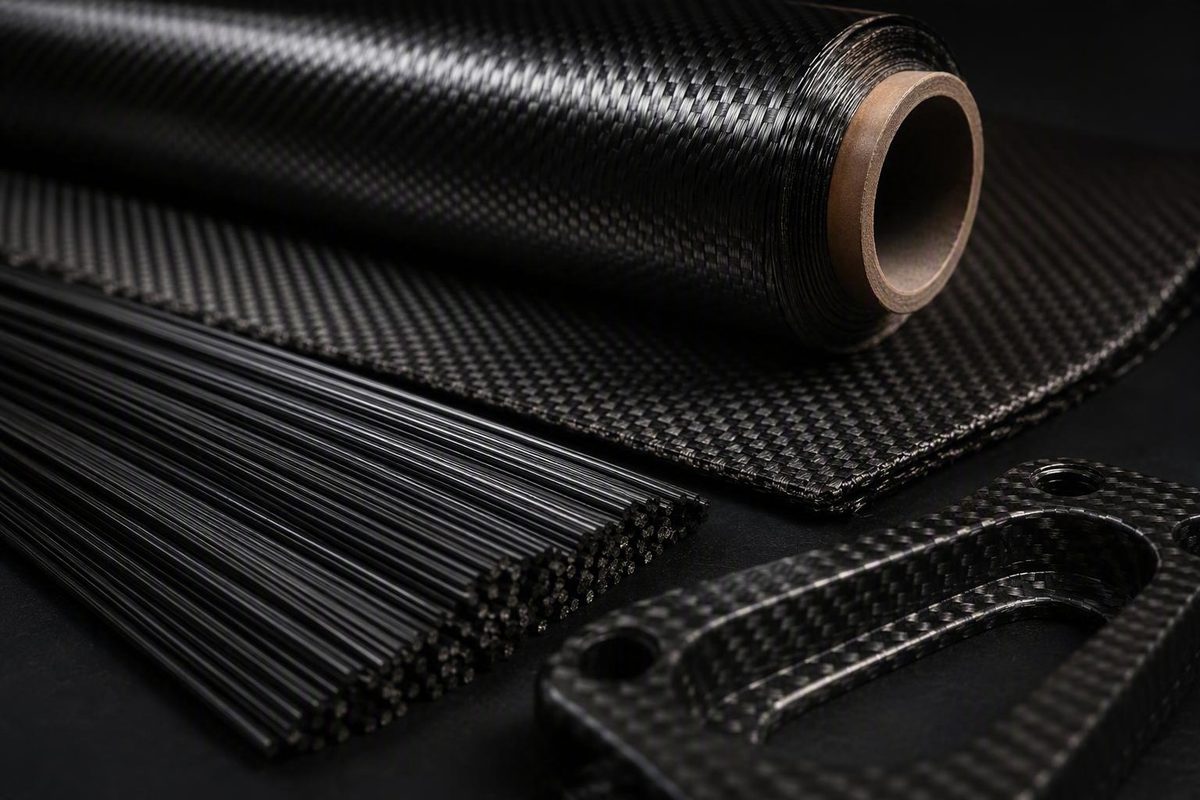
Ultra high modulus carbon fiber is not simply “better carbon fiber.” It is a specialized reinforcement for designs in which elastic stiffness—and often stiffness per unit mass—matters enough to justify added cost, reduced manufacturing flexibility, and possible sacrifices in strength or damage tolerance.
Two complications shape every selection decision. First, there is no consistently applied modulus boundary for the label. Second, a fiber’s impressive axial modulus is not the modulus of a multidirectional plate, tube, or finished assembly. Useful selection therefore starts with an exact grade and ends with representative laminate or component data—not with a category name.
This article provides screening guidance rather than qualified design data. Structural substitution, processing limits, safety factors, and service allowables require application-specific analysis and testing.
What “ultra high modulus” means—and why the boundary moves
Tensile modulus describes resistance to elastic deformation. Within the elastic range, it is the ratio of stress to strain:
E = \sigma ÷ \varepsilon
Stress is applied force divided by loaded area. Strain is the resulting change in length divided by original length. A high modulus means that substantial stress produces relatively little elastic strain.
Modulus does not state how much stress the fiber can sustain before breaking. That is tensile strength. Nor does modulus define elongation at break, toughness, impact tolerance, compression performance, fatigue resistance, or damage tolerance. These properties may interact in practice, but they are not interchangeable.
Most importantly, the available evidence does not establish a universal or official threshold for ultra high modulus carbon fiber. Suppliers and technical publications use their own classifications.
For example, Rock West Composites classifies ultra-high-modulus fiber as 65–135 MSI, equivalent to approximately 448–931 GPa. Its boundary is a vendor classification rather than an industry-wide standard in Rock West’s published grade framework.
Another commercial classification places ultra-high modulus above 600 GPa, or approximately 87 MSI. Under that convention, a 500 GPa fiber would qualify under Rock West’s lower boundary but not under the threshold published by CSMFG Supply.
Historical terminology makes the boundary less tidy. NASA’s 1999 material-selection table calls a 64 MSI fiber “UHMS,” yet lists fibers called high modulus at 105–145 MSI. These are typical axial fiber properties in an older technical guide, not a universal classification standard or current product catalog. The mismatch illustrates why a category name must be tied to its source, date, and exact grade in NASA’s fiber-reinforced polymer guidance.
The following table converts those cited starting values, plus the manufacturer-reported 900 GPa value discussed later, using approximately 6.895 GPa per MSI. Results are rounded, so reverse conversion may not reproduce the displayed input exactly.
| Starting value | Approximate equivalent |
|---|---|
| 64 MSI | 441 GPa |
| 65 MSI | 448 GPa |
| 87 MSI | 600 GPa |
| 131 MSI | 903 GPa |
| 135 MSI | 931 GPa |
| 448 GPa | 65.0 MSI |
| 600 GPa | 87.0 MSI |
| 900 GPa | 130.5 MSI |
These conversions normalize units; they do not resolve the naming problem. A defensible specification is therefore “grade X, nominal axial tensile modulus Y, tested by method Z,” not merely “UHM carbon.”
Product names also require restraint. A prefix such as UHM, HM, or ultra may reflect a manufacturer’s product family, historical naming practice, or intended positioning. It does not prove that the material clears an official boundary. Laboratory labels can be equally easy to misread because they may describe a combination of properties rather than membership in a commercial modulus class.
Stiffness is not strength: the property trade space
The easiest way to avoid an expensive selection error is to keep five ideas separate:
- Stress: load normalized by the loaded cross-sectional area.
- Strain: deformation normalized by the original dimension.
- Tensile modulus: the slope of the elastic stress–strain response; effectively, resistance to elastic stretching.
- Tensile strength: the maximum tensile stress reached before failure under the stated test conditions.
- Elongation at break: the strain at failure.
Imagine two fibers subjected to equal tensile stress. The higher-modulus fiber generally stretches less. That fact alone does not reveal which fiber will sustain the greater ultimate stress or deform farther before fracture.
A fiber can therefore be very stiff yet break at a lower strain than a less-stiff grade. It may also have lower tensile strength. Higher-modulus products are commonly associated with higher cost, lower failure strain, brittleness, and greater handling sensitivity, but none of these relationships is an exceptionless law. The exact balance depends on precursor, processing, defects, microstructure, sizing, test method, and the complete composite system.
A useful counterexample to one-dimensional ranking comes from a 2025 peer-reviewed study of a laboratory-prepared PAN-based fiber called UTHM75. Its name means ultrahigh tensile strength–high modulus, not “ultra-high-modulus fiber” under either commercial threshold discussed above. Researchers reported 7.677 GPa tensile strength, 362 GPa tensile modulus, and 2.02% elongation at break in the Materials Research Express study.
The study’s comparison table shows why “best grade” is not a single-axis ranking:
| Fiber | Tensile strength | Tensile modulus |
|---|---|---|
| UTHM75 | 7.677 GPa | 362 GPa |
| M40J | 4.40 GPa | 377 GPa |
| T1000G | 6.37 GPa | 294 GPa |
| T1100S | 7.00 GPa | 324 GPa |
| T1200 | 8.00 GPa | 315 GPa |
UTHM75 had a slightly lower reported modulus than M40J but substantially higher reported tensile strength. T1200 had the highest strength in the table, while M40J had the highest modulus. The comparison does not establish that any one fiber is superior for a component. It demonstrates that tensile strength and tensile modulus occupy separate design axes.
It also puts naming in perspective. UTHM75’s 362 GPa modulus falls below both cited commercial ultra-high-modulus boundaries: approximately 448 GPa and 600 GPa. Its name concerns ultrahigh tensile strength combined with high modulus, not compliance with a universal UHM classification.
The study’s authors associate increasing graphitization and a more ordered carbon structure with greater stiffness. They also discuss how larger graphitic regions and easier failure propagation may work against tensile strength. These are the authors’ interpretations based on their comparisons and characterization—not isolated proof that one structural feature alone causes a particular mechanical result.
For initial material screening, plot tensile strength on one axis and tensile modulus on the other. Add failure strain, density, precursor, and commercial status as labels or color codes. The plot immediately exposes the weakness of ranking fibers by modulus alone: the stiffest grade need not be the strongest, and the strongest need not be the stiffest.
Even that plot is only a filter. Fiber tensile results do not answer questions about laminate compression, open-hole behavior, impact damage, fatigue, interlaminar fracture, or environmental durability.
PAN-based and pitch-based routes to high stiffness
Pitch-based carbon fibers are associated with some of the highest reported modulus values. The available evidence does not, however, establish precursor type as a universal definition of ultra-high modulus. A product still has to be evaluated against an attributed modulus classification and its complete grade-level property set.
Nippon Graphite Fiber markets its pitch-based GRANOC family across a stated modulus range of 55–900 GPa and tow sizes from 1K to 12K. The manufacturer labels the upper end ultra-high modulus on its GRANOC product-family page. The reported 900 GPa maximum is approximately 131 MSI.
That number must remain bounded to the claim being made. It is a manufacturer-reported maximum for one pitch-based product family, not a benchmark applying to every carbon fiber. A family-level range also does not identify which grade, tensile strength, density, elongation, sizing, test method, or supply form accompanies the upper value.
PAN-based development follows a different route and can produce fibers that combine high modulus with very high tensile strength. UTHM75 is a research example, although its 362 GPa reported modulus falls below the two commercial UHM boundaries discussed earlier.
The researchers prepared the 12K PAN-based fiber through successive stabilization, carbonization, and higher-temperature treatment stages while controlling atmosphere and tension. Reported stages included stabilization at 220–245°C, carbonization through 350–680°C, and later treatments at 1,200°C and 1,675°C under nitrogen as described in the UTHM75 paper.
Those details illustrate that thermal history, tension, orientation, graphitization, and resulting microstructure influence properties. They are not a production recipe. The evidence describes a laboratory-prepared material and does not establish commercial availability, scalable production, cost, qualification status, or batch-to-batch reproducibility.
Readers who need broader context on precursor, oxidation, carbonization, sizing, tow, and reinforcement conversion can consult Carbon Reference’s guide to how carbon fiber is made.
For actual selection, precursor is only one field in the specification. Buyers still need grade-specific information covering:
- Tensile modulus and strength
- Elongation at break
- Density and specific modulus
- Tow size and filament characteristics
- Sizing chemistry and compatible resin systems
- Test method and specimen basis
- Reinforcement form
- Fiber-volume fraction
- Cured-ply and laminate properties
- Variability and qualification status
“Pitch-based” can suggest a route toward exceptional stiffness, but it does not disclose the complete property set. Likewise, “PAN-based” covers a broad range and cannot predict strength, modulus, or composite performance without grade-level data.
From fiber modulus to real laminate stiffness
A raw-fiber modulus cannot be used as the modulus of a plate, tube, panel, or finished component. At least four specification levels must remain separate:
- Raw filament or tow: axial properties measured on an individual filament or fiber bundle.
- Cured unidirectional ply: fiber and matrix combined at a stated fiber volume, with fibers primarily aligned in one direction.
- Multidirectional laminate: several plies arranged at selected orientations, possibly using woven, cross-ply, quasi-isotropic, or hybrid construction.
- Qualified finished component: the manufactured geometry, joints, holes, defects, environment, load cases, and statistical design allowables relevant to service.
A fiber value is an input to composite analysis, not a laminate modulus or design allowable. Translating it into part behavior requires information about fiber volume, orientation, layup, resin, interface, cure quality, void content, defects, geometry, and loading direction.
Fibers aligned with the primary load path contribute efficiently to axial stiffness. Rotate them away from that load, and less of their axial stiffness acts in the required direction. Curvature and crimp also prevent an ideal straight-fiber response.
An all-unidirectional laminate loaded along the fiber direction can therefore exploit axial fiber stiffness much more directly than a cross-ply laminate. A cross-ply construction assigns some reinforcement to the transverse direction. A woven laminate distributes reinforcement in multiple directions and may improve handling, dimensional stability during layup, and drape, but its interlacing introduces fiber curvature.
None of these effects should be represented by a universal numerical “knockdown.” The result depends on the actual architecture, resin, fiber volume, processing quality, and load case.
Tensile strength and modulus are principally fiber-controlled, while compression and shear also depend substantially on the matrix and fiber–matrix interface. That distinction matters around joints, holes, free edges, bonded regions, load introduction points, and changes in fiber direction.
A laminate can contain exceptionally stiff fibers yet perform poorly if it develops matrix cracking, delamination, local buckling, fiber waviness, weak interfaces, or inadequate load transfer.
Appearance offers no shortcut. A decorative twill exterior does not reveal the modulus grade of the structural plies underneath. A tube with a woven cosmetic surface may contain unidirectional reinforcement, another carbon-fiber grade, glass fiber, or a mixed architecture below it. Tow size, weave pattern, gloss level, and surface finish are not universal grade identifiers.
A practical datasheet review should keep the following fields separate:
| Specification level | Questions to record |
|---|---|
| Fiber | Exact designation, precursor, modulus, strength, elongation, density, tow, sizing, test method |
| Cured ply | Resin, fiber volume, ply thickness, axial and transverse properties, cure condition |
| Laminate | Layup, orientation, reinforcement form, thickness, void criteria, specimen preparation |
| Test | Standard, loading direction, temperature, moisture condition, sample count, variability |
| Design allowable | Basis value, statistical treatment, environment, damage state, manufacturing process |
| Component | Geometry, joints, holes, tolerances, defects, load cases, inspection and acceptance criteria |
Keeping these levels separate prevents the most common catalog error: quoting a fiber’s axial modulus as though it were the measured stiffness of a finished plate.
Where exceptional stiffness can solve the right problem
Ultra high modulus carbon fiber is principally a candidate for stiffness-critical design. It is not automatically the correct choice for a structure governed by ultimate strength, impact, fatigue, compression, joint behavior, or cost.
Promising screening cases include:
- Deflection control under elastic loading
- Vibration or natural-frequency control
- Dimensional stability
- Structures in which stiffness and thermal behavior must be considered together
- Minimum-mass structures governed by stiffness rather than strength
For lightweight structures, specific modulus may be more informative than absolute modulus:
Specific modulus = E ÷ \rho
where E is modulus and \rho is density. Absolute modulus asks how stiff the material is. Specific modulus asks how much stiffness it offers relative to mass. When candidates differ in density, modulus alone can obscure the structural opportunity.
Consider a straight beam whose stress is comfortably below its allowable but whose deflection is excessive. Aligned, unidirectional high-stiffness reinforcement may reduce deformation or enable a different section design. That is an illustrative screening case, not a qualified substitution: shear deformation, local stability, joints, damage tolerance, and manufacturing still require evaluation.
A vibration-sensitive panel presents a related case. Greater structural stiffness can shift natural frequencies, but the result also depends on mass distribution, boundary conditions, damping, laminate coupling, and geometry. Replacing the fiber in an unchanged layup does not establish that the redesigned panel will avoid a problematic excitation range.
A dimensionally stable instrument support may require low deformation across mechanical and thermal conditions. The relevant comparison can include axial and transverse coefficients of thermal expansion, thermal conductivity, moisture response, interfaces, adhesive behavior, and thermal cycling—not just room-temperature tensile modulus.
Space structures are commonly cited as a specialist application because low mass, dimensional stability, and vibration control can be unusually important. That does not establish that ultra-high-modulus fiber is required for every spacecraft or that space applications represent most demand.
The case becomes weaker when performance is governed by:
- Impact and handling damage
- Open holes, fasteners, or bonded joints
- Compression or buckling
- Fatigue and repeated load cycles
- Complex curvature or forming
- Edge durability and machining damage
- Material availability or program cost
Another grade—or a hybrid construction—may deliver a better system result. A moderately stiff fiber paired with a suitable resin, robust interfaces, sensible geometry, and a qualified process may outperform a nominally stiffer fiber in the governing condition.
Comparisons should therefore be made on at least two useful bases:
- Equal mass: Which architecture provides the required stiffness and robustness at the same structural mass?
- Equal deflection or frequency target: Which architecture meets the functional constraint with the lowest mass, cost, manufacturing risk, or lifecycle burden?
Substituting a stiffer fiber into an unchanged ply schedule answers neither question. Proper optimization may change laminate thickness, ply placement, section depth, core construction, local reinforcement, and load-path design.
Reinforcement form, drape, and shop-floor handling
Fiber grade and reinforcement form are separate decisions. An exceptional axial fiber may be inefficient, unavailable, or impractical in the form required by the tool and component geometry.
| Reinforcement form | Axial efficiency | Drape and handling | Principal considerations |
|---|---|---|---|
| Raw tow | Potentially high when kept straight | Requires controlled placement and impregnation | Spreading, tension, resin wet-out, filament damage |
| Unidirectional tape | High along the fiber direction | Limited across tight compound curvature | Broad fiber choice, directional layup, ply stability |
| Prepreg | Controlled resin content and processing potential | Depends on backing, tack, ply thickness, and architecture | Storage, out-time, cure cycle, supplier qualification |
| Woven fabric | Lower ideal axial efficiency because of crimp | Often easier to handle and drape | Weave availability, fiber curvature, areal weight |
| Cross-ply sheet | Stiffness in two principal directions | Purchased as a cured plate rather than formed in the shop | Fixed layup, machining, edge and hole behavior |
| Hybrid layup | Tailored by region and direction | Can improve practical formability and robustness | Interface behavior, analysis complexity, qualification |
NASA’s selection guidance states that unidirectional tape offers the broadest fiber choice and efficient axial properties. It also explains that woven forms trade some structural efficiency for handling and drape, while high ply stiffness and brittleness may restrict deep curvature and make tight weaving difficult in its composite material-selection guidance.
Ply thickness matters as well. A thin ply of a given material may conform more readily than a thicker ply, so forming limits cannot be inferred from modulus alone.
Shop-floor reports can identify useful questions, but they do not establish universal design limits. In one engineering-forum discussion, participants described filament breakage and fuzz when low-strain fibers were dragged over handling hardware or forced into small loops. The same discussion mentioned failure strains below 1% and a personal bend-radius estimate, neither of which should be generalized across all ultra-high-modulus products in the anecdotal Eng-Tips discussion.
Practical concerns include tow-path alignment, uncontrolled loops, roller or eyelet geometry, cutting damage, fiber spreading, tack, ply placement, and the ability to preserve straight reinforcement through cure. A fiber that arrives with excellent tensile data can lose structural value if handling creates broken filaments, waviness, bridging, wrinkles, or poor consolidation.
Hybrid construction can limit those risks while placing stiffness where it earns its cost. For example:
- Use stiff unidirectional plies along a straight, deflection-critical load path.
- Use tougher or more formable reinforcement around holes, edges, joints, and transitions.
- Introduce woven or off-axis plies where shape stability and handling matter.
- Avoid forcing an all-UHM architecture into impact-prone or tightly curved regions without supporting evidence.
Hybridization is not automatically safer or more efficient. Differences in strain compatibility, thermal behavior, load transfer, failure sequence, and interfaces must be analyzed. Processing trials and representative testing remain necessary.
Before fabrication, obtain grade- and product-specific supplier instructions covering storage, thawing where applicable, allowable out-time, forming, minimum handling radius, cutting, cure, machining, inspection, and disposal. Experience with standard-modulus prepreg is not proof that a specialty high-modulus system can be processed identically.
A practical material-selection and qualification workflow
A disciplined workflow begins with the governing requirement, not a material label.
1. Define the measurable constraint. Determine whether the design is controlled by static deflection, tensile strength, mass, natural frequency, dimensional stability, thermal distortion, compression, fatigue, or another requirement. Record the load cases, boundary conditions, environment, lifetime, and acceptable variability.
2. Establish credible alternatives. Compare standard-, intermediate-, high-, and ultra-high-modulus candidates. Include nonmaterial changes such as increased section depth, sandwich construction, local ribs, revised supports, or different ply placement. The highest fiber modulus should have to outperform realistic alternatives.
3. Build a decision matrix.
| Category | Properties or constraints |
|---|---|
| Stiffness | Axial modulus, transverse modulus, shear modulus, specific modulus |
| Strength | Tension, compression, shear, bearing, open-hole behavior |
| Failure and durability | Elongation, impact tolerance, fatigue, fracture toughness, environmental durability |
| Physical and thermal | Density, thermal expansion, thermal conductivity, moisture response, service temperature |
| Architecture | Fiber volume, orientation, layup, ply thickness, geometry, load direction |
| Manufacturing | Tow and form, drape, bend radius, cure, machining, inspection, scrap risk |
| Commercial | Price, availability, lead time, minimum order, shelf life, substitutes, lot consistency |
| Evidence | Test standards, specimen details, sample size, variability, qualification basis |
The available evidence is not sufficient to populate universal values for compression, shear, fatigue, impact, fracture toughness, or environmental durability. These are critical data gaps—not invitations to infer performance from tensile modulus.
4. Audit every number. Record the test method, specimen type, sample size, statistical spread, temperature, moisture condition, loading direction, and whether the value applies to a filament, tow, cured ply, laminate, or component. “Typical” values should not silently become minimum allowables.
5. Check the matrix and interface. Confirm resin compatibility, sizing compatibility, cure temperature and pressure, service temperature, moisture behavior, processing history, and interface data relevant to compression and shear. A fiber cannot be qualified independently of the system through which it transfers load.
6. Check the geometry. Review curvature, ply thickness, supplier-approved bend radius, joints, holes, edges, load introduction, ply drops, and changes in direction. Identify regions where a stiff, low-strain reinforcement may be difficult to place or unusually sensitive to defects.
7. Check the program. Request current availability, minimum order, lead time, shelf life, storage requirements, supply stability, qualified substitutes, lot consistency, price, and schedule exposure. A technically excellent fiber can still be the wrong program choice if it cannot be procured consistently or replaced without requalification.
Fiber, reinforcement form, and polymer matrix should be selected as a system so the resulting composite meets performance and fabrication requirements while controlling cost, schedule, and technical risk.
The final decision should be gated: retain the UHM candidate only if analysis and representative tests demonstrate a worthwhile mass, deflection, vibration, thermal, or dimensional benefit. That benefit must exceed the penalties associated with reduced robustness, processing difficulty, supply risk, qualification effort, and cost.
Buying ultra-high-modulus material without overreading the catalog
Current product listings can establish that certain forms are offered and provide a starting point for an inquiry. They rarely contain enough information for engineering substitution or meaningful price normalization.
As one bounded example, Clearwater Composites lists cross-ply plates with twill exteriors in four nominal thicknesses and displays the following ranges. The prices were observed on 24 August 2026 and should be verified immediately before publication or purchasing in the Clearwater UHM plate catalog.
| Nominal thickness | Metric equivalent | Displayed price range |
|---|---|---|
| 0.063 in | 1.600 mm | $477.50–$942.50 |
| 0.125 in | 3.200 mm | $832.50–$1,650.00 |
| 0.188 in | 4.800 mm | $1,207.50–$2,472.50 |
| 0.250 in | 6.400 mm | $1,595.00–$3,275.00 |
The listing does not identify the plate dimensions or configurations corresponding to the ends of those ranges. It also omits grade-specific modulus, tensile strength, density, resin system, fiber designation, fiber volume, and test methods.
Without plate area, configuration, material identity, and mechanical data, buyers cannot calculate a defensible price per unit area or compare technical value against another plate. Prices and availability can also change, so a catalog snapshot is not a budget quotation.
Historical forum pricing is even less suitable. It may concern a different grade, purchase date, quantity, supply form, specification, or commercial relationship.
A request for quotation should ask for:
- Exact fiber and product designation
- Precursor type
- Fiber modulus, strength, elongation, and density
- Tow size and sizing
- Resin designation and compatibility
- Fiber-volume fraction
- Layup and reinforcement architecture
- Cure process and processing history
- Plate dimensions and tolerances
- Mechanical and physical test standards
- Typical values versus qualified allowables
- Minimum order and price breaks
- Lead time, shelf life, and storage conditions
- Lot traceability and consistency
- Current availability and qualified substitutes
Treat evidence in descending order of decision value: qualified design data and representative test reports first; then grade-specific technical datasheets; government technical guidance; attributed vendor classifications; catalog listings; and finally forum anecdotes.
Ultra high modulus carbon fiber earns its place only when verified stiffness, specific-modulus, vibration, dimensional, or thermal benefits govern the design. Ignore the label until the exact grade has been identified, its modulus converted and attributed, fiber data separated from laminate allowables, strength and damage-tolerance trade-offs evaluated, manufacturability confirmed, and current qualification and procurement data obtained.
What is the official modulus threshold for ultra-high-modulus carbon fiber?
The available evidence establishes no universal official threshold. Rock West uses 65 MSI, approximately 448 GPa, as its lower boundary in its vendor classification, while another commercial source uses above 600 GPa, approximately 87 MSI in its grade overview. Older NASA terminology does not align cleanly with either convention. Specify the exact grade, numeric modulus, units, source date, and test method rather than relying on the category alone.
Is ultra-high-modulus carbon fiber stronger than standard carbon fiber?
Not necessarily. Modulus measures resistance to elastic deformation; strength measures the stress sustained before failure. A high-modulus fiber can have lower strength or lower failure strain than another grade, although this is not universal. Compare tensile and compression strength, elongation, impact response, fatigue, and laminate-level behavior rather than assuming that higher stiffness means higher strength.
Is ultra-high-modulus carbon fiber always pitch-based?
The evidence does not support treating pitch as a universal requirement. Pitch-based families include some of the highest manufacturer-reported modulus values, including GRANOC’s stated upper value of 900 GPa, or approximately 131 MSI according to Nippon Graphite Fiber.
PAN-based research can also combine high modulus with very high tensile strength, but the cited UTHM75 example has a reported modulus of 362 GPa, below the commercial UHM boundaries discussed here. It therefore cannot, by itself, prove that a PAN-based fiber qualifies as ultra-high modulus under those classifications. Precursor identity alone is insufficient; use the exact grade, attributed modulus boundary, and composite-system data.
Why is a finished laminate’s modulus lower or different from the fiber modulus?
A fiber modulus normally describes axial behavior along a filament or tow. A laminate also contains resin and may include transverse, off-axis, curved, or woven fibers. Its response changes with fiber volume, orientation, layup, matrix, interface, cure quality, voids, defects, geometry, and loading direction. The relevant design value must therefore come from representative cured-ply, laminate, or component data.
How much does ultra-high-modulus carbon-fiber plate cost?
There is no single market price. In one seller’s catalog, nominal cross-ply plates from 0.063 to 0.250 inches thick displayed ranges from $477.50 to $3,275 when checked on 24 August 2026 on Clearwater Composites’ plate page.
Because the corresponding plate dimensions, configurations, fiber grade, resin, and performance data are not provided, those figures cannot support a price-per-area or technical-value comparison. Obtain a current, specification-linked quotation.