
Carbon Fiber Modulus Is Not One Number
Carbon fiber modulus ranges from about 230 to 588 GPa by grade, but laminate stiffness also depends on resin, fiber volume, orientation and geometry.
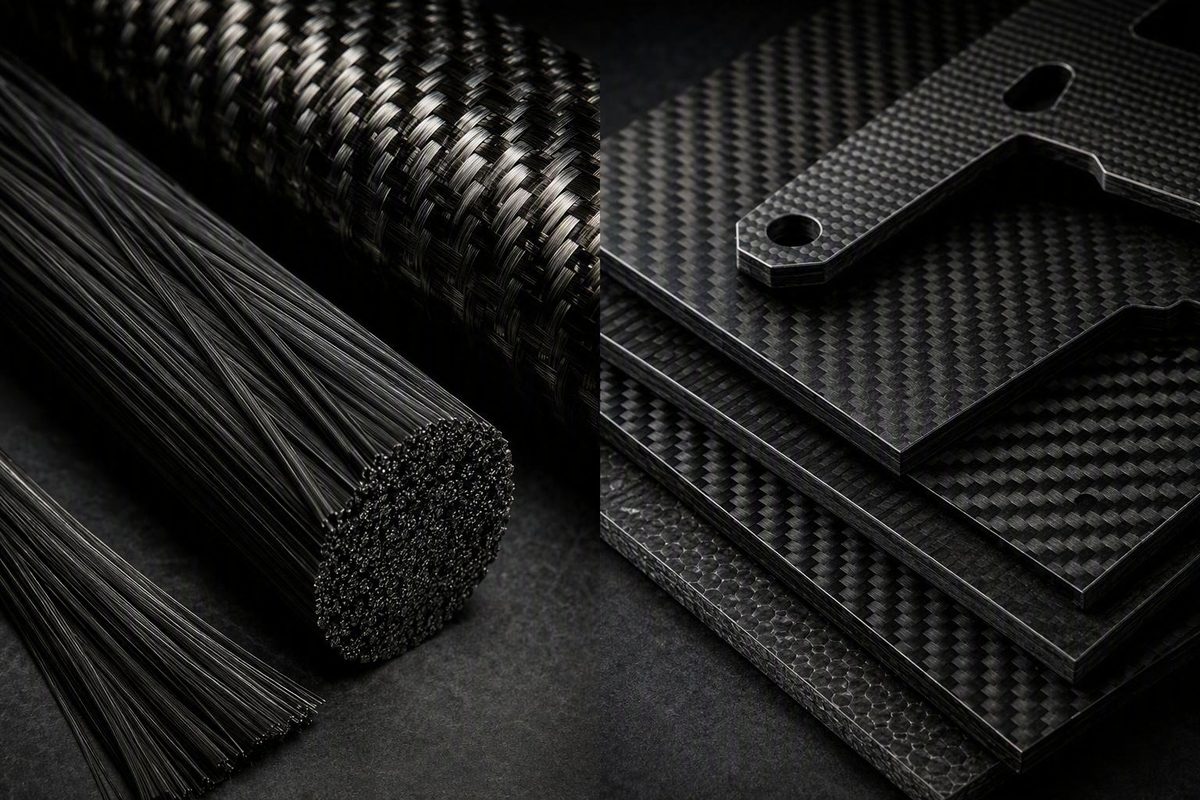
The modulus of elasticity of carbon fiber is commonly quoted as about 230 GPa (33.4 Msi) for standard-modulus fiber, but that is a fiber value—not a universal value for carbon-fiber-reinforced polymer (CFRP). Depending on grade, Toray lists PAN-based fibers from 230 GPa for T300 and T700S to 588 GPa for M60J. The cured laminate can be far less stiff, especially across the fibers or when much of the reinforcement runs off-axis. Toray’s fiber table provides the grade-by-grade values.
For a useful specification, identify all three:
- What is being measured: bare fiber, a unidirectional lamina, a multi-angle laminate or a finished part.
- In which direction: along the fibers, across them, in shear or through the thickness.
- By which test and condition: tensile or flexural; dry or moisture-conditioned; room or elevated temperature.
What modulus measures
Young’s modulus, usually written E, is the slope of the elastic portion of a stress–strain curve:
E = stress / strain
Stress has units of pressure, while strain is dimensionless, so modulus is reported in GPa, MPa, Msi or psi. A larger modulus means less elastic strain under the same stress. It does not mean the material carries a greater load before failure; that is strength.
For composite tensile data, ASTM D3039 can produce tensile chord modulus along with strength, failure strain and Poisson’s ratio. The standard also says that layup, stacking sequence, conditioning, test environment, void content and reinforcement volume should be reported because they affect the tensile response. ASTM describes those variables explicitly.
Typical carbon-fiber modulus by grade
These are nominal tensile properties of the fiber, not design allowables for a finished laminate:
| Example fiber | Common class | Tensile modulus | Tensile strength | Failure elongation |
|---|---|---|---|---|
| Toray T300 | Standard modulus | 230 GPa (33.4 Msi) | 3,530 MPa | 1.5% |
| Toray T700S | Standard modulus | 230 GPa (33.4 Msi) | 4,900 MPa | 2.1% |
| Toray T800S | Intermediate modulus | 294 GPa (42.7 Msi) | 5,880 MPa | 2.0% |
| Toray M40J | High modulus | 377 GPa (54.7 Msi) | 4,400 MPa | 1.2% |
| Toray M55J | High modulus | 540 GPa (78.2 Msi) | 4,020 MPa | 0.8% |
| Toray M60J | High modulus | 588 GPa (85.3 Msi) | 3,820 MPa | 0.7% |
Source: Toray’s technical manual. Values are typical and were measured by an impregnated-strand method. Toray says they are for material selection, not guaranteed design values.
The table also shows why “high modulus” does not mean “best.” Within these examples, modulus rises from T700S to M60J while listed elongation falls from 2.1% to 0.7%, and tensile strength does not rise with stiffness. High-modulus fiber can be appropriate when deflection, vibration or dimensional stability governs, but the complete laminate still has to satisfy strength, damage-tolerance, processing and cost requirements. See the separate guide to ultra-high-modulus carbon fiber for that narrower material choice.
Tow size does not resolve the question either. A 12K tow identifies roughly 12,000 filaments, not their modulus grade. This is why carbon-fiber tow selection has to begin with the named fiber and sizing rather than K-count alone.
Fiber modulus is not laminate modulus
Resin binds the fibers, transfers load between them and supports them against local instability, but it is much less stiff than carbon fiber. The cured ply therefore does not inherit the bare fiber’s full axial modulus. Fiber volume, voids, alignment, waviness, cure and the resin system all influence the measured result.
Toray’s T700S sheet makes the distinction unusually clear. It lists the fiber at 230 GPa, then lists a 135 GPa composite tensile modulus for T700S in its 120°C-cure resin, normalized to 60% fiber volume. Its corresponding flexural modulus is 120 GPa. Those values and test conditions appear on the same datasheet.
Direction creates a still larger difference. For Toray’s T700G/#2510 unidirectional prepreg at room-temperature ambient conditions, the manufacturer reports:
- 0° tensile modulus, E1: 125 GPa (18.2 Msi)
- 90° tensile modulus, E2: 8.41 GPa (1.22 Msi)
- In-plane shear modulus, G12: 4.23 GPa (0.61 Msi)
The same sheet reports 54.4% fiber volume for that laminate. Its woven T700S version is more balanced in-plane, at 55.8 GPa in 0° and 56.0 GPa in 90°, but gives up much of the UD tape’s axial stiffness. Toray reports these lamina and laminate properties by direction and condition.
That comparison is the practical mechanism: UD tape concentrates fibers in one load direction; a 0/90 woven reinforcement divides them between two directions. A quasi-isotropic laminate distributes plies among several angles and gives more balanced in-plane behavior, but its modulus in any one direction will not equal the fiber modulus.
Tensile modulus, flexural modulus and part stiffness are different
A tensile modulus comes from axial coupon loading. A flexural modulus is inferred from a beam-bending test. ASTM D7264 covers three- and four-point flexure and notes that the procedures determine stiffness, strength and load–deflection behavior under defined conditions. Results from the two procedures can differ slightly, so comparisons should use the same procedure. ASTM specifies that limitation.
A part’s resistance to bending depends on both material and section geometry. In elementary beam terms, bending rigidity is EI: modulus E multiplied by the section’s second moment of area I. For a rectangular section, I scales with thickness cubed. Consequently, a thicker laminate or a sandwich that separates stiff skins can reduce deflection more effectively than merely buying a higher-modulus fiber.
This is also why a supplier’s “carbon fiber modulus” cannot by itself predict the deflection of a tube, panel or bracket. The calculation needs the laminate properties in the relevant directions plus the actual section, supports and load path.
What to request from a supplier
For material selection or purchasing, ask for:
- the exact fiber manufacturer and grade—not simply “3K,” “12K” or “aerospace grade”;
- reinforcement form and orientation: UD, woven, braided, chopped or multi-axial;
- resin system, cure cycle and service condition;
- cured-ply thickness, fiber volume and void criteria;
- tensile E1, E2, shear G12 and Poisson’s ratio where analysis requires them;
- flexural modulus only when it matches the intended comparison or test method;
- the test standard, specimen orientation, temperature and moisture condition;
- typical values versus specification minimums or statistically based design allowables.
Use constituent values for screening and micromechanics, laminate coupon data for preliminary analysis, and qualified laminate or component data for consequential design. A modulus copied from a generic carbon-fiber chart is not a substitute for properties tied to the actual fiber/resin/layup/process combination.