
How to Choose a Composite Upgrade That Fits Your Car and Your Goals
"Real carbon fiber" says carbon is present, not how much, where or in what form. Check backing, matched weights, exact fitment and performance evidence.
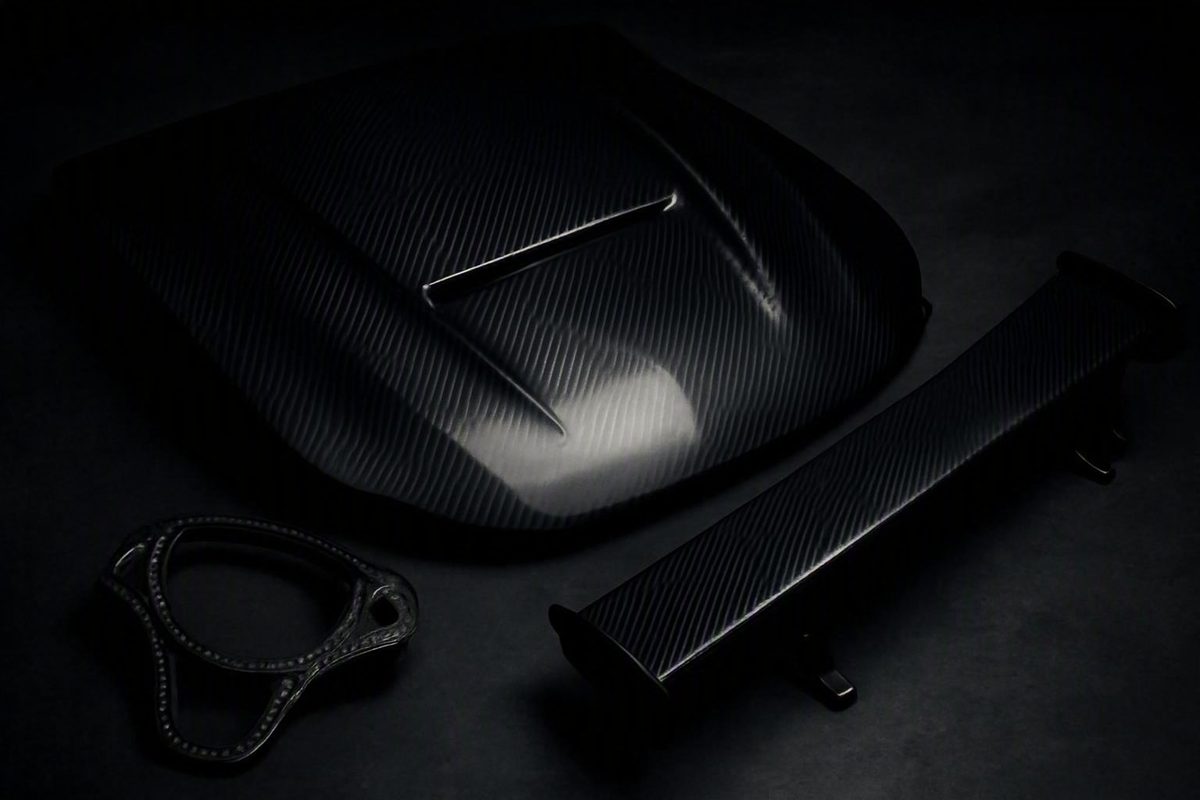
Carbon fiber car parts span an unusually broad market. The same search can return a decorative controller sticker, a replacement hood, a model-specific wing, or an entire competition-car body. These products may share a black composite appearance, but they do not offer the same construction, function, installation demands, or supporting evidence.
The right buying question is not simply, “Is carbon fiber better?” It is: What exactly is this part, what outcome should it deliver, and what proof supports that outcome?
Appearance is a valid reason to buy. But mass-reduction claims require matched weights, aerodynamic claims require relevant testing, and structural claims require application-specific engineering. Price also needs to be evaluated as a complete installed cost—not merely the number displayed on a product page.
What counts as a carbon-fiber car part?
In automotive use, carbon fiber usually means carbon-fiber-reinforced polymer, or CFRP. Carbon fibers provide reinforcement, primarily along the directions in which they run. The finished product is a composite system rather than a collection of bare carbon strands.
That distinction matters because changing the fiber direction, resin, number of layers, core, geometry, joints, or cure process can change how the finished part behaves. Two products with similar-looking twill surfaces may have materially different weight, stiffness, impact response, fit, and durability.
For shopping purposes, carbon fiber car parts fit into six practical categories:
- Cosmetic accessories. License-plate frames, mirror caps, controller skins, antenna covers, handle covers, and decorative stickers primarily change appearance.
- Interior trim. Bezels, console pieces, dashboard inlays, seat-back covers, vent surrounds, and steering-wheel trim add a composite finish inside the cabin. Some replace factory trim; others attach over it.
- Exterior replacement panels. Hoods, trunks, roofs, fenders, doors, and quarter panels replace larger factory components. They may offer more opportunity for mass reduction, but the saving must be measured for the exact assemblies being compared.
- Functional aerodynamic parts. Splitters, wings, spoilers, diffusers, side skirts, canards, and underbody elements may be designed to manage airflow. Their material alone does not prove that they improve aerodynamics.
- Structural or load-bearing components. These can include braces, seat structures, monocoque elements, or parts carrying substantial aerodynamic or vehicle loads. They require engineering and validation appropriate to the application.
- Dedicated race-car bodies. Complete bodies, front and rear clips, doors, noses, hoods, and drag-racing assemblies are commonly designed around competition chassis rather than factory street-car mounting systems.
Current catalogs illustrate this breadth without proving the quality of any individual item. Some sellers concentrate on plate frames and cabin accessories, while others list model-specific aero pieces or Mustang and Corvette appearance components. At the competition end, Five Star Bodies lists complete Camaro, Mustang, and Dodge Dart race bodies alongside clips, doors, wings, and composite sheets.
A component’s category determines what evidence a buyer should demand.
For cosmetic trim, concentrate on:
- Whether the product is genuine composite or a printed finish
- Whether it replaces or covers the factory part
- Backing material
- Exact dimensions and fitment
- Surface and edge quality
- UV protection for exposed pieces
- Attachment method
- Warranty and return terms
A decorative plate frame does not need a structural test report. It should, however, arrive with accurate dimensions, suitable mounting provisions, and a finish appropriate to its intended environment.
The standard rises for functional aero. A splitter or wing should be supported by information about the tested vehicle configuration, speed range, aerodynamic forces and balance, mounting loads, and test method. For structural components, buyers should expect design information, material and process controls, relevant load cases, inspection records, and suitable validation.
Complete race bodies require another level of caution. Do not assume that it fits factory hinges, latches, lights, seals, crash structures, sensors, airbags, or other safety equipment. Competition use also does not establish suitability or legality for public roads.
Real carbon fiber, overlays, dry carbon, and forged carbon explained
Seller terminology is inconsistent. Begin with an authenticity ladder rather than relying on the word “carbon” in a product title:
- Carbon-look film or printed plastic: a visual pattern with no carbon-fiber reinforcement.
- Sticker, skin, inlay, or overlay: a thin layer attached to an existing component. It may contain genuine carbon fiber, but it is not necessarily a replacement part.
- Carbon-faced or fiberglass-backed construction: visible carbon on the outer surface with fiberglass, plastic, or another material behind it.
- Full carbon-fiber composite replacement: a molded component in which carbon-fiber reinforcement forms the primary laminate, although the part may still include a core, inserts, local reinforcement, coatings, or non-carbon mounting features.
None of these categories is automatically dishonest or unsuitable. An overlay can be an efficient way to change a cabin’s appearance without replacing expensive factory trim. The problem arises when a buyer expects a lightweight replacement but receives a carbon-faced cover that remains attached to the original part.
Catalog wording provides useful clues:
- Carbon style normally describes appearance rather than construction.
- Overlay, cover, sticker, skin, and inlay indicate that the product probably attaches to or incorporates another substrate.
- Real carbon fiber says carbon is present, but not how much, where, or in what form.
- Full carbon suggests a more extensive composite construction but still requires clarification about cores, inserts, backing, and local reinforcement.
Retail catalogs often place materially different products under the same category. For example, KOCF lists items described as real carbon fiber alongside stickers, skins, covers, and overlays. Treat each listing according to its specific construction, not the category heading.
Dry carbon commonly refers to parts made from prepreg: reinforcement supplied with resin already incorporated at a controlled level. Prepreg normally requires controlled storage and a specified cure. By contrast, “wet carbon” commonly describes production in which liquid resin is applied to dry reinforcement during manufacture.
The dry-carbon label can be informative, but it is not a quality certificate. It does not prove that the prepreg was stored correctly, remained within its usable life, followed the intended layup, received the specified cure, or was trimmed and inspected accurately.
Forged carbon generally describes a chopped-fiber appearance or molding format rather than an orderly woven surface. It also does not establish whether a product is a structural chopped-fiber composite, a thin decorative face, or a forged-pattern finish. One seller explicitly presents its assortment as forged-carbon-fiber appearance parts, including trim, fenders, camera housings, and spoilers.
Weave is another source of confusion:
- Twill is popular for its diagonal appearance and ability to conform to curved molds.
- Plain weave is comparatively stable.
- Satin weave can drape well over complex shapes.
- Unidirectional reinforcement places most fibers along one axis, concentrating stiffness and strength in that direction.
A laminate can use woven fabric on its visible face and unidirectional plies underneath. The visible weave therefore says little by itself about engineering function. A glossy, aligned surface does not prove that carbon reinforcement continues throughout the part, that the laminate has low void content, or that load-bearing fibers run in useful directions. Nor does it demonstrate meaningful weight reduction.
Before ordering, ask the seller:
- Is this a replacement component or an overlay?
- What is the backing material?
- Is the stated construction used throughout the part?
- Does it contain fiberglass, plastic, foam, honeycomb, metal inserts, or another core?
- What carbon-fiber format and orientation are used?
- What resin system and cure method are used?
- Is the material prepreg, infused, transfer-molded, or manually laminated?
- What does the bare finished part weigh, excluding packaging and optional hardware?
- Does that weight include brackets, latches, vents, grilles, and clear coating?
- Can the seller provide photographs of the back, trimmed edges, and mounting areas?
Clear answers do not guarantee quality, but vague or contradictory answers expose assumptions before money changes hands.
Which upgrades can provide functional value?
Carbon-fiber purchases usually pursue one or more of four goals: appearance, mass reduction, aerodynamic function, or structural performance. Evaluate each goal separately.
Appearance
Small overlays, mirror caps, plate frames, bezels, controller skins, and trim covers are generally appearance purchases. They may make a cabin or exterior more distinctive, and genuine composite can provide visual depth that printed plastic does not. That is sufficient value if appearance is the objective.
These pieces should not be presented as measurable performance upgrades without evidence. Replacing a small plastic bezel is unlikely to create a meaningful vehicle-level change, while applying an overlay retains the original part and adds another layer.
Mass reduction
Large replacement panels provide more opportunity to reduce mass because they displace substantial factory components. Hoods, roofs, doors, hatch panels, and trunks may be candidates, but the carbon-fiber label alone cannot establish the saving.
Compare like with like:
- Weigh the complete factory assembly.
- Weigh the complete installed replacement assembly.
- Include latches, hinges, brackets, vents, heat shields, glass, seals, fasteners, and coatings where applicable.
- Record whether beams or reinforcements have been removed.
- Use the same scale and measurement procedure.
- State the scope of both measurements.
A bare carbon hood compared with a complete factory hood is not a valid comparison. Neither is a generic density calculation. A composite panel may require additional thickness, bonded reinforcement, inserts, or mounting structures, so raw-material density cannot be translated directly into installed mass saved.
Aerodynamic function
A spoiler, splitter, wing, diffuser, or canard is not effective merely because it is made from carbon fiber.
Ask for:
- Downforce or lift change at stated speeds
- Drag change
- Front-to-rear aerodynamic balance
- Test vehicle and configuration
- Ride height, wing angle, and other setup conditions
- Test method
- Mounting loads and recommended reinforcement
- Data for the complete system if the part is intended to work with other components
Even useful aero can involve tradeoffs.
Structural performance
Raw-fiber tensile strength, modulus, or density cannot validate a finished part. Composite performance also depends on fiber direction, fiber fraction, resin, laminate schedule, geometry, cores, joints, inserts, cure quality, defects, and the direction and type of loading.
Carbon composites are directionally tailorable. That is an advantage when reinforcement follows the intended load paths and a weakness when loads arrive in poorly reinforced directions.
A steel or aluminum component should not simply be copied at the same dimensions in carbon fiber. Metal geometries, fastener details, edges, and local load paths may be unsuitable for a laminated composite. Element 6 Composites explains that structural substitutions require application-specific loading analysis and experimental validation rather than a universal plate-thickness conversion.
The priority changes with the vehicle:
- Show build: appearance, weave consistency, finish, and fit may reasonably come first.
- Street build: balance appearance and verified mass reduction against cost, weather exposure, repairability, ground clearance, and installation consequences.
- Track-day car: prioritize complete-part weights, secure mounting, thermal exposure, serviceability, and validated aerodynamic balance.
- Dedicated race car: complete lightweight body assemblies may make sense, but they must work with the chassis, safety systems, maintenance program, and applicable class rules.
Use this matrix as a first comparison:
| Part type | Likely purpose | Evidence required | Installation complexity | Safety sensitivity | Could another material offer better value? |
|---|---|---|---|---|---|
| Mirror cap or bezel | Appearance | Material, finish, fit, UV protection | Low | Low | Yes; painted plastic or vinyl may suffice |
| Interior replacement trim | Appearance, minor mass change | Construction, fit, attachment method | Low to moderate | Usually low | Often |
| Hood, trunk, or fender | Appearance, possible mass reduction | Matched complete weights, fitment, latch and mount details | Moderate to high | Moderate to high | Fiberglass, aluminum, or OEM may |
| Splitter or diffuser | Aerodynamic function | Vehicle-specific aero and mounting-load data | High | High at speed | Aluminum or mixed-composite alternatives may |
| Wing | Aerodynamic function | Downforce, drag, balance, speed, and mount data | High | High | Aluminum systems may be easier to adjust or repair |
| Structural component | Load bearing | Engineering, process records, inspection, and testing | Very high | Very high | Frequently |
| Complete race body | Competition bodywork | Dimensions, weight, fitting requirements, and rules compatibility | Extensive | High | Fiberglass or mixed-composite bodies may cost less |
Carbon fiber offers potential, not an automatic result. The best functional upgrade is the one with a defined target and evidence tied to the exact vehicle and part.
How manufacturing affects fit, finish, and performance
The path from carbon fiber to a finished composite part generally continues through mold preparation, release treatment, reinforcement placement, resin introduction or prepreg layup, consolidation, curing, demolding, trimming, surface preparation, coating, and inspection.
Every stage can affect the buyer’s outcome.
Wet layup
In wet layup, dry fabric is placed in or over a mold and liquid resin is applied manually. The process can use relatively accessible tooling and may suit prototypes, short runs, or straightforward shapes.
Results depend heavily on workmanship. Resin quantity, air removal, fiber placement, and cure conditions all require control. Challenges include maintaining consistent thickness, avoiding trapped air, controlling resin content, and repeating the result from one part to the next.
Wet layup is not automatically poor quality. It can produce a suitable component when the design and process are appropriate.
Vacuum bagging
Vacuum bagging can be combined with wet layup or prepreg. The laminate is enclosed under a flexible bag, and vacuum pressure consolidates the layers while helping remove trapped air and excess resin.
Bagging can improve consistency, but it does not correct a distorted mold, incorrect fiber orientation, unsuitable materials, inadequate cure, or inaccurate trimming.
Prepreg lamination
Prepreg reinforcement arrives with resin already incorporated. It can support more consistent resin distribution and precise layups, particularly for complex or engineered components.
It also requires controlled storage, handling, consolidation, and cure conditions. “Prepreg” should therefore prompt further questions rather than end the evaluation:
- Which prepreg system was used?
- How was it stored?
- What cure schedule was specified?
- Were material-batch and cure records retained?
- How was the finished laminate inspected?
Resin infusion and transfer molding
In resin infusion, dry reinforcement is positioned before liquid resin is drawn through it under vacuum. Resin transfer molding uses a closed mold and introduces resin under pressure.
Depending on tooling and process development, these methods can offer repeatability and advantages for larger or higher-volume products. Flow paths still need to be designed correctly. Poor resin movement can leave dry areas, voids, or inconsistent fiber content.
Autoclave curing
An autoclave applies controlled heat and external pressure during cure. With suitable materials, tooling, and process controls, it can support repeatable, low-void laminates.
Autoclave curing is not universally necessary, and the label does not prove quality. A part can still suffer from incorrect ply orientation, contamination, poor debulking, cure errors, distorted tooling, or inaccurate trimming. Conversely, a properly engineered infused or vacuum-bagged component may be suitable for its intended use. A manufacturing overview from Formlabs distinguishes wet layup, prepreg lamination, and transfer molding by how reinforcement and resin enter the mold.
No process is automatically best. Suitability depends on geometry, loads, production quantity, tooling, process control, inspection, and validation.
Why tooling and trimming matter
Mold accuracy determines the starting geometry. If a mold was produced from a distorted panel, scaled incorrectly, or repeatedly repaired, the finished component may not match the vehicle even when its surface looks attractive.
Trimming defines outer edges, openings, mounting holes, and clearances. Errors can create uneven panel gaps, misaligned holes, sharp or unfinished edges, interference with adjacent parts, and inconsistent positioning. CNC trimming can improve repeatability, but accurate fixtures, programming, and inspection are still necessary.
Visible defects can include:
- Pinholes
- Weave distortion
- Wrinkles
- Sanding marks
- Dust under the clear coat
- Uneven gloss
- Clouding or discoloration
- Poorly finished edges
- Inaccurate holes
- Exposed fibers
Hidden or less obvious concerns can include:
- Air voids
- Dry reinforcement
- Excess resin
- Inconsistent thickness
- Poor bonding around inserts
- Bridging in corners
- Local delamination
- Incorrect ply orientation
- Incomplete cure
- Mold deviation
Exterior parts encounter UV exposure, moisture, temperature cycling, vibration, road debris, and impact. Their laminate, bonding materials, edge sealing, and coating need to suit that environment. Interior trim generally faces less severe exposure, although cabin heat and sunlight still matter.
Before buying, request documentation appropriate to the part’s function:
- Fiber format and orientation
- Backing, core, and insert materials
- Resin system
- Layup and cure method
- Bare finished-part weight
- Dimensional tolerances
- Trimming method
- Inspection procedure
- Exterior UV coating
- Material or batch traceability
- Cure records where relevant
- Structural, thermal, durability, or aerodynamic test records where relevant
A cosmetic bezel does not need the same documentation as a load-bearing component. The greater the load and the consequence of failure, the stronger the evidence should be.
Fitment and installation: verify more than make and model
A listing that says “fits BMW M3” or “for 2018–2024 Camry” is only the beginning. Before ordering, verify:
- Make and model
- Exact model year
- Trim and performance package
- Sedan, coupe, hatchback, wagon, convertible, or other body style
- Country or market specification
- Pre-facelift or facelift generation
- Factory bumper, hood, trunk, and fender configuration
- Mounting-point locations
- Required brackets and hardware
- Left- or right-hand-drive differences where relevant
Modern vehicles add another compatibility layer. Confirm openings, brackets, clearances, and mounting provisions around:
- Parking sensors
- Forward or rear radar
- Cameras
- Active-aero systems
- Washer nozzles
- Hood vents
- Lighting
- Antennas
- Wiring harnesses
- Trunk-release switches
- Factory brake ducts
- Heat shields
- Latches and safety catches
Do not assume that a camera-housing listing includes the correct camera bracket or preserves the intended position. Likewise, physical fit alone does not establish compatibility with radar, sensors, or active systems. Obtain written supplier or installer confirmation for the exact vehicle and equipment package.
Installation complexity can be ranked as follows:
- Adhesive sticker or overlay: clean, align, and bond to the existing surface.
- Clip-on or screw-mounted accessory: remove minor trim or use existing fasteners.
- Bolt-on aerodynamic component: align the part, fit brackets, and verify clearance and mounting provisions.
- Replacement panel: transfer hardware, adjust hinges or latches, and establish acceptable gaps.
- Bonded or drilled component: modify the vehicle and use a specified adhesive or fastener pattern.
- Complete race body: trim, fixture, reinforce, fabricate mounts, cut openings, and integrate the body with a competition chassis.
Seller fitment language is not independent proof of factory-like gaps or consistency between production batches. Composite parts can vary because of tool condition, cure movement, trimming, and manual finishing. Ask for recent installation photographs showing the same year, trim, and body style—not only close-ups of the weave.
Obtain the instructions before purchase. Confirm whether installation requires:
- Drilling or bonding
- Trimming or sanding
- Painting or additional clear coating
- Bracket, seal, grille, or latch transfer
- Heat shielding
- Professional fitting
- Alignment or system calibration
Also ask whether holes are final or merely pilot references.
Interfaces between carbon composite and aluminum deserve attention. Conductive carbon fibers in direct contact with aluminum can create a galvanic-corrosion risk when an electrolyte such as water is present. Joint design may require electrical isolation, coatings, sealants, sleeves, washers, or specified fasteners; JCSPORTLINE’s material comparison likewise flags the need to isolate carbon-fiber and aluminum interfaces.
Get the commercial remedy in writing:
- Can the part be test-fitted before drilling, trimming, or removing protective film?
- Does test fitting affect return eligibility?
- Who pays return freight for a fitment problem?
- How quickly must shipping damage be reported?
- What happens if damage is found after the carton is opened?
- Will the seller replace, repair, refund, or offer an allowance for a misfitting part?
- Are custom or made-to-order finishes nonreturnable?
- Who bears additional labor if professional fitting takes longer than expected?
Fitment risk is part of the product’s cost. A cheaper panel with no usable remedy can become the more expensive purchase.
Price ranges and the real installed cost
Carbon-fiber car-part prices range from small-accessory money to the cost of a used car. Every figure below is a seller-listed snapshot observed in the supplied catalogs in 2026, not a stable market average. Prices, options, material configurations, availability, promotions, and shipping terms can change.
| Product level | Illustrative seller-listed price |
|---|---|
| Small stickers or skins | From about $23 in KOCF’s catalog |
| Genuine-carbon plate accessories | About $53–$84 among selected Carbon Fiber Gear listings |
| Trim, covers, and overlays | Tens to several hundred dollars across accessory catalogs |
| BMW-focused aero parts | Commonly high hundreds or four figures in AutoTecknic’s visible assortment |
| Selected Mustang or Corvette spoilers | About $2,199 in TRUFIBER’s forged-appearance collection |
| Race-car front clips | Starting around $3,299–$4,431 in Five Star Bodies’ catalog |
| Complete race-body packages | Starting around $8,775–$11,727 in the same race-body catalog |
For small accessories, KOCF showed an Airlift controller and manifold cover-sticker set starting at $22.99. Carbon Fiber Gear displayed selected genuine-carbon motorcycle and vehicle plate frames from approximately $53 to $65, with forged-pattern examples around $82 to $84. These are primarily cosmetic products, so their prices should not be compared with functional panels on a performance-per-dollar basis.
Model-specific aero catalogs move quickly into the high hundreds and four figures. AutoTecknic’s catalog displayed examples including a BMW G87 M2 rear diffuser at $795, a G80 M3/G82–G83 M4 front lip at $900, side skirts at $1,299.95, and an OEM-branded front lip at $2,896.95. These are retailer listings, not evidence of aerodynamic effect or manufacturing superiority.
TRUFIBER displayed selected Mustang and Corvette spoilers at $2,199. Its page describes the collection as appearance parts and does not provide independent aerodynamic, weight, or structural validation for those products.
Race-body prices are starting points rather than complete project costs. Five Star Bodies displayed front clips starting at $3,299 for a Mustang, $3,588 for a Camaro, and $4,431 for a Dodge Dart, while complete body packages started at $8,775 for a Dodge Dart, $11,519 for a Mustang, and $11,727 for a Camaro. Because these are configurable products available in multiple materials, the first displayed number may not represent the carbon-fiber option or final specification.
A starting price may also exclude:
- Windows and hardware
- Spill plates or other aero pieces
- Surface finishing
- Crating and freight
- Taxes or customs charges
- Mount fabrication
- Trimming and fitting
- Paint or clear coating
- Installation labor
Price differences can reflect:
- Fiber, prepreg, and resin costs
- Backing and core materials
- Tooling size and mold quality
- Mold maintenance
- Labor and layup complexity
- Cure time and energy
- Production volume
- Machining and trimming
- Bonded inserts and hardware
- Surface preparation
- Paint or clear coating
- Inspection and record keeping
- Packaging and shipping
- Installation difficulty
None of those factors alone proves that a more expensive part is better. A costly component may have low production volume or expensive branding without stronger validation. A low-priced part may omit finishing, hardware, support, or quality control.
Build a total-cost worksheet before comparing products:
| Cost item | Seller A | Seller B |
|---|---|---|
| Base product price | ||
| Carbon construction option | ||
| Weave, color, or finish option | ||
| Mounting hardware | ||
| Adhesive, sealant, or isolation materials | ||
| Freight and crating | ||
| Customs or brokerage | ||
| Taxes | ||
| Paint, clear coat, or refinishing | ||
| Trimming and test fitting | ||
| Professional installation | ||
| Alignment or calibration | ||
| Post-installation inspection | ||
| Future repair or replacement allowance | ||
| Complete installed cost |
Do not treat coupon codes, discounts, financing offers, memberships, stock notices, free-shipping thresholds, review counts, or stated lead times as durable product facts. They may affect a transaction, but they do not describe construction or performance.
For a mass-reduction purchase, dollars per pound or kilogram saved can be useful only when the OEM and replacement assemblies have been weighed on a matched basis:
Complete installed cost ÷ verified installed mass saved
That metric does not capture appearance, aerodynamic effect, exclusivity, or structural value. It is simply a disciplined comparison when weight reduction is the stated objective. If the seller cannot provide an actual finished-part weight, the calculation is not yet possible.
Durability, impact damage, repair, and safety
Carbon composites do not necessarily respond to impact like steel or aluminum. A metal panel may dent or bend visibly. A composite may crack, crush locally, separate between layers, or debond from an insert. Internal delamination may not be obvious from the visible surface, a risk also identified in JCSPORTLINE’s comparison of automotive carbon composite and aluminum.
Surface appearance is therefore not a complete condition assessment. The appropriate inspection method depends on the part, its construction, its role, and the consequence of failure; meaningful damage to a functional or load-bearing component should be assessed by a qualified composite professional.
Repairability depends on:
- Damage size and location
- Whether reinforcement is broken
- Extent of delamination
- Access to the damaged area
- Laminate and core construction
- Proximity to inserts, hinges, and fasteners
- Heat exposure
- Required surface finish
- Structural or aerodynamic role
- Availability of repair data
- Inspection findings after repair
A cracked decorative cover may be primarily a cosmetic problem. Damage around a mounting point on a load-bearing or speed-sensitive component is a different case. It is inaccurate to say that every damaged carbon part must be discarded, but it is equally unsafe to assume that every crack can be sanded, filled, and refinished.
After a meaningful impact, stop and obtain professional advice if a functional part has looseness, cracking, a soft area, new vibration, unusual noise, changed alignment, or visible damage around a mount. This is especially important when the component carries loads, controls airflow at speed, or attaches near safety-related equipment.
Exterior longevity depends partly on the resin, coating, bonding, edge sealing, and laminate design. Vibration, salt, heat, and repeated mounting loads create additional demands. The supplied product listings do not establish multi-year durability for particular components.
Ownership and compliance questions require confirmation from the relevant supplier, installer, insurer, sanctioning body, or local authority:
- Does the modification affect any applicable vehicle or corrosion warranty?
- Does the insurer require disclosure?
- Is the replacement value covered?
- Is the component permitted for road use in the relevant jurisdiction?
- Does the installation affect local inspection requirements?
- Are lighting, plate visibility, edges, or other regulated features affected?
- Has compatibility with cameras, radar, sensors, airbags, or active systems been established?
- Will replacement parts remain available after damage?
Structural replacements require more than copying the geometry of a factory steel or aluminum part. Application-specific loading, joint design, manufacturing controls, and physical validation are required; generic strength or stiffness claims do not establish that a replacement preserves the functions of the original component.
This guide can help buyers assess terminology and documentation. It cannot certify the roadworthiness, crashworthiness, structural suitability, or legal status of a carbon-fiber car part.
A step-by-step buying and custom-order checklist
Use the following process to compare products and sellers consistently.
1. Define the intended outcome
Choose the primary objective:
- Appearance
- Verified mass reduction
- Tested aerodynamics
- Structural function
- Race-body replacement
Secondary benefits can be noted, but they should not replace the evidence required for the primary objective. If appearance is the goal, buy the finish you want without inventing a performance justification.
2. Establish what the product physically is
Confirm whether it is:
- Printed carbon-look film
- Sticker
- Overlay or skin
- Real-carbon decorative inlay
- Carbon-faced fiberglass or plastic
- Mixed-material component
- Full carbon-composite replacement
Request photographs of the front, back, edges, attachment points, and cutouts. Ask for a written description of backing, cores, inserts, and local reinforcement.
3. Verify exact vehicle compatibility in writing
Provide more than a model name:
- Year, make, and model
- Trim and body style
- Country or market
- Facelift generation
- Factory option packages
- Current bumper or body configuration
- Sensor, camera, and radar equipment
- Active-aero equipment
- Relevant lighting and washer systems
Confirm which hardware is included and whether brackets, seals, clips, grilles, latches, heat shields, or wiring mounts transfer from the factory component. Disclose aftermarket equipment that could create interference.
4. Request matched weight information
Ask for the actual bare and complete finished-part weights. Then obtain the matched OEM weight using the same scope.
A useful request is:
Please provide the weight of the finished production part, identify everything included in that figure, and provide the weight and configuration of the OEM assembly used for comparison.
Do not substitute generic carbon-fiber density or raw-fiber strength for these measurements.
5. Review manufacturing and quality information
Request:
- Fiber format and orientation
- Carbon, fiberglass, or other backing
- Core material
- Resin system
- Cure method
- UV-protective finish
- Dimensional tolerances
- Trimming method
- Inspection procedure
- Material and batch traceability
- Available cure, load, thermal, impact, or durability records
The required depth should reflect the risk. A cosmetic bezel can be evaluated with limited documentation. A load-bearing component cannot.
6. Demand relevant evidence for performance claims
For an aerodynamic product, request downforce or lift change, drag, balance, speed, test configuration, and mounting-load information.
For a structural product, request load cases, analysis assumptions, physical test results, inspection criteria, process records, and installation requirements.
Classify each claim as one of four levels:
- Seller marketing
- Seller-supplied specification
- Independently measured
- Independently tested
Words such as “race proven,” “performance,” “aero,” “strong,” or “ultralight” remain marketing until tied to a method, configuration, and result.
7. Calculate delivered and installed cost
Add:
- Product and options
- Freight and crating
- Customs and tax
- Hardware and adhesives
- Coatings or refinishing
- Fitting and professional labor
- Alignment or calibration
- Inspection
- Replacement risk
Then compare the complete figure with OEM, aluminum, fiberglass, and mixed-material alternatives. Aluminum may offer easier fabrication, adjustment, heat transfer, or repair. Fiberglass may provide similar styling at lower cost. OEM parts may offer the most predictable fit and system compatibility.
8. Review warranty, returns, and logistics
Obtain written terms for:
- Warranty duration and exclusions
- Fitment remedies
- Test-fitting requirements
- Return authorization
- Restocking fees
- Custom-product exclusions
- Shipping damage
- Lost shipments
- Lead-time delays
- Order cancellation
- Replacement-part availability
Treat lead times as estimates unless the contract defines a guaranteed date and remedy.
9. Evaluate custom-order pathways
Custom work can follow different business models. P1 Motor Cars says customers can send an existing part for recreation or pay an added cost for the company to source one. That seller-described workflow may suit a one-off request, but the page does not establish engineering validation, tolerances, material specifications, or eligibility for every component.
A series manufacturer may operate differently. Dexcraft says it can manufacture from a sample or 3D model and describes tooling, prototyping, production, machining, finishing, and inspection, but sets a minimum order of 20 pieces. That route is more relevant to a club, shop, brand, or product developer than to an individual seeking one trim panel.
For custom carbon fiber car parts, ask:
- Who owns the mold, tooling, scan, and design files?
- Can the supplier reuse or sell the design?
- Is a prototype included?
- Who approves the prototype?
- How many revisions are included?
- What do additional revisions cost?
- How will dimensions be inspected?
- Which datums and tolerances apply?
- What is the minimum quantity?
- What defines an acceptable weave and finish?
- Is an approved master sample retained?
- Who is responsible if the supplied sample is damaged, warped, or inaccurate?
- Will the original part be returned?
- What happens if the original is damaged during tooling?
- What testing is included?
- How will later batches be checked against the approved part?
10. Stop and reassess when evidence is missing
Pause the purchase if you encounter:
- Vague construction language
- No actual finished-part weight for a weight-saving claim
- No rear or edge photographs
- No installation instructions
- Unsupported universal-fit claims
- No information about exterior UV protection
- No return or fitment remedy
- Pressure to drill or trim before checking alignment
- Performance claims without relevant testing
- Structural language without engineering records
- Unclear compatibility with sensors or active systems
- A starting price that does not identify the included material
- Refusal to clarify backing, cores, or inserts
The right carbon-fiber part is the one whose construction, verified benefit, fitment, installation demands, and complete ownership cost match the vehicle’s purpose. Appearance is a legitimate goal. Mass-reduction claims need matched measurements, while aerodynamic and structural claims need relevant test data. Where the evidence is missing—or repairability, heat management, budget, or street practicality matters more—an OEM, aluminum, or fiberglass component may be the better choice.
Frequently asked questions
Do carbon-fiber car parts make a car faster?
Not automatically. A sufficiently large, verified reduction in installed mass may affect vehicle performance, while a properly developed aerodynamic component may provide a benefit within its tested configuration and operating range. The result depends on the vehicle, the amount and location of any mass removed, and the part’s actual aerodynamic behavior.
Small overlays, mirror caps, bezels, and plate frames should generally be treated as appearance products. A carbon-fiber wing without aerodynamic data remains an unverified wing, and a replacement panel without matched weights has an unverified mass benefit.
What is the difference between dry carbon and wet carbon?
“Dry carbon” commonly refers to prepreg reinforcement containing resin before layup, followed by a controlled cure. “Wet carbon” commonly refers to production in which liquid resin is applied to dry reinforcement during layup.
The terms describe broad manufacturing approaches, not guaranteed quality levels. Prepreg can aid resin control and repeatability, but it still requires correct storage, handling, layup, consolidation, cure, trimming, and inspection. A carefully controlled wet-laminated or infused part may be more suitable than a poorly made prepreg component.
Is forged carbon fiber stronger than woven carbon fiber?
There is no universal answer. “Forged carbon” generally describes a chopped-fiber molding format or visual pattern, while woven composites use continuous fiber bundles arranged in fabric. Relative performance depends on fiber type and length, fiber content, orientation, resin, molding conditions, laminate thickness, geometry, defects, and loading direction.
Woven and unidirectional laminates can place continuous fibers along planned load paths. Chopped-fiber systems can offer molding flexibility in complex shapes. Neither label alone proves that a finished automotive part is stronger.
Can cracked carbon-fiber car parts be repaired?
Some can; others should not be repaired or may be uneconomical to repair. The decision depends on damage location and extent, laminate and core construction, access, structural role, heat exposure, repair information, and inspection findings.
A cosmetic crack in non-load-bearing trim presents a different problem from damage around a mount on a functional component. Have a qualified composite repair professional inspect meaningful impact damage, particularly when the part carries loads or controls airflow at speed.
Are carbon-fiber race-car parts legal for street use?
Race use does not establish street legality. Competition parts may be designed for tube chassis, extensive custom fitting, controlled maintenance, and sanctioning-body rules rather than road regulations. They may also lack provisions for factory equipment.
Road legality depends on the component, vehicle, installation, and jurisdiction. Confirm requirements with the supplier, installer, insurer, and relevant authority before purchase. Do not assume that a complete race body, front clip, door, splitter, or wing is suitable for public-road use merely because it can be fitted to a vehicle.