
How to Check a Rear Diffuser Before You Buy
Learn how to confirm exact vehicle and bumper fitment, then verify construction, installation needs, delivered cost, warranty and return exposure.
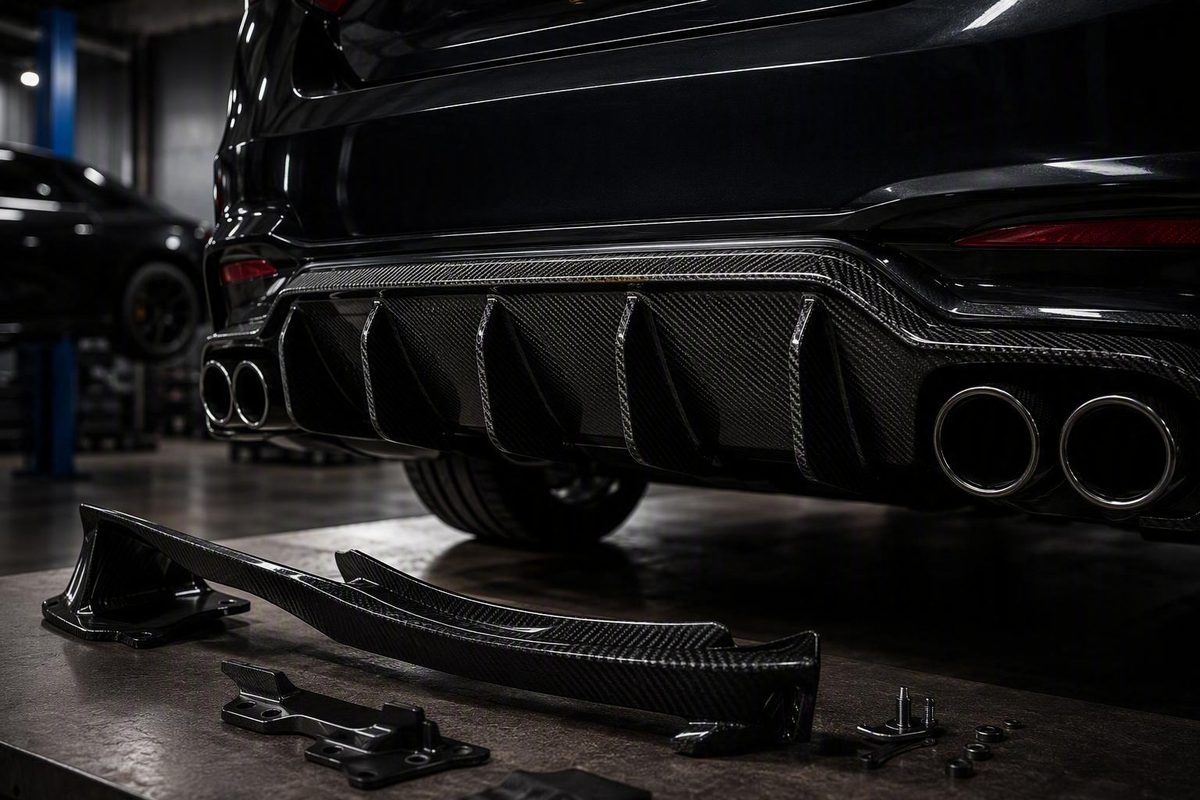
Choose a carbon fiber diffuser only after the seller confirms compatibility with your exact vehicle and factory bumper. Then verify the part’s construction, installation requirements, delivered cost, warranty, and return exposure. A carbon-fiber title, visible weave, high price, discount, or retailer badge does not prove material quality, fitment, or aerodynamic performance.
Use this pre-purchase checklist first
Before comparing styles or prices, record:
- Chassis code or vehicle generation
- Model year and build date
- Trim and drivetrain variant
- Factory bumper or appearance package
- Market or regional specification
- Exhaust layout and tip configuration
- Parking sensors, cameras, or driver-assistance equipment
- Tow hitch or other rear-mounted equipment
- Existing aftermarket exhaust, bumper, splitter, or bodywork
Ask whether the listing fits that exact configuration. Do not rely solely on a general make-and-model match; instead, require the seller to check the bumper, exhaust arrangement, equipment, and modifications you identify.
Also request written information covering:
- Whether the structural body is carbon-fiber laminate, carbon over another substrate, a mixed-material composite, or carbon-look material
- The visible weave, finish, substrate, backing, resin, and clear coat
- Included brackets, fasteners, adhesive, templates, and instructions
- Any required drilling, trimming, bumper removal, or exhaust adjustment
- Warranty coverage and exclusions
- Return window, restocking fees, and fitment-related eligibility
- Shipping charges and responsibility for return freight
- Stock status or estimated lead time
Save the product page, seller’s fitment confirmation, quoted shipping cost, and applicable warranty and return terms before paying. A vehicle-specific catalog can help identify candidates, but the supplied retailer extract does not document detailed fitment, construction, installation, warranty, or stock information for every listed product.
Treat exact fitment as the first decision gate
A useful listing should identify more than the vehicle manufacturer and model. Match the documented application against your chassis or generation, year, trim, factory bumper package, regional variant, and exhaust configuration.
Do not assume similarly named applications are interchangeable. The supplied retailer extract, for example, contains two Audi RS3 8Y products with different part numbers and advertised prices: audirs38y05 and audirs305. It does not fully document their design or fitment differences. Their similar names therefore cannot establish which one belongs on a particular vehicle.
Create a fitment record before contacting the seller:
| Fitment field | Your vehicle | Listing states | Seller confirms |
|---|---|---|---|
| VIN | |||
| Market or region | |||
| Model year/build date | |||
| Chassis or generation | |||
| Trim and drivetrain | |||
| Factory bumper/package | |||
| Exhaust configuration | |||
| Sensors/tow equipment | |||
| Aftermarket modifications |
Ask the seller to identify the product by part number in the reply. If the response only says that the diffuser “fits an RS3” or “should work,” request confirmation tied to your factory bumper and other recorded details before ordering.
Fitment uncertainty should be investigated rather than filled with assumptions. Ask specifically whether your configuration affects the mounting points, exhaust openings, sensor clearance, or required installation work.
Verify what “carbon fiber” means in the listing
A product title containing “carbon fiber” does not independently establish that the complete diffuser is made from carbon-fiber laminate.
Treat the following as minimum purchase gates:
- What is the main structural body made from?
- Is carbon fiber used structurally, as a skin, or only for appearance?
- What are the backing, core, mounting tabs, and inserts made from?
- What surface finish and clear coat are applied?
- Does the seller provide photographs of the underside, edges, tabs, and mounting points?
- Is the supplied part consistent with the seller’s written description?
Ask the seller to describe those components rather than accepting the shorthand alone.
Additional quality indicators may include:
- Number and orientation of reinforcement layers
- Molding and curing method
- Resin system
- Clear-coat specification
- Weave pattern and surface finish
- Finished part weight
- Available repair methods or replacement sections
A retailer may not possess every manufacturing detail, and some information may be proprietary. Missing optional details do not automatically disqualify a product, but they limit your ability to compare its construction with another diffuser or determine what a higher price represents. Missing answers to the basic material classification create a more significant purchase risk.
Ask one direct question in writing:
Is the structural body full carbon-fiber laminate, carbon fiber over another substrate, a mixed-material composite, or carbon-look material? Please also identify the materials used for the backing, core, mounting tabs, and inserts.
Do not infer prepreg construction, autoclave curing, vacuum infusion, hand layup, or any other manufacturing method unless it is documented for the exact part.
Compare price only after fitment and construction
The figures in this section come from an undated, truncated single-retailer category-page extract. They are not a market-wide price guide, a current quote, or evidence of complete inventory. Every application, part number, price, label, promotion, and availability detail should be checked on the live seller page immediately before publication or purchase.
In the extract, visible Audi listings range from $399.95 for part audi8v004 to $2,999.95 for part audir815. Visible BMW listings range from $379.95 for part bmwe82009 to $2,149.95 for part bmwf13002. The selected prices and labels below are also taken from the same RW Carbon retailer catalog extract.
| Application and part | Advertised price and label | Construction status | Fitment status and open questions |
|---|---|---|---|
| Audi RS3 8Y — audirs38y05 | $1,299.95; “Best Seller” | Not verified by extract | Detailed year, trim, bumper, installation, and hardware conditions remain open |
| Audi RS3 8Y — audirs305 | $879.95; “New Product” | Not verified by extract | Differences from audirs38y05 and detailed fitment remain open |
| Audi RS6/RS7 C8 — audirs602 | $1,049.95; “On Sale” | Not verified by extract | Exact application, included hardware, installation, and seller terms remain open |
| BMW F06/F12/F13 — bmwf12010 | $999.95; “Best Seller” | Not verified by extract | Trim restrictions, bumper compatibility, and installation remain open |
The extract does not show whether these price differences reflect material architecture, design complexity, finish, included hardware, detailed fitment, or seller protection. It should therefore be used as an example of retailer merchandising—not as a robust comparison of competing products.
Compare prices only after the products pass the same fitment and documentation checks. If one seller provides clear construction details, installation requirements, and return protection while another does not, the sticker prices are not directly comparable.
Look beyond sale prices and merchandising labels
“Best Seller,” “New Product,” and “On Sale” are retailer-provided merchandising labels. They are not independent rankings of popularity, quality, reliability, fitment, or effectiveness.
The same retailer extract shows an Audi 8V RS3 diffuser at $779.95 against a crossed-out $950.00, and a BMW E92 M3 Varis Style diffuser at $1,659.95 against $2,000.00. Treat those crossed-out amounts only as retailer-provided prior prices, not verified historical selling prices, typical market values, or proof of savings. The figures should be rechecked before use because the source extract does not establish when they were retrieved. These amounts appear in the retailer’s supplied category-page information.
A higher advertised price does not by itself establish better laminate construction, closer fitment, greater finish durability, or aerodynamic benefit. A less expensive part with clear specifications and favorable return terms may present less uncertainty than a premium-priced part with vague documentation.
Calculate the likely delivered and installed cost:
Product price + shipping + tax + hardware + installation labor + anticipated modification or correction costs
Before ordering, ask an installer whether the quoted job could require drilling, trimming, refinishing, exhaust adjustment, replacement fasteners, or bodywork. These are costs to investigate, not assumptions about any specific product in the retailer extract.
Confirm installation, returns, and performance claims in writing
Send the seller a questionnaire tied to the exact part number.
Vehicle and fitment
- Will this part fit my VIN, model year, chassis, trim, regional specification, and factory bumper package?
- Is it compatible with my exhaust layout, sensors, tow equipment, and listed modifications?
- Do you provide a written fitment guarantee for this configuration?
Construction
- Is the structural body carbon-fiber laminate, carbon over another substrate, a mixed-material composite, or carbon-look?
- What materials are used for the backing, core, mounting tabs, and inserts?
- What weave, finish, and clear coat are used?
- Can you provide underside, edge, and mounting-point photographs?
- Are the resin system, manufacturing method, finished weight, or repair options documented?
Installation
- Must the bumper be removed?
- Is drilling, trimming, adhesive, or exhaust adjustment required?
- What brackets, fasteners, adhesive, templates, and instructions are included?
- Is professional installation recommended or required?
- Is installation reversible without permanent bumper modification?
Seller protection
- What are the warranty length, exclusions, and finish coverage?
- What is the return window, and are there restocking fees?
- Does test-fitting, drilling, trimming, removing protective film, or installation make the part nonreturnable?
- Who pays return shipping for poor fit, transit damage, or an incorrect item?
- What photographs and deadlines apply to a damage claim?
- Is the part in stock, and what lead time applies?
- Are replacement components or mounting hardware available?
Keep styling and aerodynamic performance separate. A diffuser may provide the appearance you want without having documented effects on downforce, drag, stability, or handling. Before accepting such claims, ask for vehicle-specific CFD, wind-tunnel, or comparable testing covering the exact diffuser design and installation configuration.
The decision rule is straightforward: do not order until exact bumper-level fitment, construction, installation method, delivered cost, and return exposure are documented well enough for your risk tolerance.