
Choose Carbon Fiber Fabric by Shape and Load Direction
Compare carbon fiber weaves by drape, handling and fiber direction. See when plain, twill, satin, spread tow, UD or non-crimp fabric fits your layup.
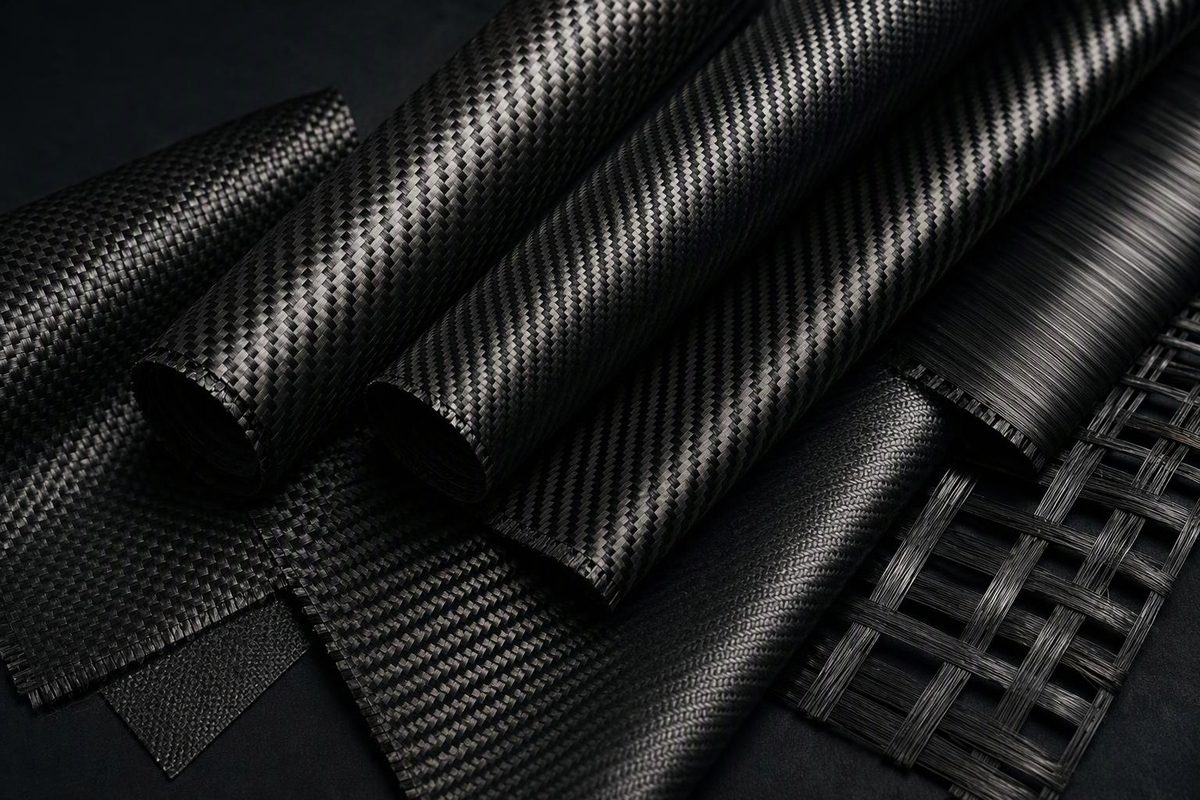
Plain carbon fiber weave favors handling stability; twill balances stability and drape; satin favors conformability but demands more careful handling. None is automatically strongest in a finished part. Fiber grade, resin, fiber volume, ply orientation and manufacturing quality also determine laminate performance, as Gurit’s composites guide explains. Choose the reinforcement to carry the loads first, then select a fabric that follows the mold without compromising those fiber directions.
Select your load-direction requirement, mold shape and handling priority to get a starting fabric choice.
Fabric Starting-Point Selector
Start With Plain Weave
Plain weave favors handling stability and is a sensible starting point for flat or gently curved work.
Trial the actual cloth on the mold. Keep the specified fiber directions; the pattern alone does not establish laminate strength.
Compare the Woven Trade-Offs
| Weave | Drape | Handling |
|---|---|---|
| Plain | Relatively limited | Stable |
| 2×2 twill | More pliable than plain | More stable than satin |
| Satin | High | Lower stability |
| Basket | Trial actual cloth | Less stable than comparable plain |
These are construction tendencies, not measured rankings across all fabrics. Satin face orientation matters. Twill's diagonal is not a ±45° fiber direction.
Weave Changes Drape, Crimp and Handling Stability
A conventional woven fabric interlaces two sets of carbon-fiber bundles, or tows. The warp runs lengthwise along the roll; the weft, also called fill, runs across it. They start approximately perpendicular to each other. The weave describes how these bundles pass over and under one another. ACP Composites’ fabric guide defines this construction.
Crimp is the waviness introduced by that over-under path. Drape is the fabric’s ability to conform to a curved surface. Stability means the uncured fabric’s ability to retain its arrangement during cutting and handling—not the stiffness of the cured part.
Interlacing holds the cloth together, but also bends fibers away from a straight load path. Reducing this waviness can improve mechanical performance in otherwise comparable laminates. More frequent interlacing generally improves handling stability; longer uninterrupted yarn sections, called floats, generally improve drape. Tow size and thread count modify these tendencies. Gurit describes this trade-off across the common weave styles.
Plain, Twill, Satin and Basket Suit Different Layups
| Weave | Construction | Selection Point |
|---|---|---|
| Plain, or 1×1 | Over one, under one; checkerboard pattern | Stable during handling, but relatively difficult to drape. A starting point for flat or gently curved work. |
| 2×2 twill | Over two, under two; staggered interlacing creates diagonal ribs | More pliable than plain, with more stability than satin. Useful for curved parts and visible surfaces. |
| Satin: 4HS, 5HS or 8HS | Longer floats; common 5HS fill passes over four warp yarns and under one | High drape and low crimp, but lower handling stability. Consider for complex contours with controlled yarn movement. |
| Basket | Groups of two or more tows interlace like grouped plain weave | Flatter and less crimped than comparable plain construction, but less stable. Particularly useful in heavier fabrics. |
These are construction tendencies, not guaranteed rankings for every cloth. The definitions and comparisons follow ACP’s weave guide and Gurit’s fabric guidance. Neither a matching pattern nor a matching tow count establishes that two fabrics will behave identically.
Satin adds a layup constraint: its two faces present different predominant surface directions. Gurit warns that this asymmetry must be considered when assembling multiple plies. Follow the specified face orientation and stacking sequence rather than treating either side as interchangeable.
For selection within the two common starting options, see the plain-weave guide and twill selection guide.
Twill’s Diagonal Is Not a ±45° Fiber Direction
The diagonal stripe in twill comes from the progression of its interlacing points. The warp and weft still run along and across the roll, not along the visible stripe. ACP distinguishes yarn directions from the twill line.
If a design calls for ±45° fibers relative to the part axis, those fibers must actually be placed in those directions. That can mean rotating a conventional 0°/90° woven ply by 45°, or using a specified ±45° reinforcement. Choosing twill for its diagonal appearance does not accomplish this.
A balanced weave is also not automatically equally stiff in every in-plane direction. Gurit’s guidance explains why fiber orientation matters; the woven-composites review identifies orientation and stacking sequence as design variables. A visible pattern is not a laminate specification.
Spread Tow, UD and Non-Crimp Describe Different Features
Spread tow describes bundle preparation, not a separate over-under pattern. Spreading makes the yarn wider and thinner; it can still be woven. Teijin’s spread-tow fabric announcement describes flatter undulations at yarn intersections. Do not assume that all plain-weave fabrics have the same crimp simply because their pattern matches.
Unidirectional, or UD, reinforcement places the main fibers in one direction, often stabilized by stitching or a lightweight scrim. SGL Carbon’s textile brochure illustrates both stabilization methods. UD is worth considering when a dominant load direction makes a conventional two-direction weave inefficient. That does not establish the complete ply schedule for a part.
Non-crimp fabric, or NCF, holds aligned fiber layers together with stitching rather than weaving the structural tows over and under each other. It can be unidirectional or multiaxial, including 0°/90° and ±45° arrangements, as SGL’s brochure illustrates. Stitching and binders still affect handling and processing; “non-crimp” is not a finished-part performance guarantee.
These labels answer different purchasing questions. “Plain” specifies an interlacing pattern; “spread tow” describes how the bundles are prepared; “UD” describes the principal fiber direction; “NCF” describes how aligned layers are held together.
Specify More Than “3K Twill” Before Ordering
3K means 3,000 filaments per tow, not a strength grade. ACP explains this K-count convention. SGL lists both plain and 2×2 twill fabrics at 200 g/m² using 3K yarn, illustrating that tow count, areal weight and weave are separate specifications.
An order needs the fiber manufacturer and grade, warp/weft fiber distribution and thread count, reinforcement architecture, tow size and areal weight in g/m². It also needs the sizing and any binder or stabilizer, with compatibility for the intended resin. Toray explains that sizing affects both processability and resin compatibility.
Confirm suitability for the intended wet layup, infusion or prepreg process. For structural comparisons, request cured-ply thickness and laminate property data identifying the resin, cure, fiber volume and test direction. The sources here do not provide a single comparable strength figure across all these architectures, so there is no defensible numerical “strongest weave” ranking.
Before committing a roll, trial a sample on the actual mold. Check whether it follows the radii while preserving the specified fiber directions. For structural work, accept the fabric against the engineered layup and relevant laminate or component tests—not its appearance or a generic “stronger weave” claim.