
Carbon Fiber vs Aluminum Density: About 1.6 vs 2.7 g/cm³
Compare carbon-fiber and laminate density with 6061 aluminum, calculate equal-volume weight savings, and see how thickness changes the result.
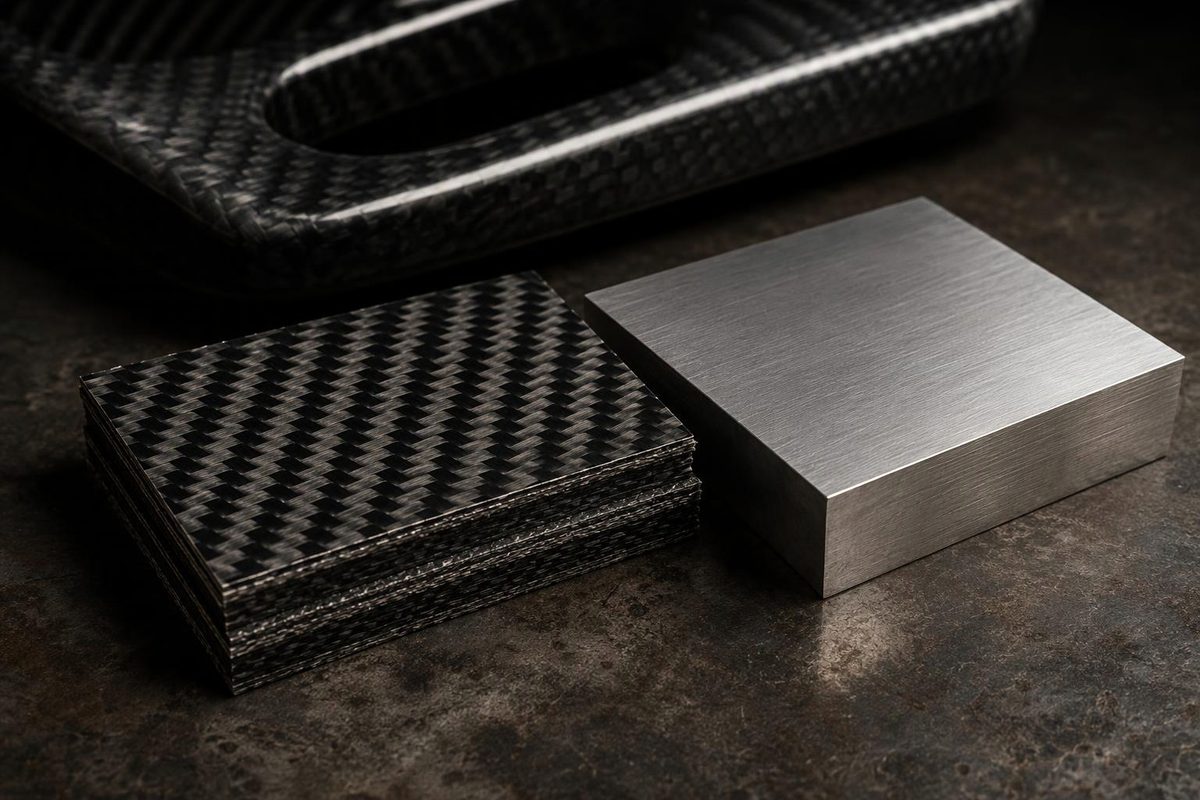
A carbon/epoxy laminate can weigh about 41% less than 6061 aluminum at equal material volume. A useful rounded comparison is 1.6 g/cm³ for the laminate versus 2.7 g/cm³ for aluminum. For example, Hexcel lists nominal densities of 1.56–1.58 g/cm³ for the specific carbon/epoxy laminates in its HexPly 8552 datasheet; Gabrian lists 2.70 g/cm³ for 6061-T4 and 6061-T6 aluminum.
That percentage is a density comparison—not a promise that a replacement part will be 41% lighter. First distinguish the carbon filaments from the cured composite, then account for the actual part geometry.
Density values: fiber, laminate and aluminum
Density is mass divided by volume. Here, g/cm³ and g/cc mean the same thing; 1 g/cm³ = 1,000 kg/m³.
| Material and form | Density, g/cm³ | Density, kg/m³ |
|---|---|---|
| Toray T300 carbon fiber, fiber-only nominal value | 1.76 | 1,760 |
| HexPly 8552/AS4 unidirectional cured laminate, nominal | 1.58 | 1,580 |
| HexPly 8552/IM7 unidirectional cured laminate, nominal | 1.57 | 1,570 |
| 6061 aluminum, T4 or T6 | 2.70 | 2,700 |
Sources: Toray’s carbon-fiber property card, Hexcel’s laminate datasheet, and Gabrian’s 6061 property sheet. The laminate values describe those particular systems, not every product sold as “carbon fiber.”
For a sheet, tube or molded shell, use cured-laminate density, not fiber density. Dry cloth also contains open space between yarns: its fabric weight in g/m² is an areal mass, not a density that can be compared directly with aluminum’s g/cm³.
Why the laminate can be less dense than the fiber
A cured carbon-fiber-reinforced polymer contains both fiber and resin. When the resin is less dense than the fiber, it lowers the composite’s average density.
For a two-component laminate with negligible void volume:
Laminate density = (fiber volume fraction × fiber density) + (resin volume fraction × resin density)
Hexcel’s 8552/AS4 example lists fiber density of 1.79 g/cm³, resin density of 1.30 g/cm³ and nominal fiber volume of 57.42%. Those inputs give:
(0.5742 × 1.79) + (0.4258 × 1.30) ≈ 1.58 g/cm³
This agrees with the datasheet’s nominal laminate density. Use volume fractions, not resin weight percentages, in this equation. Hybrid reinforcement, fillers or a different resin require their own inputs.
Calculate the weight saving—and the thickness penalty
For equal material volume, the calculated mass reduction relative to aluminum is:
Mass reduction = [1 − (laminate density ÷ aluminum density)] × 100%
Using 1.58 and 2.70 g/cm³ gives 41.5% less mass.
Consider a flat, solid plate with an area of 1 m², excluding coatings, adhesive and hardware:
| Plate | Calculated mass |
|---|---|
| 6061 aluminum, 2 mm thick | 5.40 kg |
| Carbon/epoxy at 1.58 g/cm³, 2 mm thick | 3.16 kg |
| Carbon/epoxy at 1.58 g/cm³, 3 mm thick | 4.74 kg |
Increasing the composite thickness to 3 mm reduces the saving to 12.2%. At approximately 3.42 mm, it would match the mass of the 2 mm aluminum plate. These are mass calculations, not structurally equivalent designs.
Use density for mass, not structural equivalence
Density does not establish the thickness or layup needed to replace aluminum. Hexcel’s unidirectional laminate data show different mechanical properties along and across the fibers, so load direction matters even when density stays unchanged. See fiber modulus versus laminate stiffness for that separate comparison.
For a practical weight estimate, specify the aluminum alloy, obtain the cured density for the chosen fiber/resin system, calculate each design’s actual material volume, and add cores, inserts, bondlines, coatings and fasteners separately. For hollow or sandwich parts, do not multiply laminate density by the entire outside-envelope volume.