
The Ritchey Recall Is an Insert-Bond Defect
See why Ritchey’s 2026 carbon fork recall concerns a loose alloy crown insert, how that differs from laminate damage, and how to obtain the free fix.
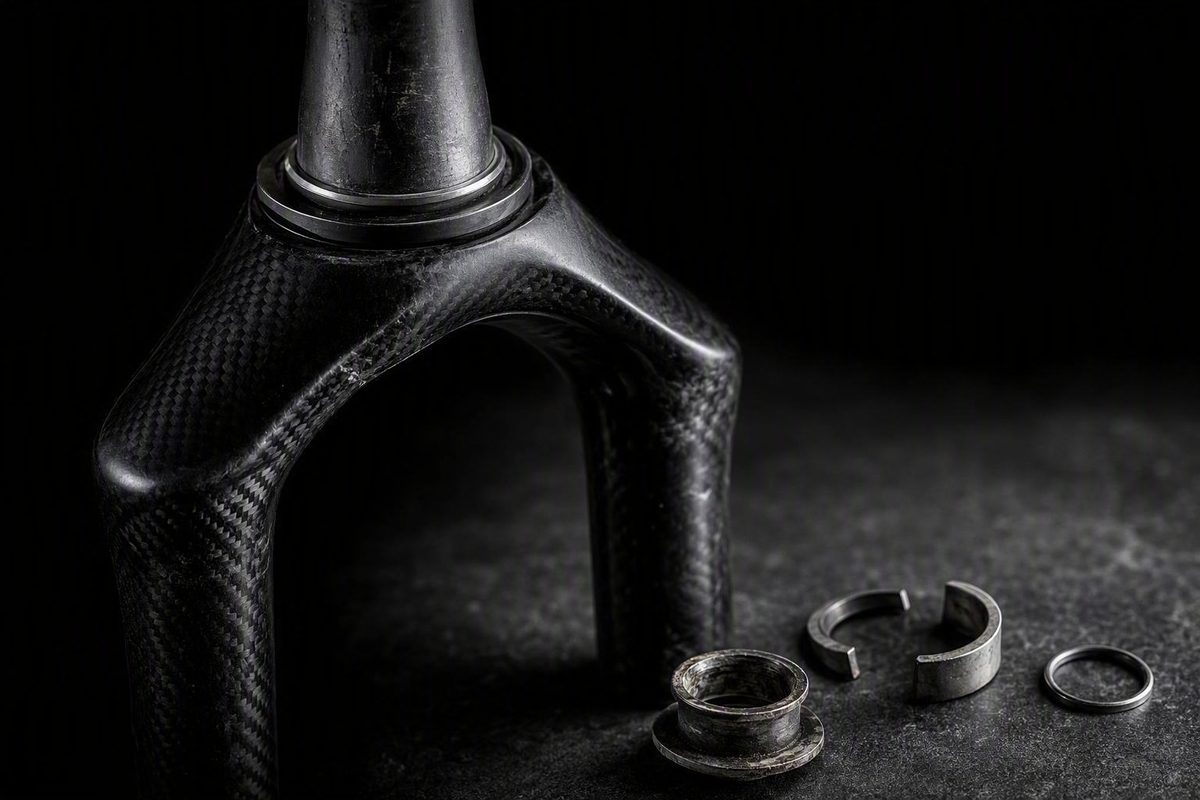
Ritchey’s recall of about 775 carbon forks concerns an alloy insert that can loosen in the crown accessory hole—not a documented failure of the carbon laminate. The loose insert can let an attached accessory reach the front wheel, creating a serious fall hazard, so owners of potentially affected bicycles must stop riding and obtain the free closure kit described in CPSC Recall 26-696.
Safety warning: If a bicycle may have an affected fork, stop using it immediately. Removing an accessory, inspecting the insert or finding that it feels tight is not the stated remedy. Register through Ritchey’s official recall page and follow the instructions supplied with the free Fork Crown Hole Closure Kit.
Why A Carbon Recall Sounds Worse Than This Defect Is
The received view is understandable: carbon damage can be difficult to judge from the surface, and failure of a fork blade, crown or steerer could have severe consequences. A recall carrying a fall-and-crash warning therefore sounds like evidence that the composite fork itself is structurally compromised.
That is not what the published defect description says. The CPSC identifies the component capable of loosening as the alloy insert in the front crown hole. Ritchey’s technical information says the issue followed a manufacturing change at one supplier and can arise under some circumstances when third-party accessories are installed. Neither source reports delamination, fractured fibers, cracked fork blades or a damaged steerer.
The distinction does not reduce the need to follow the recall. An intact fork can still cause a crash if a rack, fender or bracket drops into its rotating front wheel. It does limit what the recall proves: this is evidence of a problem at a bonded accessory interface, not evidence that carbon forks generally fail more often than metal forks.
At the recall announcement, Ritchey had received one report of an insert coming loose and no injuries. That low incident count provides context, but it does not make continued riding acceptable because the potential consequence remains serious (CPSC).
The Insert Bond Is The Relevant Load Path
The mounting point sits at the top or front of the fork crown, immediately above the tire. A threaded alloy insert provides a durable metal interface for accessory hardware while the surrounding crown is composite.
When an accessory pulls or rocks on that fastener, its load must pass from the insert through the bonded interface and into the surrounding structure. In the simplest uniform-shear model, average bond stress equals applied force divided by effective bonded area. A corresponding rated pull-out load can be written as effective bond area multiplied by allowable adhesive shear stress, then divided by the chosen safety factor.
That relationship explains why bond coverage matters. If the intended interface is fully bonded, the load is distributed over the available area. Voids, poor wet-out, contamination or an under-filled bond line reduce the effective area and concentrate load in what remains. Once the effective area becomes small enough, the insert interface can lose margin even though the adjacent laminate is intact.
The public recall material does not disclose the insert dimensions, measured bond area, adhesive system, tested shear strength, accessory forces or a numerical safety factor. It therefore does not support calculating the actual pull-out capacity of a Ritchey fork. It also does not establish whether the supplier change produced under-fill, poor surface preparation or another bond-process problem. What it does establish is that the reported loose component is the alloy insert, not the carbon structure (Ritchey).
Enter your own bond assumptions, then reduce effective coverage to see when the accessory load wins.
The preset is an illustrative unit-scale bond, not a Ritchey measurement. Reduce effective coverage to model an under-filled or starved interface.
Capacity wins: ~22.5 lb rated pull-out exceeds the selected 10 lb load.
The illustrative margin is 2.25×. Reduce coverage below about 45% and the selected load wins.
| Accessory Load | Calculated Margin | Which Side Wins |
|---|---|---|
| 5 lb | 4.50× | Bond capacity |
| 10 lb | 2.25× | Bond capacity |
| 15 lb | 1.50× | Bond capacity |
Rated pull-out load = intended area × effective coverage × allowable shear strength ÷ safety factor. The calculator converts newtons to pounds-force.
This simplified uniform-shear model does not include peel, impact, fatigue, edge stress, temperature, workmanship variation or laminate damage. It cannot clear a recalled fork for use.
Source note: Recall scope and defect description come from CPSC Recall 26-696 and Ritchey’s recall bulletin. Ritchey has not published bond dimensions or strength data; values marked ~ are illustrative user-adjustable assumptions.
The calculator is a load-path demonstration, not a diagnosis. Its area, shear-strength and safety-factor presets are illustrative unit assumptions because Ritchey has not published the corresponding product data. The 5–15 lb accessory-load band provides the comparison requested in the topic brief; it is not a Ritchey test specification.
With unchanged adhesive strength, halving effective bond area halves calculated capacity. Reducing coverage from 100% to 20% cuts capacity to one-fifth. That proportional behavior is the relevant point: a local process shortfall at an insert can erase an otherwise comfortable margin without requiring the laminate itself to fracture.
Insert Loosening Is Not Laminate Failure
A bonded-insert failure occurs at or near the interface joining the insert to its surrounding material. The practical signs are localized: movement or rotation of the insert, a changing gap around it, displaced adhesive, or hardware that no longer remains secure. The Ritchey notice specifically addresses an insert that can loosen when an accessory is mounted.
A genuine laminate failure involves the composite plies. Delamination is separation between layers; fiber fracture is breakage of the reinforcing fibers. Surface evidence can include a crack extending through the composite, lifted or buckled material, exposed fibers, crushing, or a local change in shape. Internal damage may not be fully visible.
Those conditions are inspected differently. Checking whether a metal insert moves tests an interface symptom. Assessing suspected laminate damage may require comparison with an undamaged area and professional methods capable of finding subsurface changes. A home visual inspection cannot certify either the bond or an internally damaged laminate.
The recall remedy reinforces the limited scope of the documented defect. Owners are instructed to close the threaded crown hole using the supplied kit; they are not instructed to return every fork for laminate inspection or automatic replacement. The CPSC lists the remedy as a repair. Its Fast Track designation does not independently certify the laminate, but the published notice contains no structural carbon-failure finding.
The Recall Covers Specific Ritchey Products
Recall 26-696 was announced on August 13, 2026. It covers certain Ritchey carbon forks and framesets sold from July 2024 through June 2026.
| Recall Detail | Published Information |
|---|---|
| Approximate units | About 775 |
| Classification | Fast Track Recall |
| Reported incidents | One loose insert; no injuries |
| Remedy | Free Fork Crown Hole Closure Kit |
| Ritchey contact | 800-748-2439; ritcheydesign@ritcheylogic.com |
The individually sold forks were priced at $660–$700. Framesets with the relevant fork were priced at $1,760–$3,500. The products were manufactured in Taiwan and imported by Ritchey Design of Reno, Nevada, according to the published recall summary.
| Product | Type | Reported Finish |
|---|---|---|
| WCS Carbon Mountain Adventure | Fork | Black |
| WCS Carbon Brevet Road | Fork | Black |
| WCS Carbon Adventure Gravel | Fork | Black |
| WCS Carbon Tapered Adventure Gravel | Fork | Black |
| Montebello | Frameset | Hot Sauce |
| Septimer | Frameset | Black & White |
| Outback | Frameset | Aurora or Winter Sage |
The frameset listings identify products supplied with the relevant fork; they do not mean the frame contains the insert at issue. A rebuilt bicycle may also have a different fork from the one originally supplied.
Look for Ritchey branding and a threaded mounting hole at the front or top of the crown above the wheel. The published information provides no serial-number lookup, batch-code range or manufacturing-date decoder. Purchase date, color and apparent insert tightness are therefore supporting clues rather than conclusive eligibility tests.
If a secondhand fork, replacement fork or product with an unknown history appears to match, keep it out of service and send Ritchey photographs of the complete fork, branding, model markings and crown hole. Do not use a test ride or repeated tightening as an identification method.
The Closure Kit Is The Required Repair
The official remedy is a complimentary Fork Crown Hole Closure Kit. Owners register with Ritchey, receive the kit and close the threaded crown hole according to the supplied instructions.
The available notices do not provide installation steps, torque values, adhesive requirements, tools, cure times or minimum skill requirements. They also do not promise dealer labor reimbursement, delivery within a particular period, automatic fork replacement or reimbursement for previous work. Those questions require direct guidance from Ritchey.
An empty crown hole is not an exception to the stop-use instruction. Neither is removal of a rack or fender. If the insert is loose, spinning, damaged or missing, do not glue, drill, extract or replace it. Keep the bicycle out of service and contact Ritchey before proceeding.
Owners outside the United States should also ask Ritchey about regional arrangements. The CPSC notice documents the U.S. recall but does not establish international eligibility or shipping procedures.
How To Inspect Other Bonded Inserts
The Ritchey repair must not be replaced with a home inspection, but the defect illustrates what to examine during routine checks of other bonded mounts on carbon forks and frames.
First unload the fitting. Remove only hardware that the product manufacturer permits the owner to remove, and do not exceed published torque instructions. Clean enough of the surrounding area to distinguish the insert edge, adhesive line and laminate surface without scraping or probing the bond.
Examine the interface for a changing gap, displaced adhesive, corrosion products, rotation marks or a fitting that sits differently from adjacent mounts. Check the surrounding composite for cracks, exposed fibers, crushing, bulging or lifted surface material. A symptom confined to the insert edge points toward the interface; damage extending into the composite requires the laminate itself to be evaluated.
Compare matching mounts where the design provides them, but do not treat visual symmetry as proof of internal integrity. Stop using the part if an insert moves, hardware will not hold the specified torque, the laminate is visibly damaged, or the manufacturer has issued a stop-use notice. Refer it to the manufacturer or a qualified composite repair specialist rather than adding adhesive or installing a larger fastener.
For recalled Ritchey forks, none of those observations clears the bicycle for use. The controlling steps remain: stop riding, verify the product with Ritchey, request the free closure kit and follow its instructions.