
What You Are Really Paying for in a Carbon-Fiber Part
For one-off and short-run parts, tooling, engineering, labor, finishing and inspection can together exceed the cost of fiber and resin.
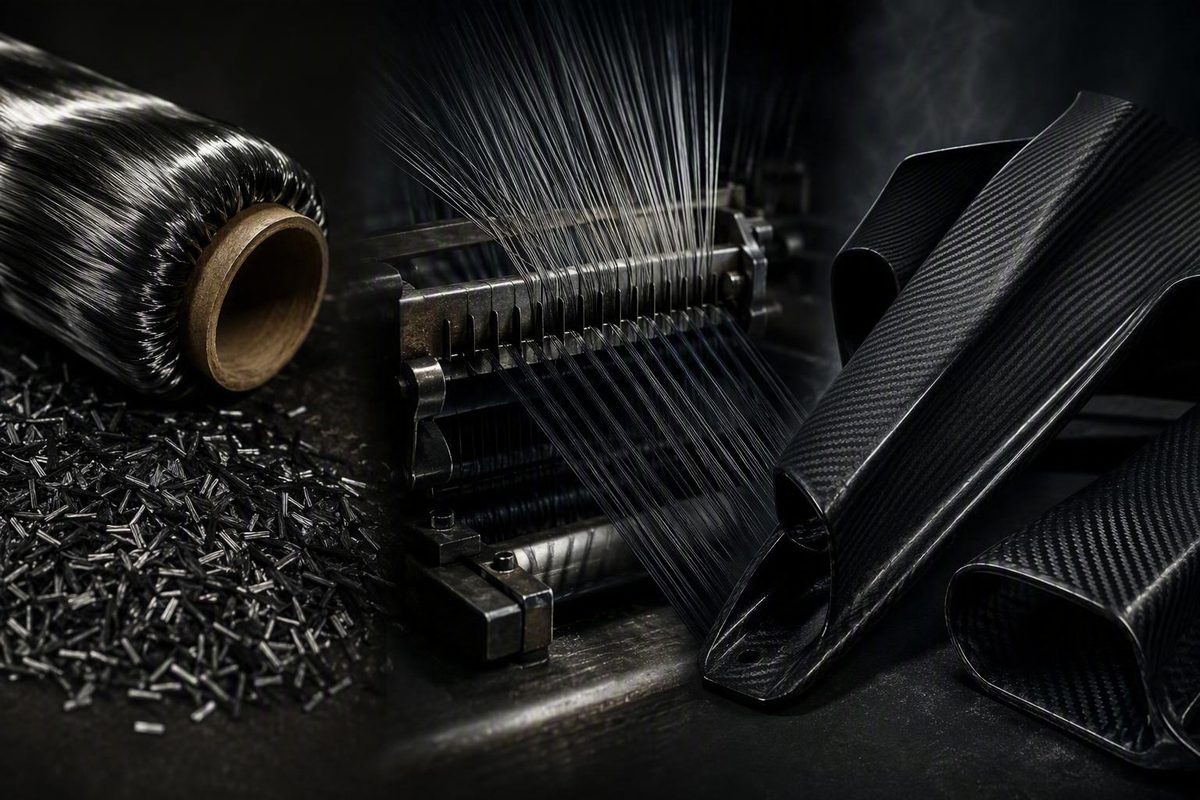
The short answer: carbon fiber has two cost stacks
Carbon fiber is expensive because buyers pay for two difficult conversions:
- A chemical precursor must be converted into carbon fiber.
- That fiber must be converted into a finished composite component.
The first cost stack includes polyacrylonitrile (PAN) precursor, material lost during conversion, controlled high-temperature processing, inert gas, specialized production lines, energy, labor, and capital equipment. The second includes conversion into fabric or prepreg, resin, storage, engineering, tooling, cutting, layup, curing, trimming, finishing, inspection, and waste.
For a custom or short-run part, the second stack can exceed the cost of the fiber and resin. A small component may contain relatively little carbon fiber yet require a dedicated mold, many hours of engineering and handwork, a controlled cure, extensive cosmetic finishing, and careful inspection.
A few terms help keep these costs distinct:
- A filament is one continuous carbon fiber.
- A tow is a bundle of filaments. A 12k tow, for example, nominally contains 12,000 filaments; the bundle size affects manufacturing throughput and modeled fiber cost (2019 Heliyon carbon-fiber cost model).
- Dry fabric is woven or directionally aligned reinforcement without its final resin matrix.
- Prepreg is reinforcement supplied with a controlled amount of resin already applied.
- A laminate is the cured combination of fiber and resin.
- A finished component is a shaped laminate that has also been demolded, trimmed, machined as necessary, finished, and inspected.
These products are not interchangeable price references. A quote for large-tow industrial fiber cannot be compared directly with aerospace prepreg, decorative woven cloth, a cured sheet, or a clear-coated automotive component.
That is why there is no useful universal answer in dollars per pound. A meaningful comparison must specify at least:
- Fiber grade and tow size
- Dry fiber, fabric, prepreg, laminate, or finished part
- Weave or unidirectional architecture
- Resin system
- Manufacturing and cure route
- Order quantity
- Dimensional tolerances
- Surface finish
- Traceability, testing, and inspection requirements
Without those details, the apparent price of “carbon fiber” may describe an entirely different product from the one a buyer actually needs.
Cost stack one: turning PAN precursor into carbon fiber
Most commercial carbon fiber begins with polyacrylonitrile, usually shortened to PAN. Rayon and pitch are alternative precursors, but PAN is the dominant route. Converting it into useful fiber involves a linked sequence rather than one simple heating operation.
1. Precursor production and spinning
PAN must first be produced with suitable chemical consistency and spun into continuous filaments. Those filaments are drawn and assembled into tows.
Spinning establishes the continuity and molecular alignment needed for later thermal stages. A defect introduced here can persist through the rest of production, so the manufacturer is not merely making inexpensive plastic thread and correcting it later.
2. Stabilization or oxidation
The precursor travels under tension through heated ovens containing air. During this stage, the polymer structure changes so it will not melt during subsequent high-temperature treatment.
Oxidation is controlled and time-consuming. Temperature, airflow, residence time, and tension must be managed across thousands of fine filaments. Heating too quickly or unevenly can compromise the material, while slow processing limits the volume of saleable fiber that the line can produce.
3. Carbonization
The stabilized fibers then pass through much hotter furnaces in an inert atmosphere, generally nitrogen. The absence of oxygen prevents the material from burning while non-carbon constituents are driven off.
This stage produces the carbon-rich filament, but it also creates mass loss. The process therefore incurs both the cost of heat and inert gas and the cost of precursor that does not remain in the final product.
The linked oxidation, carbonization, surface-treatment, and sizing stages require controlled temperatures, atmospheres, material movement, and process inputs rather than a single furnace operation (Clemson University’s PAN-based manufacturing study).
4. Optional graphitization
Certain grades receive an additional treatment at still higher temperatures to alter their structure, particularly where higher modulus is required. Graphitization is not a universal step for every carbon fiber. Including its equipment and energy burden in every cost explanation would overstate the standard process.
5. Surface treatment
Freshly carbonized fiber needs a surface that can bond effectively with the intended resin. Manufacturers therefore treat the fiber surface, often through a controlled electrochemical process.
This is functional interface engineering, not decorative finishing.
6. Sizing and winding
A thin compatible coating called sizing is applied to protect the filaments, improve handling, and support bonding or processing with a selected resin system. The treated tow is then dried and wound onto packages for later conversion into fabric, tape, or other reinforcement forms.
At every stage, the line must control temperature, atmosphere, tension, speed, and timing. Variability can affect filament strength, modulus, handling, or resin compatibility. The manufacturer consequently needs continuous furnaces, gas systems, drives, treatment baths, controls, ventilation, and quality assurance—not simply a high-temperature oven.
For additional context, Carbon Reference’s guide to how carbon fiber is made from precursor to finished part walks through the manufacturing sequence. It is related reading rather than independent evidence for the cost conclusions here.
Precursor loss, energy, and equipment multiply the fiber cost
Raw-fiber cost is not simply the purchase price of PAN plus an electricity bill. It combines fixed and variable expenses, with yield acting as a multiplier across the chain.
A 2016 Clemson University manufacturing model divided the costs into two broad groups:
- Fixed costs: labor, overhead, and capital
- Variable costs: PAN precursor, consumable chemicals, inert gas, and energy
The model also used an approximate 2:1 PAN-to-carbon-fiber conversion ratio: about two units of PAN input for one unit of carbon-fiber output. It described oxidation under controlled heat in air, carbonization at high temperature in an inert atmosphere, and subsequent surface-treatment and sizing operations (Clemson University’s 2016 manufacturing cost model).
That ratio does not mean half the material is casually discarded as solid scrap. During thermal conversion, non-carbon constituents leave the precursor largely as gaseous products, reducing the fiber’s mass. The economic result is nevertheless straightforward: the cost of the input must be recovered from a smaller mass of saleable output.
Oxidation costs time as well as heat
Oxidation must proceed gradually enough to stabilize the precursor throughout its cross-section. A slow stage affects cost in several ways:
- Ovens occupy substantial line length.
- Material remains in process longer.
- Air must be heated and circulated.
- Tension must remain controlled.
- Throughput is constrained.
- Equipment and factory space must be financed and maintained.
A process can therefore be costly even when its peak temperature is lower than that of a later stage. Temperature alone does not determine cost; residence time, equipment size, throughput, and control requirements matter too.
Carbonization adds temperature and atmosphere control
Carbonization demands high temperatures while excluding oxygen. Furnaces, insulation, gas handling, controls, and material transport must work together continuously. Nitrogen and electrical or thermal energy are recurring inputs, while furnace systems and associated infrastructure contribute depreciation and maintenance.
Surface treatment and sizing then add chemicals, electrical energy, drying, equipment, and processing time. They should not be dismissed as cosmetic post-processing because they prepare the fiber for reliable use in a composite.
PAN can dominate without being the only important cost
A 2019 peer-reviewed cost model identified PAN precursor as the largest contributor to final fiber cost under its modeled conditions. It also found that tow size materially changed both the cost per kilogram and the proportional cost breakdown.
A tow’s “k” number indicates its nominal filament count: 3k is about 3,000 filaments, while 50k is about 50,000. Processing more filaments in a larger bundle can increase throughput and distribute certain production costs over more output.
In the model, increasing tow size from 3k to 50k reduced the precursor contribution from 76.6% to 49.6% of final fiber cost. Meanwhile, the proportional contributions of labor, energy, and depreciation rose. Modeled cost fell sharply between 3k and 12k, then more gradually, becoming nearly stable above 50k (the 2019 Heliyon study).
This does not establish today’s universal cost shares. Input prices and industrial processes vary by manufacturer, location, grade, capacity utilization, and time. The finding is better read as an explanation of a cost mechanism:
- Larger tows can improve throughput.
- Better throughput can lower cost per kilogram.
- The benefit diminishes as tow size becomes very large.
- Material and processing requirements may prevent substituting a large tow for a smaller one in every application.
The dates matter. The detailed manufacturing study is from 2016, and the tow-size model is from 2019. They explain the structure of cost but should not be presented as current supplier quotations.
Cost stack two: turning fiber into a finished component
Carbon fiber is normally the reinforcement, not the complete material. It must be combined with a matrix—commonly epoxy—formed into the required geometry, and cured into a laminate. Prices consequently vary with the reinforcement, resin, storage requirements, and manufacturing route selected (Managing Composites’ overview of carbon-fiber cost drivers).
Between a spool of tow and an installed component, some or all of the following operations may occur:
- Converting tow into woven fabric, unidirectional tape, or another reinforcement
- Applying resin to make prepreg, if that route is selected
- Transporting and storing the material under suitable conditions
- Designing the laminate and defining fiber orientations
- Designing and manufacturing the mold
- Creating cutting files, ply books, and work instructions
- Cutting reinforcement into individual plies
- Laying the plies into the mold in the specified sequence
- Mixing or managing resin
- Applying release films, peel ply, breather, and vacuum-bagging materials
- Pulling and checking vacuum
- Curing in ambient conditions, an oven, a press, or an autoclave
- Demolding
- Trimming, drilling, and machining
- Bonding inserts or joining subcomponents
- Sanding, painting, or clear coating
- Inspecting dimensions, appearance, and laminate quality
- Reworking or rejecting nonconforming parts
The exact chain depends on the product and process. It nevertheless explains why the cloth visible at the surface may be only a small fraction of the customer’s bill.
Recurring and non-recurring costs behave differently
Recurring costs are incurred again with each part or batch. They can include:
- Fabric, tape, or prepreg
- Resin and adhesive
- Vacuum-bagging consumables
- Release materials
- Energy
- Direct production labor
- Abrasives and coatings
- Inspection time
- Scrap and rework
Non-recurring costs are incurred mainly to establish the product and process:
- CAD and laminate design
- Engineering analysis
- Mold design and manufacture
- Machine setup and programming
- Fixtures, templates, and cutting files
- Process development
- First-article inspection
- Testing and validation
This distinction is central to carbon-fiber pricing. Reducing resin consumption will not make a one-off component inexpensive if engineering and tooling dominate its unit cost.
Prepreg improves control but adds handling requirements
Prepreg arrives with resin already distributed through or onto the reinforcement. That can provide controlled resin content, cleaner handling, accurate ply placement, and repeatable processing.
Those advantages have a cost. Cure temperature, heating rate, vacuum integrity, and sometimes pressure must also be carefully managed.
Dry fabric with liquid resin avoids the same cold-storage model, but it transfers more resin-metering and impregnation responsibility to fabrication. Lower material-handling cost can therefore come with greater operator dependence or process variability.
Directional design creates waste
A carbon-fiber part is not cut like an unpatterned sheet merely to maximize area utilization. Fibers must run in directions selected for the load path. Rotating a ply to fit an empty space on a roll may violate the laminate design.
Curved boundaries, openings, overlaps, roll widths, and required orientations all create offcuts. Additional material may be removed after curing to establish final edges and holes. Defects, contamination, bridging, wrinkles, porosity, or dimensional errors can generate further losses. The cutting-waste problem is particularly visible in low-volume prepreg work, where roll dimensions and fixed fiber directions limit nesting choices (low-volume composite-part cost analysis).
This is the price of controlled anisotropy: designers can place reinforcement where it is most effective, but manufacturers must preserve those directions through cutting, layup, cure, and inspection.
Visually similar components can also have very different economics. One may be cosmetic, while another carries structural loads. One may accept broad tolerances and visual inspection; another may require material traceability, controlled cure records, dimensional reports, or nondestructive examination. Appearance alone does not reveal the cost of assurance behind the laminate.
Why one-off and short-run parts are particularly expensive
A dedicated mold has nearly the same initial design and manufacturing burden whether it produces one part or many. For a prototype, that full cost may effectively land on one unit. In a long production run, it can be divided among many units.
The same logic applies to CAD, laminate development, CNC programming, templates, setup, and validation. This is why a small carbon-fiber cover can appear disproportionately expensive even when it contains little material.
A documented engine-cover exercise illustrates the mechanism. It is not an industry benchmark, but it separates the line items clearly. The selected process was vacuum-bagged carbon/epoxy prepreg followed by an oven cure—an out-of-autoclave route suitable for that example.
The commentary reported approximately $76 in direct materials, including $63 for 0.9 square meters of prepreg. It listed 195 minutes of direct labor, valued at $81.25 using a $25-per-hour wage; clear coating occupied 120 minutes of that labor. Tooling materials totaled $749, while tooling preparation required 27.5 labor hours and six machine hours. CAD/CAM accounted for 15 of the tooling labor hours (the worked engine-cover cost analysis).
The figures come from self-published commentary on a third-party fabrication video. The commentator identifies himself as a senior engineer working for a composites manufacturer, but the worked figures remain illustrative rather than an independently audited industry dataset.
Cheap materials do not imply a cheap part
The example’s direct materials were not negligible, but they were not the dominant explanation for the total cost of a one- or two-part job once tooling and preparation were considered. Pricing only the visible prepreg ignores the mold and the work needed to turn the material into a repeatable shape.
A wage is not a shop rate
The hourly figure in the exercise represented direct wages, not a fully burdened manufacturer rate. A customer-facing rate must also help recover expenses such as:
- Factory rent and utilities
- Production and quality-management staff
- Equipment purchase and maintenance
- Depreciation
- Insurance and taxes
- Inventory and material handling
- Software and administration
- Downtime and training
- Scrap and warranty exposure
The difference is not necessarily markup without value. It reflects the infrastructure needed to deliver a controlled result.
Finish can outweigh layup labor
The engine cover was primarily visual, and clear coating accounted for most of its reported direct-labor time. A high-quality exposed-weave finish can demand careful mold preparation, ply positioning, pinhole correction, sanding, coating, and polishing.
A painted structural part may avoid some cosmetic work while adding reinforcement, testing, or inspection. “Cosmetic” does not automatically mean inexpensive, and “structural” does not automatically mean visually refined.
The example has strict limits
This case used small-quantity material pricing, a very small production quantity, oven-cured prepreg, and a cosmetic engine cover. It does not represent:
- Large structures
- Certified aerospace parts
- Autoclave production
- High-volume compression molding
- Automated layup
- Safety-critical validation
- Bulk material purchasing
Its value is not that it predicts a market price. It demonstrates how tooling, engineering, labor, and finishing can overwhelm direct material cost in a short run.
Manufacturing method changes the economics
Not every carbon-fiber component uses prepreg, and not every prepreg component requires an autoclave. Available routes include:
- Wet layup
- Vacuum-assisted resin infusion
- Out-of-autoclave prepreg with oven cure
- Autoclave-cured prepreg
- Resin-transfer molding
- Compression molding
- Pultrusion
Other specialized processes also exist, but these illustrate why “carbon-fiber manufacturing” is not one cost structure.
Wet layup
In wet layup, dry reinforcement is placed in or on a mold and impregnated with liquid resin. Startup requirements can be relatively modest, especially for large or low-volume parts.
The tradeoff is operator dependence. The fabric must be positioned, wetted, and consolidated without excessive or insufficient resin. Skilled work can produce useful parts, but repeatability and labor content require active management.
Resin infusion
The route can be attractive for large parts and suitable production volumes, provided the geometry and quality requirements fit the process.
Out-of-autoclave prepreg
Out-of-autoclave prepreg uses factory-controlled resin content but is formulated to cure without autoclave pressure, commonly under vacuum in an oven. It retains prepreg’s storage and handling requirements while avoiding pressure-vessel processing.
The engine-cover example used this route, demonstrating directly that prepreg does not always mean autoclave.
Autoclave curing
An autoclave is essentially a pressurized oven.
Autoclaves are costly to acquire and operate because they are pressure vessels with heating, controls, safety systems, and finite chamber capacity. Wet layup, prepreg, matched-mold methods, and other routes carry different combinations of startup cost, labor, control, and repeatability (Formlabs’ manufacturing-method overview).
Whether autoclave expense is justified depends on the component. Specifying an autoclave for a part that does not benefit from it adds cost; avoiding one where the required material system and quality cannot otherwise be achieved creates risk.
Resin-transfer molding and compression molding
Resin-transfer molding uses matched tooling and injects resin into a closed mold containing dry reinforcement.
Their economics depend on greater upfront investment in tooling, presses, injection equipment, material preparation, and process development. Higher capital cost can still produce a lower unit cost when utilization and production volume are sufficient.
Pultrusion
This illustrates a recurring principle: a low-cost process is often low-cost because the design fits its constraints.
Practical ways to reduce cost
Cost reduction works best when tied to the actual design and production volume. Options include:
- Optimizing ply shapes and nesting without violating fiber orientation
- Selecting an appropriate tow size and reinforcement form
- Using lower-temperature cure systems where specifications permit
- Simplifying molds or designing reusable tooling
- Applying an in-mold finish where feasible
- Automating cutting, placement, molding, or trimming for repeatable volume
- Designing parts around a scalable process instead of adapting a prototype method later
Additively manufactured molds may also be useful for certain sizes, temperatures, pressures, and production quantities. Formlabs, a printer manufacturer, presents 3D-printed polymer tooling as an option for suitable applications, not as a universal replacement for durable production tooling.
No route is universally cheapest. The correct choice depends on geometry, quantity, laminate performance, surface finish, tolerances, inspection, cure temperature, and validation requirements.
When is carbon fiber worth paying for?
Carbon fiber is not automatically superior to fiberglass, aluminum, or steel. It is a design option whose premium must solve a valuable problem.
Reasons to consider it include:
- Low mass
- High strength relative to weight
- High stiffness relative to weight
- Directional control of reinforcement
- Corrosion resistance in appropriate environments
- Freedom to mold complex forms
- Potential consolidation of several pieces into one component
The phrase “relative to weight” matters. Its behavior depends on fiber grade, resin, fiber fraction, orientation, stacking sequence, thickness, geometry, and manufacturing quality.
Directional performance is both the benefit and the burden
A carbon-fiber laminate can instead place fibers along principal load paths.
That can produce an efficient component because reinforcement is concentrated where it does useful work rather than added equally in every direction. But the same feature increases complexity:
- Engineers must understand the load paths.
- Plies must be assigned specific orientations.
- Cut pieces cannot be rotated freely to save material.
- Layup sequence and orientation must be preserved.
- Holes and joints need careful treatment.
- Inspection must catch wrinkles, gaps, and misplaced plies.
Part of the premium is therefore payment for intentionally engineered directionality.
Situations where the premium may be defensible
Carbon fiber becomes easier to justify when reducing mass or increasing stiffness produces measurable value. Examples may include:
- Moving systems where mass affects acceleration or energy consumption
- Structures where stiffness limits performance
- Equipment that must be carried or repeatedly handled
- High-speed rotating or reciprocating components
- Corrosive environments where a compatible composite system improves durability
- Designs where molding and part consolidation reduce assembly count
These are possibilities, not automatic returns. Lower mass alone does not prove that a component will save enough energy, improve enough performance, or last long enough to recover its added cost.
When fiberglass may be the better answer
Fiberglass also provides corrosion resistance, moldability, and useful structural performance, generally with a more economical reinforcement and a mature manufacturing base. Tencom, a composites manufacturer, describes carbon fiber’s PAN route as more involved while presenting fiberglass as a practical choice where minimum mass or high stiffness is unnecessary (Tencom’s fiberglass and carbon-fiber comparison).
Hybrid designs can also place carbon fiber only where its stiffness is useful, although they introduce their own analysis, joining, and manufacturing considerations.
A decision checklist
Before paying the premium, define:
- Mass target: Is low weight mandatory or merely desirable?
- Stiffness target: What deflection, vibration, or buckling limit controls the design?
- Strength and damage tolerance: Which loads, impacts, and failure modes matter?
- Production quantity: Is this a prototype, short run, or repeatable high-volume product?
- Geometry: Does the shape fit an economical composite process?
- Quality assurance: What traceability, inspection, testing, or certification is required?
- Repairability: Can damage be detected and repaired in the intended operating environment?
- Finish: Is exposed weave required, or can the component be painted or left as-molded?
- Budget: Is the constraint purchase price, unit production cost, or lifecycle cost?
- Alternatives: Can fiberglass, aluminum, steel, plastic, or a hybrid design meet the requirement?
Carbon fiber is worth paying for when this comparison produces a clear application-specific advantage—not because the material is fashionable or nominally lighter.
Will carbon fiber become cheaper?
Some cost-reduction mechanisms are already well understood. Others remain development goals whose commercial effect depends on scale, grade, and application.
Demonstrated cost mechanisms
Larger tow: More filaments per bundle can improve throughput and reduce modeled cost per kilogram, although savings diminish as tow size grows and not every product can use every tow.
Higher volume: Engineering, molds, programming, and validation can be spread over more units.
Better equipment utilization: A furnace, press, oven, or autoclave costs more per saleable unit when it spends too much time idle or operates below capacity.
Optimized nesting: Better cutting plans can reduce offcuts, provided required fiber directions are maintained.
Appropriate automation: Automated cutting, placement, molding, and trimming can reduce direct labor and improve repeatability when part design and volume support the investment.
These measures do not make precursor, resin, energy, equipment, or quality control disappear. They improve how effectively those resources produce saleable output.
Savings that may change the material
It should be evaluated for the actual load case rather than treated as a direct substitute in every structure.
They still require fiber, resin, tooling, molding equipment, process control, and finishing.
These formats can be economical because they solve a different manufacturing problem—not because they necessarily deliver identical performance at a lower price.
Development areas with plausible but uncertain savings
Research and industrial development continue around:
- Alternative precursors
- Faster stabilization or oxidation
- Faster or more efficient carbonization
- Lower-temperature resin cure
- Out-of-autoclave processing
- Improved reusable tooling
- Additive tooling
- More automated material placement
- Better recycling and reclaimed-fiber formats
Each has a plausible cost mechanism. Faster oxidation could increase throughput; a lower-temperature cure could reduce energy or tooling demands; out-of-autoclave prepreg can avoid pressure-vessel processing; improved tooling can shorten setup or spread cost over more cycles.
But a credible mechanism is not the same as a guaranteed market-wide price reduction. A new process must still meet requirements for fiber consistency, laminate quality, cycle time, reliability, capital cost, and production scale.
High-performance fiber and tightly controlled structural components are therefore likely to retain meaningful process costs even if automation and volume improve.
When confronted with “cheaper carbon fiber,” ask what changed:
- Fiber grade?
- Tow size?
- Continuous or chopped reinforcement?
- Virgin or recycled fiber?
- Resin system?
- Cure and molding process?
- Inspection level?
- Production quantity?
- Structural requirements?
- Surface finish?
The lower price may represent genuine process efficiency. It may also reflect a materially different product.
Frequently asked questions
Which stage contributes the most to carbon-fiber cost?
There is no universal answer covering both raw fiber and finished parts.
For PAN-based fiber production, precursor can be the largest contributor under particular modeled conditions, but its share changes with tow size and other assumptions. Energy, labor, depreciation, chemicals, and capital still contribute, and the balance varies by producer and process.
For a finished component, tooling, engineering, labor, finishing, inspection, or certification can exceed the cost of fiber and resin—especially in one-off and short-run production. The dominant stage therefore depends on whether the product is raw fiber, prepreg, a commodity profile, a cosmetic panel, or a qualified structure.
Why are roughly two kilograms of PAN needed for one kilogram of carbon fiber?
PAN contains elements and chemical groups that do not remain in the final carbon-rich filament. During stabilization and carbonization, the polymer structure changes and non-carbon constituents leave, largely as gaseous products. Published manufacturing descriptions place the approximate PAN input at about two or more units for one unit of carbon fiber output (JCC’s carbon-fiber manufacturing overview).
The ratio is best understood as a mass-yield relationship. It does not mean an equivalent mass of intact PAN is cut from the production line and discarded as solid waste.
Does every carbon-fiber part have to be cured in an autoclave?
No. Carbon-fiber parts can be made by wet layup, infusion, out-of-autoclave prepreg and oven cure, resin-transfer molding, compression molding, pultrusion, and other routes.
An autoclave provides controlled heat and pressure and can be justified for demanding material systems and quality requirements. It is not a universal requirement for every high-quality component. The appropriate cure method follows from the resin, geometry, laminate, performance target, and validation requirements.
Why can a finished carbon-fiber part cost far more than its cloth and resin?
Cloth and resin are only recurring material inputs. The manufacturer may also need to recover design, laminate engineering, mold production, cutting, hand layup, vacuum consumables, curing, demolding, trimming, drilling, coating, inspection, scrap, and overhead.
Short runs amplify the difference because engineering and tooling are spread over very few parts. Exposed-weave cosmetic surfaces can add substantial finishing labor, while structural parts may add traceability, testing, and inspection.
Why is carbon fiber more expensive than fiberglass?
Carbon fiber commonly starts with PAN and passes through controlled stabilization, high-temperature carbonization, surface treatment, and sizing. Fiberglass uses a different glass-forming and fiber-drawing route and is widely used for cost-sensitive applications.
Carbon fiber may justify its higher cost when lower mass or greater directional stiffness creates enough value. Fiberglass is often more economical when performance requirements are moderate. The correct comparison must use complete laminates and actual part requirements, not isolated raw-fiber claims.
The bottom line
Carbon fiber’s premium is neither arbitrary nor automatically worthwhile. The material begins with a costly precursor, loses mass during controlled thermal conversion, and requires specialized equipment before it ever reaches a mold.
A finished component then adds another cost stack: resin, storage, engineering, tooling, cutting, labor, curing, waste, trimming, finishing, inspection, and overhead. These costs become especially visible in prototypes and short runs because non-recurring work is divided among very few parts.
Carbon fiber makes economic sense only when the application’s requirements for weight, stiffness, durability, geometry, consolidation, or lifecycle performance create enough value to justify the selected fiber and manufacturing route.